

Boat licensing is a state or federally mandated Boating Safety Certificate confirming that an operator has demonstrated knowledge of safe vessel operation. Without it, you risk fines, legal liability, and far greater exposure to on-water accidents. The importance of boat licensing extends well beyond paperwork. It covers navigation rules, emergency procedures, and equipment handling. States like California require the California Boater Card for operators born after 1993, while Canada enforces the Canadian Pleasure Craft Licence for all motorized vessels. Whether you're renting a sailboat in the Mediterranean or cruising a Florida bay, understanding what licensing requires protects you, your passengers, and every other boater sharing the water.
Why boat licensing matters for legal and safe operation
Boat licensing regulations exist because waterways are shared, high-risk environments where operator error causes most accidents. Mandatory education aims to reduce the most common accident causes, including failure to maintain a proper lookout and right-of-way errors. These are not obscure edge cases. They account for a significant share of reported collisions each year, and most involve operators who simply were never taught the rules.
Licensing mandates are driven primarily by safety concerns and waterway congestion, not revenue collection. As more recreational boaters enter the water each season, the margin for untrained operators shrinks. A certified operator who understands buoy systems, speed limits in no-wake zones, and distress signal protocols is measurably less likely to cause an incident than one who learned by trial and error.

The legal consequences of operating without a required license vary by state but consistently include fines, vessel impoundment, and potential criminal liability if an accident occurs. Insurance companies treat unlicensed operators as high-risk, which can void coverage entirely in the event of a claim. The importance of boating safety is not theoretical. It is written into law across most of the United States and Canada.
Which states and regions require a boat license?
Licensing requirements vary significantly by state, age, and vessel type, but the trend since 2020 has moved toward broader mandatory education. Here is a snapshot of how requirements break down across key regions:
- Massachusetts introduced new boater safety education requirements effective April 1, 2026 for operators born after 1989, with certification being lifetime once obtained and deadlines staggered by birth cohort.
- California requires the California Boater Card for all motorized vessel operators, phased in by age group since 2018.
- Florida mandates a Boating Safety Education ID card for anyone born on or after January 1, 1988, who operates a vessel with 10 horsepower or more.
- Canada requires the Pleasure Craft Operator Card for all operators of motorized pleasure craft, regardless of age, with 5-year renewal now required and a $24 fee.
Most states set the minimum age for unsupervised operation between 12 and 16, with younger operators permitted only under adult supervision. Reciprocity between states is common but not universal. A certificate earned in New York is accepted in most neighboring states, but you should always verify the rules of the state where you plan to operate.
Pro Tip: Before traveling to a new state or province by boat, check that state's boating authority website directly. Reciprocity rules change, and a certificate valid in your home state may not satisfy requirements elsewhere.
What is the difference between boat licensing, registration, and federal documentation?
Confusing licensing with registration is one of the most common mistakes new boaters make. These are three distinct legal categories, each serving a different purpose.
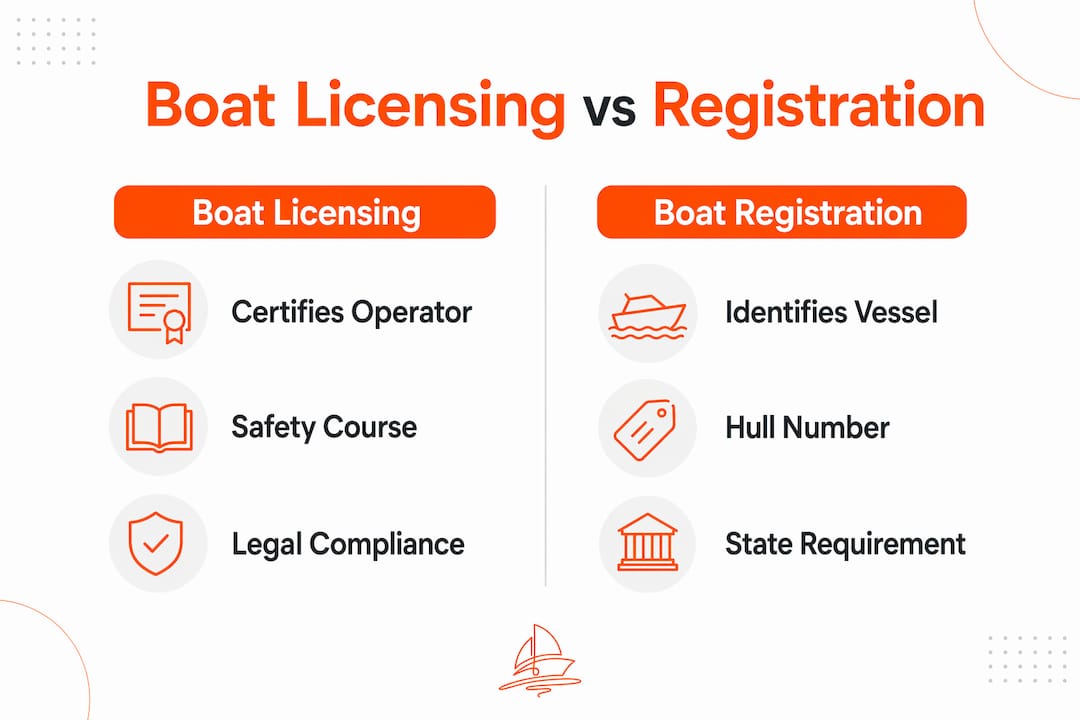
Licensing certifies the operator. It proves you have completed an approved safety course and understand the rules of the water. It travels with the person, not the boat.
Registration identifies the vessel. It is a state-level requirement that assigns a hull identification number and registration decal to the boat itself. Registration fees range from $5.50 to over $150 depending on vessel size and state. Registration is renewed periodically and must reflect the current owner's address.
USCG Documentation is a federal ownership record issued by the U.S. Coast Guard. It is recognized nationally and internationally, supports preferred ship mortgages, and is renewed annually for $26. Documentation does not replace state registration in all cases but provides a stronger legal foundation for vessel ownership, particularly for lenders and international travel.
| Category | What it covers | Who holds it | Typical cost | Key benefit |
|---|---|---|---|---|
| Boat license | Operator competency | The person | Varies by course | Legal operation, insurance discounts |
| State registration | Vessel identification | The boat | $5.50 to $150+ | Local legal permission to operate |
| USCG documentation | Federal ownership record | The vessel | $26/year | Financing, international recognition |
Federal documentation offers stronger lien protections and is favored by lenders compared to state registrations. If you plan to finance a vessel or sail internationally, USCG documentation is worth pursuing alongside state registration.
Pro Tip: If you're purchasing a boat with a loan, ask your lender whether they require USCG documentation. Many marine lenders will not issue a preferred ship mortgage without it, and the $26 annual renewal is a minor cost relative to the legal protection it provides.
To learn more about how documentation connects to marina access rights, Sailorix has a practical breakdown of what marinas require from visiting vessels.
Why boat licensing is important beyond legal compliance
The safety case for licensing is stronger than most boaters realize. Boat safety certification reduces accident risk by teaching navigation rules, emergency procedures, and equipment handling in a structured format that self-taught operators simply do not receive. The knowledge gap between a certified and uncertified operator is not trivial.
"Licensing mandates are driven primarily by safety concerns and waterway congestion, not just revenue collection." — BoaterExam.com
Beyond safety, the financial case for licensing is compelling. Insurance providers routinely offer discounts to certified operators, and some policies require certification as a condition of coverage. Even in states where licensing is not yet mandatory, holding a certificate reduces your liability exposure in the event of an accident. A court is far more likely to find negligence in an uncertified operator than in one who completed an approved course.
The boat registration benefits of combining a valid license with proper vessel registration include smoother interactions with law enforcement, faster processing at marinas, and cleaner documentation trails if a vessel is ever involved in an incident or needs to be sold. These are practical advantages that compound over time.
Why boat licensing matters also shows up in resale value. A vessel with complete documentation, a registered owner with a current safety certificate, and a clean incident history commands a higher price than one with gaps in its paper trail. Buyers and brokers notice.
How to obtain and maintain your boat license
Getting licensed is straightforward. The process typically follows these steps:
- Identify your state or province's requirements. Check whether your age, the vessel type, or the waterway triggers a mandatory certification. The U.S. Coast Guard and Transport Canada both publish current requirements online.
- Choose an approved course. Most states accept online courses from providers like BoaterExam.com or the National Association of State Boating Law Administrators (NASBLA)-approved programs. In-person courses are also available through the U.S. Power Squadrons and the American Red Cross.
- Complete the exam. Most courses end with a proctored or online exam. Passing scores typically range from 70% to 80%, and most programs allow retakes.
- Receive your certificate. Lifetime certificates are issued in states like Massachusetts and California once you pass. Other jurisdictions require periodic renewal.
- Stay current with renewal rules. Canada now requires 5-year renewal of the Pleasure Craft Licence with a $24 fee and mandates address updates within 30 days of moving. These modernized renewal cycles maintain accurate vessel databases that are critical for search-and-rescue operations.
For a detailed walkthrough of the licensing process for recreational and rental use, Sailorix covers how to get a sailing license with step-by-step guidance tailored to different regions.
Pro Tip: Take the course in the off-season, before you need the certificate. Courses taken under time pressure lead to rushed studying and lower retention of the safety knowledge that actually protects you on the water.
Key takeaways
Boat licensing is the single most effective tool for reducing operator-caused accidents, satisfying legal requirements, and lowering insurance costs across U.S. and Canadian waterways.
| Point | Details |
|---|---|
| Licensing certifies the operator | A Boating Safety Certificate proves competency and travels with the person, not the vessel. |
| Registration and licensing are separate | Registration identifies the boat; licensing qualifies the operator. Both are often required simultaneously. |
| 2026 regulations are tightening | Massachusetts and Canada both updated requirements in 2026, expanding who must be certified. |
| Safety benefits exceed legal compliance | Certified operators gain insurance discounts, reduced liability, and measurably lower accident risk. |
| Renewal rules now matter more | Canada's shift to 5-year renewal improves vessel database accuracy and supports search-and-rescue readiness. |
Sailorix's take on licensing as a boating standard
Boat licensing is not a bureaucratic hurdle. It is the baseline competency standard that makes shared waterways function. At Sailorix, we see the difference licensing makes every time a well-prepared boater steps aboard versus one who is figuring out the rules in real time. The gap is not subtle.
What concerns us most is the misconception that licensing only matters where it is legally required. That framing misses the point entirely. Even where a certificate is optional, the knowledge it represents is not. Understanding right-of-way rules, reading weather patterns, knowing how to deploy a life raft under pressure. These are skills that protect lives, and no amount of boating experience substitutes for structured education.
The regulatory trend is clear. States and countries are expanding mandatory certification requirements because voluntary compliance has not been sufficient. Massachusetts in 2026, Canada's updated renewal rules, California's phased rollout. These are not isolated decisions. They reflect a coordinated recognition that waterway safety requires a trained operator base, not just a registered fleet.
We encourage every boater, regardless of where they operate or whether their state currently requires it, to treat licensing as a personal standard rather than a legal threshold. The water does not care whether your state has caught up with the regulation yet.
— Sailorix
Plan your next trip with Sailorix

Sailorix gives you access to yachts and boats worldwide at the lowest market prices, with a €100 annual membership that cuts service fees to roughly 1%. Before you book, knowing your licensing status matters. An unlicensed operator on a rented vessel creates legal and insurance exposure that can turn a great trip into a costly problem. Sailorix connects you with the resources you need to get certified, stay compliant, and book with confidence. Whether you're planning a coastal charter or a lake weekend, explore boats on Sailorix and start your next trip fully prepared, legally covered, and ready to enjoy the water.
FAQ
Do I need a boat license to rent a boat?
Most rental operators require proof of a valid boating safety certificate before handing over the keys, regardless of whether your state legally mandates one. Requirements vary by country, vessel type, and charter company, so confirm before booking.
What is the difference between a boat license and boat registration?
A boat license certifies the operator's knowledge of safe boating practices, while boat registration identifies the vessel and grants legal permission to operate it in a given state. You typically need both.
Is a boating license valid in other states?
Most states honor certificates earned through NASBLA-approved courses, but reciprocity is not universal. Always verify the rules of the state where you plan to operate before departure.
How often do I need to renew my boat license?
In the U.S., many state certificates are lifetime once earned. In Canada, the Pleasure Craft Licence now requires renewal every 5 years with a $24 fee and an address update within 30 days of any move.
Does having a boat license lower my insurance costs?
Boat safety certification offers insurance discounts and meets legal requirements in many states. Some insurers require certification as a condition of coverage, making it a financial necessity as much as a legal one.