

Most yacht charter refunds come down to timing: cancel far enough out and you get most or all of your money back, cancel close to departure and you likely forfeit it. Bareboat charters and crewed (MYBA) charters handle those cutoffs differently, and an operator canceling on you is a different situation entirely, usually ending in a full refund or a free reschedule. If you want to protect the non-refundable part of your booking, cancellation insurance bought at deposit time is the standard fix.
TL;DR:
- Refunds decrease significantly as cancellation gets closer to the departure date, with full refunds usually available more than 90 days out.
- The responsible party for cancellation—charterer, operator, or weather—determines whether you receive a refund, rebooking, or lose your deposit.
- Weather cancellations are typically at the captain’s discretion, backed by official advisories, and often result in rescheduling without penalties.
- Refund processing generally takes up to 30 business days after written confirmation, with additional delays from bank posting times.
- Cancellation insurance is advisable for protection against non-refundable costs, especially when booking far in advance or during uncertain conditions.
Table of Contents
- How Do Yacht Charter Refund Schedules Typically Work?
- Who's Responsible When a Charter Gets Canceled?
- Who Decides When Weather Cancels a Charter?
- How Long Does a Yacht Charter Refund Take?
- Is Yacht Charter Cancellation Insurance Worth Buying?
- What Should You Check in the Contract Before You Pay?
- What Are Your Rights If a Refund Gets Refused?
- How Sailorix Approaches Cancellation Transparency
- Flexibility Costs Money, and That's Not Always a Bad Trade
- Book With Fewer Cancellation Surprises
- Sources
How Do Yacht Charter Refund Schedules Typically Work?
Refund schedules are almost always tiered by how many days before departure you cancel, and the earlier you pull out, the more money comes back. A common market pattern looks something like this:
- More than 90 days out: full or near-full refund, sometimes minus a small administrative fee.
- Between 90 and 30 days: partial refund, often 50% of what you've paid, though this range varies widely by operator.
- Less than 30 days: no refund on most or all payments already made.
Bareboat operators tend to make the initial deposit non-refundable almost immediately, since that payment reserves inventory during peak season. Crewed charters booked under MYBA contract terms often follow a different milestone structure tied to broker and owner obligations, not just the boat's calendar. If your payment schedule shows a balance due 60 days out, that date is usually also where your refund percentage drops. Match your own dates against the schedule before you assume anything is refundable.
Who's Responsible When a Charter Gets Canceled?
The refund outcome changes entirely depending on who pulls the plug. A charterer canceling voluntarily faces the tiered schedule above and typically forfeits the deposit if the cancellation lands inside the no-refund window. Some operators allow that forfeited deposit to transfer to a rebooked date within the same season, but that's a courtesy, not a right, so ask for it in writing.
- Charterer cancels: deposit is usually at risk first; balance refundability depends on the days-out cutoff.
- Operator cancels: for mechanical failure or safety reasons, expect a full refund or a rebooked date at no added cost.
- No-show: treated the same as a last-minute cancellation, with little to no recourse unless you have documentation showing extenuating circumstances.
If you're a no-show due to a missed flight or medical emergency, ask the operator for a written exception request process. Some will consider it case by case, especially with supporting documentation, but none are obligated to.
Who Decides When Weather Cancels a Charter?
The captain, not the charterer, has the final call on whether a trip goes out, and that authority exists for a real reason. Rough seas, small craft advisories, or mechanical concerns discovered dockside can trigger a safety cancellation that operators generally treat as their own cancellation, not yours.
- Small craft advisories, gale warnings, or lightning forecasts are the most common weather triggers.
- Operators typically document the decision with a written captain's statement and, when available, an official weather advisory.
- A captain's safety call is rarely disputed once it reaches a court or arbitrator, so the paperwork matters more than the argument.
Rescheduling after a weather cancellation usually comes with a defined window, often the remainder of the season, and no added fee. Get the new date and any fee terms in writing the same day, not weeks later.
Pro Tip: Screenshot the marine forecast and save the captain's written cancellation note the day it happens. If a refund gets delayed later, that timestamped record moves the dispute along faster than any phone call will.
How Long Does a Yacht Charter Refund Take?
Refund timing is where a lot of frustration starts, mostly because people expect instant processing that rarely happens.
- Processing window: many operator policies commit to issuing refunds within 30 business days of the cancellation being confirmed in writing.
- Bank posting delay: your card issuer or bank can add another 3 to 10 business days on top of that before the money actually shows up.
- Method: refunds typically return to the original payment method; some operators offer a credit toward a future charter instead, sometimes with a small administrative fee attached.
If a refund is late or refused, escalate in order: written request to the operator, formal dispute with your payment processor or card issuer, and small-claims court if the amount justifies the time.
Is Yacht Charter Cancellation Insurance Worth Buying?
Cancellation insurance exists specifically to cover the money an operator's policy won't refund, and it's worth serious consideration for anything beyond a short local rental.
- Coverage commonly includes illness or injury, severe weather disruption, and in some policies, operator insolvency or supplier default.
- Most exclude cancellations tied to a known event that already existed when you bought the policy.
- Claims typically require the contract, proof of payment, and documentation of the reason for cancellation.
Buy the policy when you pay your deposit, not later. Insurers routinely reject claims tied to an event, like a named storm or a diagnosed illness, that was already known before the policy was purchased.
Pro Tip: Read the insolvency clause before you buy. Not every cancellation policy covers an operator going out of business, and that gap matters more than people expect when a booking is made months in advance.
What Should You Check in the Contract Before You Pay?
Before any deposit leaves your account, confirm the exact figures and dates that will determine your exposure if plans change.
- Deposit amount, balance due date, and the specific refund percentages tied to each cutoff date.
- Force majeure language, the weather/rescheduling clause, and who holds final cancellation authority.
- No-show terms, refund processing timeline, administrative fees, and any third-party vendor clauses covering catering or provisioning add-ons.
Reviewing what APA, force majeure, and no-show clauses actually mean before signing takes ten minutes and saves a lot of arguing later.
What Are Your Rights If a Refund Gets Refused?
You're entitled to a written explanation of any refund denial, and a reasonable operator will give you an itemized breakdown of what was withheld and why. If they won't, you have a real path forward, not just a complaint.
- Request written confirmation of the cancellation date and the refund calculation applied.
- File a dispute with your payment processor, including the contract, receipts, and any communication showing the operator's response.
- Consider small-claims court for amounts within your local threshold, or a consumer protection agency if the operator is unresponsive.
Keep every document: the signed contract, payment receipts, written statements, and any weather reports if safety was the stated reason. Reviewing your charter guest rights before you book gives you a clearer sense of what's reasonable to expect.
How Sailorix Approaches Cancellation Transparency
Sailorix publishes payment schedules and refund cutoffs at the point of booking, not buried in a PDF you find after paying. That matters because service fees on typical charter platforms run 10% to 20%, while Sailorix membership holders pay closer to 1%, meaning less money is at stake if a cancellation does hit a non-refundable window.
Before booking, confirm your refund dates, add insurance if your schedule is uncertain, and favor flexible-date listings when they're available. Fewer hidden fees means fewer surprises if your plans change.
Flexibility Costs Money, and That's Not Always a Bad Trade
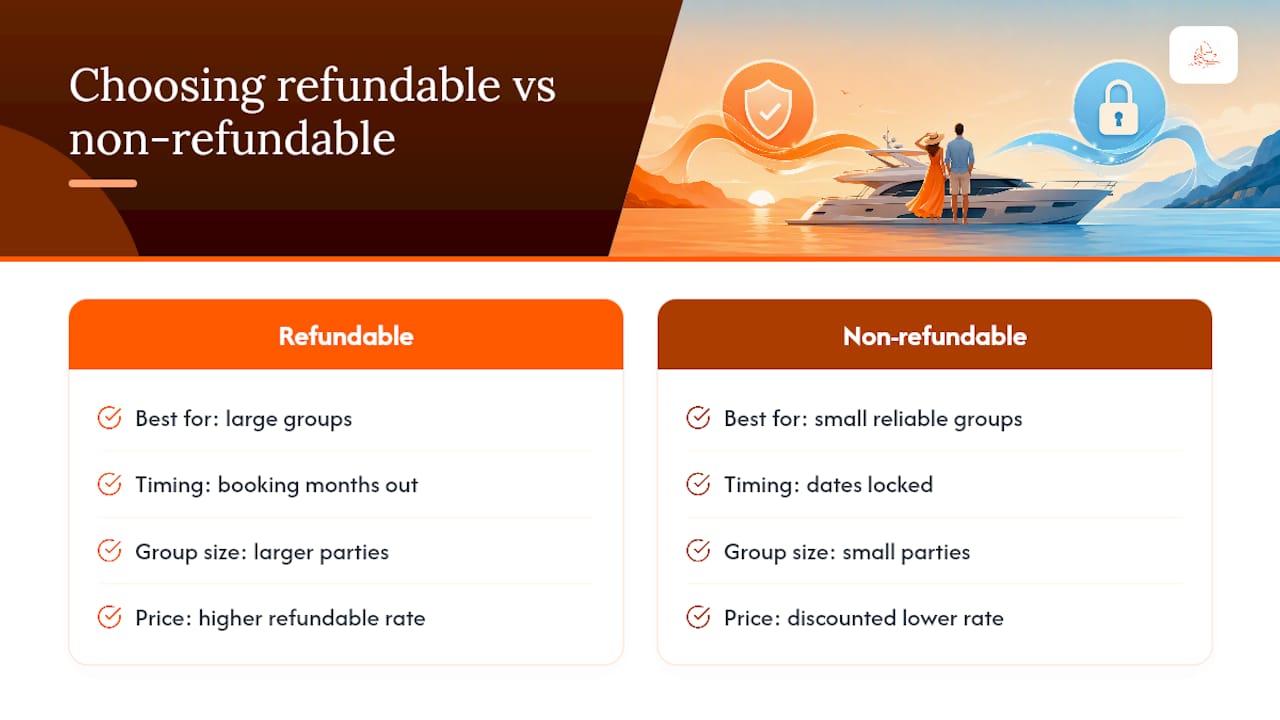
Refundable rates make sense for large groups, work-dependent schedules, or anyone booking more than a few months out. If your dates are locked and your group is small and reliable, the discounted non-refundable rate is usually the smarter bet.
Sailorix's low-fee membership model narrows that gap either way, since you're not paying a steep service markup on top of whichever choice you make.
— SAILORIX
Book With Fewer Cancellation Surprises
Sailorix gives you the payment schedule and refund cutoffs up front, before you commit a deposit, so you're not deciphering fine print after the fact.

Recommended insurance options appear right alongside the listing, so you can weigh the cost of flexibility before you pay anything. If you're weighing a nonrefundable deal against a flexible one, start by comparing real listings and their refund terms on Sailorix to see the schedule for your actual dates.