
Key yacht charter contract terms define what you pay for, what you can do onboard, and who is liable if something goes wrong. Read them before you send a deposit, not after. Three terms decide most of the outcome: MYBA (the standard contract format), APA (the cash account that covers your onboard expenses), and the security deposit (your exposure if something breaks).
The highest-impact clauses to check first:
- Base charter fee — what the boat and crew cost, before anything else.
- APA (Advance Provisioning Allowance) — the running account for fuel, food, and dockage.
- Security deposit / insurance — your liability ceiling if gear gets damaged.
- Cruising area and redelivery — where you can go and when you must be back.
A charter contract sets payment, liability, cruising limits, and who controls safety decisions onboard. Read it before you pay, not after.
Before signing anything, confirm the APA percentage in writing, check the cancellation tiers line by line, and verify the cruising area matches the trip you actually planned.
Key Takeaways
A charter contract's base fee, APA percentage, and security deposit terms determine your total cost exposure far more than the headline rental price does.
| Point | Details |
|---|---|
| Confirm APA percentage | Ask for the exact percent (typically 25 to 35 percent of base fee) and how reconciliation works. |
| Check cancellation tiers | Read refund windows line by line; note what triggers force majeure protection. |
| Verify cruising area | Match the contract's geographic limits against your actual planned itinerary. |
| Document vessel condition | Photograph and timestamp every cabin and system at embarkation and redelivery. |
| Compare fees on Sailorix | Sailorix charges roughly 1 percent in service fees versus the 10 to 20 percent typical elsewhere. |
Table of Contents
- What Is a Yacht Charter Contract?
- What Are Bareboat, Skippered, and Fully Crewed Charters?
- What Do MYBA, CYBA, and IYBA Contracts Cover?
- How Much Does an APA and Base Fee Actually Cover?
- What Payment and Cancellation Terms Should You Expect?
- Which Operational Clauses Change Your Itinerary?
- How Are Vessel Damage Claims Handled?
- What Safety Documents and Crew Credentials Should You Verify?
- How Do You Review a Charter Contract Before Signing?
- Charter Contract Glossary
- Sailorix's View on Fair Charter Terms
- Book Smarter With Sailorix
- Frequently Asked Questions
- Sources
What Is a Yacht Charter Contract?
A yacht charter contract is a rental agreement bundled with a service agreement: it covers the boat, the crew (if any), and the money terms that govern the trip. Understanding yacht charter paperwork starts with knowing who is actually party to the deal, because the document allocates cost and risk between them.
Three or four parties typically appear:
- The charterer — you, the person renting and signing the payment schedule.
- The owner — the vessel's legal owner, sometimes represented by a management company.
- The broker or agent — negotiates terms and often holds the APA and deposit in escrow.
- The captain — signs off on safety authority even when not a contracting party.
The contract controls dates, the vessel and its inventory, the base fee, APA percentage, security deposit, cruising area, insurance coverage, and how disputes get resolved. Everything else in this guide is really just an expansion of those line items.
What Are Bareboat, Skippered, and Fully Crewed Charters?
The charter type you pick changes almost every other clause in the contract, starting with who is legally responsible for the boat. This is the first real decision in charter boat terminology, and it comes before you even look at pricing.
- Bareboat charters put you in the operator's seat. You need a recognized sailing qualification, and the contract shifts liability onto you directly, with a higher security deposit to match.
- Skippered charters include a professional skipper, but you still fund the APA and defer to the captain's authority on safety calls.
- Fully crewed charters add a full team, with gratuity customarily layered on top of the base fee and a more detailed service-level section in the contract.
Pro Tip: If you have never chartered before, book skippered or fully crewed on your first trip. A bareboat contract puts legal and financial exposure on you the moment you take the helm, and that is not the place to learn the rules.
What Do MYBA, CYBA, and IYBA Contracts Cover?
These three acronyms are the templates your contract is probably built on, and each one signals a different region and expense structure. Recognizing charter agreement terms tied to these forms tells you what's negotiable and what isn't.
MYBA is the industry standard for commercial crewed charters worldwide, especially across the Mediterranean and Caribbean. It runs on a "plus expenses" model, meaning APA sits on top of the base fee, and it includes recommended clauses on cancellation, crew authority, and dispute resolution. CYBA is a regional association whose templates dominate U.S. and Caribbean markets, sometimes with different tax handling. IYBA shows up in similar American markets, often with region-specific legal addenda.
Brokers negotiate percentages, delivery points, and cruising areas inside these templates, while boilerplate enforcement language usually stays untouched.
| Template | Primary region | Expense model | Watch for |
|---|---|---|---|
| MYBA | Mediterranean, Caribbean | APA plus base fee | Cancellation tiers, crew authority clause |
| CYBA | U.S., Caribbean | Varies by contract | Local tax handling, cruising conventions |
| IYBA | U.S. markets | Varies by contract | Regional legal addenda |
How Much Does an APA and Base Fee Actually Cover?
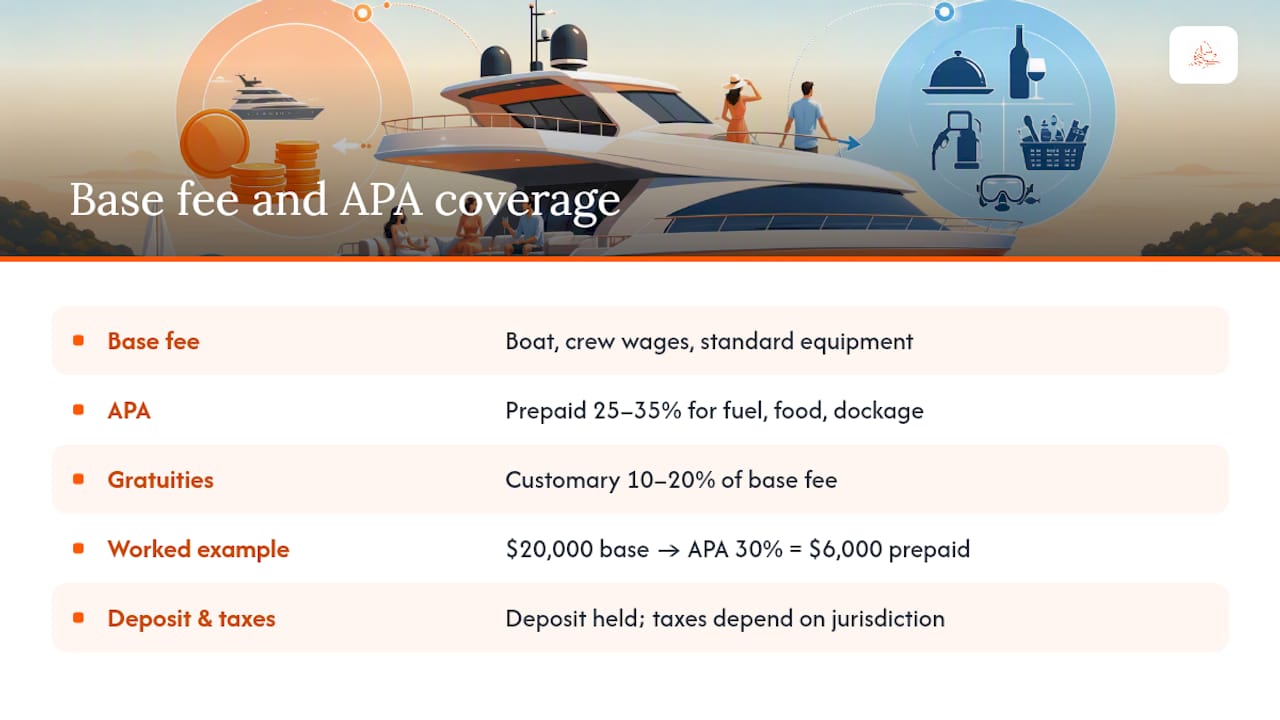
The base charter fee pays for the boat, the crew's wages, and standard equipment. It almost never covers fuel, food, dockage, or communications. That gap is why APA exists, and misreading it is the single most common source of budget shock among first-time charterers.
APA (Advance Provisioning Allowance) is a prepaid account, typically 25 to 35 percent of the base charter fee on Mediterranean crewed trips, that the captain draws down for fuel, food, dockage, and other variable costs. At the end of the trip, the captain reconciles the account against receipts and refunds whatever wasn't spent. Overruns get billed back to you.
Statistic Callout: APA typically runs 25 to 35 percent of the base fee, and gratuities customarily land between 10 and 20 percent of the base fee, region and service level dependent.
Here's a worked example on a $20,000 base fee for a seven-night charter: APA at 30 percent adds $6,000 upfront, bringing your total prepayment to $26,000 before you set foot on the boat. If the crew spends $5,200 on fuel, provisioning, and dockage, you get $800 refunded after reconciliation. If they spend $6,600, you owe the difference.
The security deposit is separate money entirely, usually held (not paid outright) against damage. Taxes and VAT often appear as a line item calculated on the base fee, and who pays them depends on the jurisdiction and the specific template you're signing, so ask your broker to itemize this before you commit. Fuel and marina fees typically run through the APA; provisioning does too, unless you've arranged your own. For more on what the base number includes, see how charter fees break down before comparing quotes.
What Payment and Cancellation Terms Should You Expect?
Most contracts follow a predictable payment rhythm, and knowing it in advance helps you spot an unusual clause before you sign.
- Signing — typically 50 percent of the base fee as a deposit.
- Balance due — the remaining 50 percent, usually 30 to 60 days before embarkation.
- APA transfer — often due alongside or shortly after the balance.
MYBA-style cancellation tiers generally scale refunds by how much notice you give:
- Cancel far in advance (roughly 90+ days out): most or all of your deposit is protected.
- Cancel closer to departure (around 30 days out): expect a smaller refund, sometimes none.
- Owner cancels: you're typically entitled to a full refund plus, in some cases, a remedy for costs incurred.
Force majeure and hurricane clauses can rescue a cancellation that would otherwise forfeit your deposit, but they usually require documented evidence, such as an official storm warning, and prompt written notice. Contracts also commonly include breakdown clauses that trigger a pro-rata refund if major equipment fails for an extended period, often 12 to 24 hours.
Which Operational Clauses Change Your Itinerary?
Delivery and redelivery clauses set your embarkation and disembarkation times, and they are almost always firm. That's because of turnaround day, the intensive cleaning, restocking, and systems check the crew runs between charters.
Turnaround day is operationally intensive, and that is exactly why requests for earlier boarding usually get denied. The crew simply doesn't have the hours.
Cruising area clauses define where you're contractually allowed to sail. Push past that boundary, and you can trigger extra fees, insurance gaps, or an outright refusal from the captain. Speaking of which, the captain's authority is not decorative: safety clauses typically let the captain override guest requests whenever conditions warrant it, and that authority usually survives even the most detailed itinerary you negotiated.
- Delivery/redelivery times are fixed by turnaround logistics, not preference.
- Leaving the agreed cruising area can void insurance coverage for that leg.
- Jurisdiction and governing law clauses decide where a dispute gets heard, arbitration versus court, and under whose law.
Ignore a jurisdiction clause and you may find yourself contesting a damage claim in a country you've never set foot in. For more on what protections you're owed as a guest, review charter guest rights before you sign.
How Are Vessel Damage Claims Handled?
Every charter starts with an inventory and condition check at embarkation, and this is the moment that protects you if a dispute arises later. Walk the boat with the crew, check the inventory list against what's actually onboard, and note anything already scuffed or broken.

Crews typically log pre-charter condition in writing, and you should sign it only after confirming it matches what you see, not what the paperwork claims. During the trip, report damage immediately rather than waiting for redelivery. Documented condition records substantially reduce post-charter disputes, and owners typically process claims against the security deposit in the days following redelivery.
Pro Tip: Photograph and video every cabin, the galley, and all visible equipment at embarkation, with a timestamp visible in frame. Do the same at redelivery. It takes ten minutes and it's the difference between a fair deposit return and a dispute you can't win.
What Safety Documents and Crew Credentials Should You Verify?
Ask to see the vessel's certificate of inspection, proof of P&I cover, and hull and machinery insurance details before you finalize anything. Larger commercial yachts operate under SOLAS and IMO safety standards, which drive equipment requirements and passenger limits that will show up as appendices to your contract.
Crew credentials matter too: ask for the captain's license and STCW certification, plus any endorsement required for your specific cruising area.
Safety Callout: Carrying more than 12 paying passengers can shift a vessel's commercial classification entirely, changing both insurance terms and legal capacity limits.
Ask the crew to walk you through the safety briefing and show you where emergency equipment is stored. If a broker hesitates on any of this, treat it as a red flag, not an oversight. Readers considering a bareboat option should also confirm licensing requirements match the cruising area before booking.
How Do You Review a Charter Contract Before Signing?
Work through the contract in a fixed order so nothing slides past you in the fine print.
- Confirm which template you're signing: MYBA, CYBA, or IYBA, and note the region-specific quirks that come with it.
- Verify the APA percentage and how reconciliation works.
- Check the cruising area matches your actual itinerary.
- Review the inventory list line by line.
- Confirm insurance coverage, including P&I and hull terms.
- Read the cancellation tiers and deposit mechanics twice.
A short set of direct questions for your broker will surface most red flags:
- What percentage is APA, and who reconciles it?
- Is the security deposit held or paid outright?
- What's the exact cruising area, and what happens if we cross it?
- What are the cancellation tiers, and what triggers force majeure?
- Can I see the captain's license and the vessel's safety certificate?
Keep every receipt during the trip and insist on a written APA reconciliation from the captain at the end. If a clause reads ambiguous on liability or jurisdiction, that's the moment to loop in a maritime lawyer rather than assume it will sort itself out. First-timers should also walk through a step-by-step booking checklist before their first signature.
Charter Contract Glossary
- APA (Advance Provisioning Allowance) — prepaid account for fuel, food, and dockage, typically 25 to 35 percent of the base fee. See the financial terms section above.
- Base charter fee — the boat and crew wage cost, excluding APA and taxes.
- MYBA — the standard commercial crewed charter contract template, used mainly in the Mediterranean and Caribbean.
- CYBA — a regional association whose templates dominate U.S. and Caribbean charters.
- IYBA — a similar U.S.-market template with region-specific addenda.
- Security deposit — funds held against damage, separate from APA.
- Turnaround day — the crew's handover day between charters; boarding times are firm because of it.
- Redelivery — the contractual return of the vessel at the end of the charter.
- Force majeure — a clause excusing performance due to events like storms, subject to notice and documentation.
- COI — certificate of inspection, a vessel's core safety document.
- P&I — Protection and Indemnity insurance, covering third-party liability.
- Cruising area — the geographic boundary you're contractually permitted to sail within.
Sailorix's View on Fair Charter Terms
Contract disputes almost always trace back to the same root cause: nobody explained the APA percentage or the cancellation tiers in plain language before money changed hands. Transparent pricing and clear reconciliation aren't a courtesy; they're the difference between a charterer who trusts the process and one who feels ambushed by a bill. A good broker or platform will walk you through APA mechanics and send a preference sheet before you ever board, and you should treat any refusal to do that as a warning sign.
Book Smarter With Sailorix
Most charter platforms charge 10 to 20 percent in service fees on top of everything already discussed here. Sailorix works differently: a $100 annual membership unlocks bookings at roughly 1 percent service fees, real-time availability across a global fleet, and add-ons like skippers, insurance, and early check-in you can bundle right into the booking.

That matters most right at the contract stage, because the platform's transparent pricing means there's no markup hiding inside your APA quote or your base fee, the two numbers this entire guide has walked you through. If you're comparing quotes and want to see what a fair, low-fee booking actually looks like, check available yachts on Sailorix and request a quote before you sign anything with a traditional broker.
Frequently Asked Questions
What does APA mean in a yacht charter contract? APA stands for Advance Provisioning Allowance, a prepaid account covering fuel, food, and dockage, typically 25 to 35 percent of the base charter fee on Mediterranean crewed trips, reconciled with receipts at the end of the trip.
Is MYBA the same as CYBA or IYBA? No. MYBA is the dominant template for Mediterranean and Caribbean crewed charters. CYBA and IYBA are regional templates more common in U.S. and Caribbean markets, often with different tax handling and legal addenda.
Who pays for fuel and provisioning on a charter? These costs typically run through the APA, which the charterer funds upfront and the captain draws down during the trip, with unused funds refunded afterward.
Can I get my deposit back if I cancel? It depends on your notice window and the contract's cancellation tiers. Canceling far in advance usually protects most of your deposit; canceling close to departure often does not, unless a force majeure clause applies.
Do I need a license to charter a yacht? Only for bareboat charters, where you act as the operator. Skippered and fully crewed charters include a professional captain, so no personal license is required.
This article is general information, not a substitute for advice from a qualified lawyer. Consult a qualified legal professional about your own circumstances before acting on anything here.
Sources
- How to Read a MYBA Charter Agreement: Clause-by-Clause Guide
- Yacht Charter Terms Nobody Explains (Plain-English Guide)
- About CYBA