
The yacht's own insurance protects the owner, not you. If you're renting a boat, buy three things: charterer's liability coverage, deposit or collision damage waiver (CDW) protection, and travel medical/evacuation insurance. Skip any one of these and you're personally exposed to repair bills, medical costs, or legal claims that the owner's policy was never designed to cover.
Here's the fast version before we get into specifics:
-
Charterer's liability: covers damage you cause and legal defense costs, typically 2%–4% of the charter cost for a single trip.
-
Deposit/CDW protection: reduces or eliminates your exposure to the security deposit, often a few hundred euros per week depending on the yacht.
-
Travel medical/evacuation: covers injuries and emergency transport offshore, where standard health insurance usually doesn't reach.
Budget roughly a low single-digit percentage of your total charter cost for adequate coverage across all three. That's cheap compared to a €10,000 hull deductible landing on your credit card.
Key Takeaways
Charterers who buy liability, deposit protection, and medical/evacuation coverage separately from the owner's policy avoid the majority of financial exposure during a charter.
| Point | Details |
|---|---|
| Owner's policy doesn't cover you | The yacht's hull and P&I insurance protects the owner, not the charterer, per charter agreement terms. |
| Budget 2%–4% for liability | Charterer's liability typically runs 2%–4% of the charter cost per trip. |
| CDW costs €150–€450 weekly | Operator damage waivers reduce deposit exposure but often exclude sails and rigging. |
| Bareboat needs commercial cover | Owners renting bareboat require commercial insurance since personal policies are void for rental use. |
| Ask about subrogation before signing | Confirm whether the owner's insurer can pursue you after paying a claim. |
Table of Contents
- What Yacht Charter Insurance Actually Covers for the Charterer
- How Much Yacht Charter Insurance Really Costs
- Bareboat vs. Captained, and CDW vs. Deposit Insurance
- How to Choose the Right Policy: A Checklist and the Right Questions
- How Sailorix Helps Charterers Manage Insurance Exposure
- Frequently Asked Questions
- Sources
What Yacht Charter Insurance Actually Covers for the Charterer
The boat's hull insurance and the owner's protection and indemnity (P&I) policy exist to protect the owner's asset and the owner's liability, not yours. That gap is exactly what charterer-focused coverage fills, and it works differently depending on what kind of policy you're looking at.
A standalone charterer's liability policy typically includes:
- Third-party liability for injury or property damage you cause to other people or vessels.
- Damage to the vessel up to a set limit, usually tied to the security deposit amount.
- Legal defense costs if you're sued following an incident.
- Water-sports and excursion coverage, often with lower sub-limits for jet skis, paddleboards, or dinghies.
Most policies carry exclusions that catch people off guard. Sails and rigging damage is commonly excluded outright, along with anything tied to willful misconduct, operating outside agreed cruising limits, or incidents involving alcohol or drug impairment. Read the exclusions list before the fine print becomes a problem at 2 a.m. off some unfamiliar coastline.
There's also a subrogation risk worth understanding: if the owner's insurer pays out for damage, that insurer can turn around and pursue you for reimbursement if the charter agreement puts liability on the charterer. This is precisely the mechanism that makes owner-side coverage feel like protection when it isn't.
Coverage limits vary widely, but many charterer policies cap out in the low hundreds of thousands for liability, which sounds like plenty until you're staring at a total-loss claim on a six-figure vessel.
Pro Tip: Photograph every scratch, scuff, and worn line during handover, timestamped, before you leave the dock. It's the cheapest insurance policy you'll ever buy, and it costs nothing.
How Much Yacht Charter Insurance Really Costs
Pricing follows a fairly predictable pattern once you know what to compare against.
- Per-trip charterer's liability: roughly 2%–4% of the total charter cost.
- Operator CDW/damage waiver: a few hundred euros per week, depending on yacht size and value.
- Security deposits: commonly range from $1,500 to $10,000+ depending on vessel size, which is the exposure a waiver is protecting against.
- Annual charterer policies for frequent renters run from a few hundred to a couple thousand dollars depending on chosen limits.
A one-week bareboat charter on a mid-size catamaran might land you a CDW fee of a few hundred euros, versus a several-thousand-dollar deposit sitting fully exposed without it. A captained week on a larger yacht often carries higher liability limits and a proportionally higher premium. Someone chartering four or five times a year usually comes out ahead buying one annual policy instead of paying the per-trip fee each time, since annual charterer coverage tends to offer better value and higher limits than repeated one-off waivers.
The variables that move price most: vessel value, cruising area (Caribbean hurricane zones cost more than sheltered Mediterranean routes), skipper experience if you're operating bareboat, passenger count, and the deductible you choose. Lower deductible, higher premium. That trade-off is yours to make, not the operator's.
Bareboat vs. Captained, and CDW vs. Deposit Insurance
Whether you're at the helm or someone else is changes what you need to buy, and it changes it substantially.
- Bareboat charters put you in operational control, which means you need coverage built for that exposure. Owners renting out bareboat must carry commercial or bareboat-specific insurance, because a personal recreational policy is void the moment the vessel is used commercially. As the charterer, you inherit real liability for how the boat is handled, so your own charterer's liability policy matters more here than in any other charter type.
- Captained charters shift day-to-day operational liability toward the professional crew and the operator's own commercial policy. That doesn't mean you're fully covered. Gaps remain around personal injury, your own medical needs, and damage caused by guests during water activities.
- CDW and deposit insurance solve the same problem, differently. An operator's CDW is convenient and bundled into the booking, but it often excludes sails, rigging, and certain hull sections. Independent deposit insurance can be broader but requires you to shop separately and file your own claim. Compare the nonrefundable CDW fee against the actual deposit at risk before deciding, because for a short trip the waiver frequently looks cheap relative to what it's protecting.
- Marketplaces and marinas increasingly require proof of competence and minimum liability limits before handing over the keys, particularly for bareboat rentals.
Pro Tip: If a captained charter's booking page doesn't specify who's liable for guest-caused water-toy damage, ask before you sign. That's exactly the gap that falls on you by default.
How to Choose the Right Policy: A Checklist and the Right Questions
Run through this before you commit to a charter agreement, not after.
Checklist:
- Decide single-trip versus annual coverage based on how often you charter.
- Target liability limits that cover the vessel's full value, plus medevac limits of at least $100,000.
- Add a scheduled-articles rider if you're bringing cameras, dive gear, or jewelry worth protecting individually.
- Understand how your deductible choice affects both premium and out-of-pocket exposure.
- Document the vessel's condition at handover with photos and a signed checklist.
Questions to ask your insurer or operator, verbatim:
- "Does this policy cover subrogation, or can the owner's insurer pursue me after paying a claim?"
- "Are sails and rigging excluded from this coverage?"
- "Is medevac included, and what are the coverage limits?"
- "What is the deductible, and how does it interact with the security deposit?"
Reviewing the charter contract terms before signing catches most of these issues early, particularly the clause language that determines who's actually liable when something goes wrong.
How Sailorix Helps Charterers Manage Insurance Exposure
Booking through a platform doesn't replace buying the right coverage, but it should make the decision easier, not harder. Sailorix publishes practical guides on charter terms, renter standards, and charter costs precisely because most charterers don't know what they're exposed to until something breaks. At booking, document the vessel's condition, confirm whether deposit protection is available for that listing, and read the liability clause before you pay a deposit. A five-minute check at handover beats a five-week insurance dispute afterward.
For anyone weighing crewed excursions with added water activities, examples like a crewed charter with a personal chef show how quickly liability questions multiply once you add excursions and equipment into the mix.
Frequently Asked Questions
Does my homeowners or auto insurance cover a yacht charter? Rarely for damage. Personal policies may offer limited liability help, but they typically won't pay for damage to the rental watercraft itself. Treat charter coverage as a separate purchase.
Is charterer's liability insurance required by law? Not universally by law, but nearly every charter agreement contractually requires it, often through a clause similar to "Clause 16" that shifts liability onto the charterer. Skipping it doesn't remove the exposure; it just leaves you uninsured against it.
What's the difference between a CDW and deposit insurance? A CDW is bundled through the charter operator and reduces your deposit exposure directly, usually with sails and rigging excluded. Deposit insurance is purchased independently, can offer broader terms, but requires filing your own claim rather than relying on the operator's process.
Do I need separate coverage for a captained charter? Yes, though less than for bareboat. The crew and operator carry professional liability, but personal medical costs, evacuation, and guest-caused water-toy damage frequently fall outside that coverage.
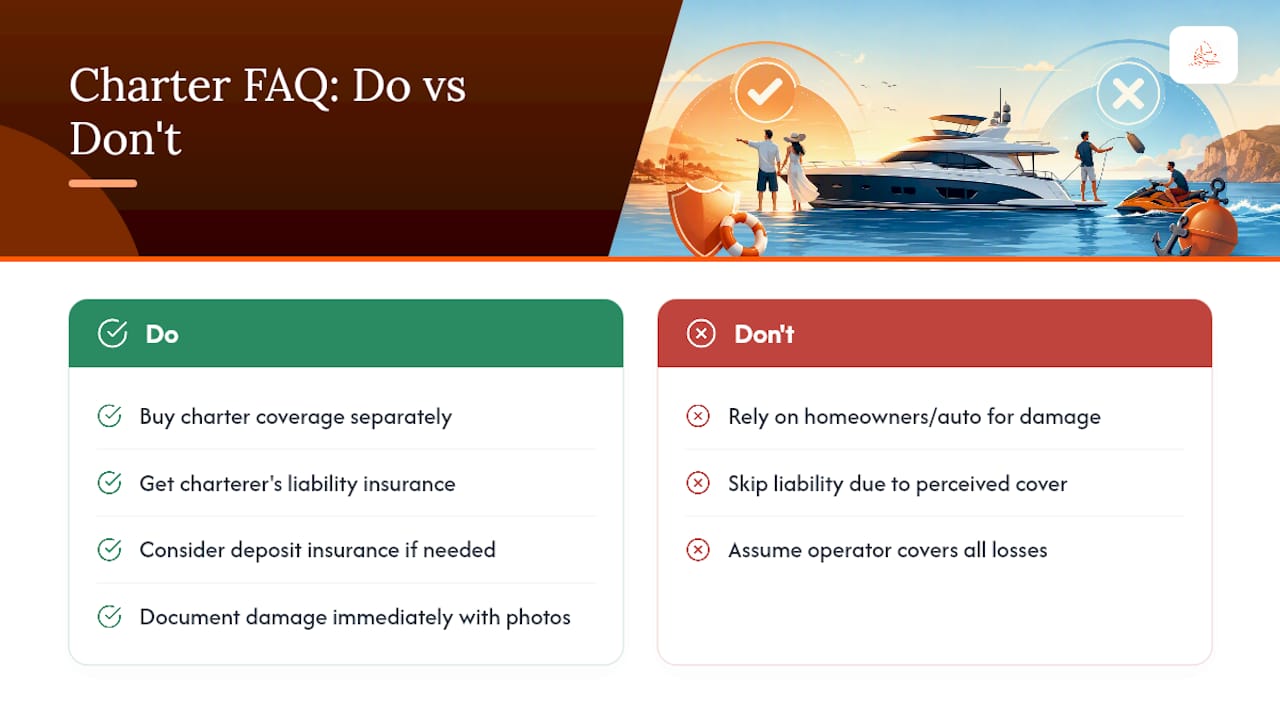
How fast are yacht charter insurance claims typically processed? Timelines vary by insurer and claim complexity, but documenting damage immediately at the scene with photos and a written report speeds up every step that follows. Delayed reporting is the single biggest cause of denied or reduced claims.
Sources
- MHG Insurance — Yacht Charterer’s Liability
- Casey Insurance — Bareboat charter insurance requirements
- Boat Tomorrow — Charter yacht insurance: what's covered, what's not
- Progressive — Boat rental insurance
Review each provider's full policy PDF for exact medevac limits and exclusion wording before you buy.