
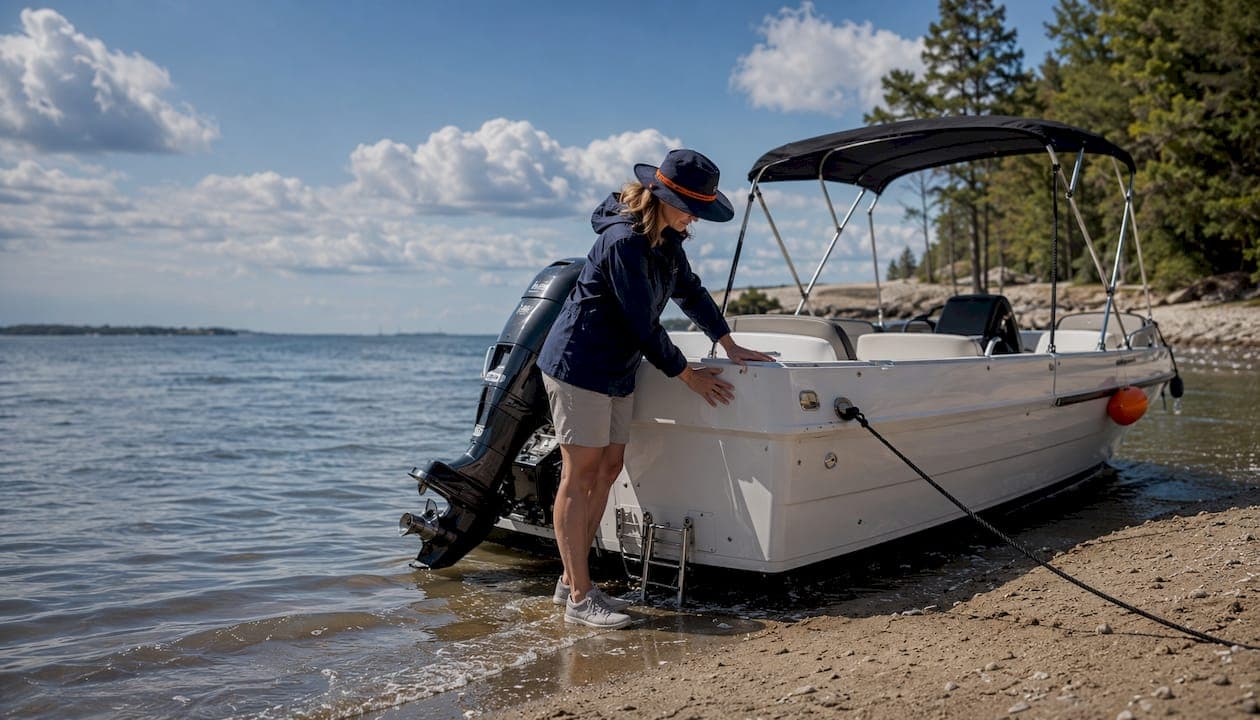
The boat transom is the flat or slightly curved panel that closes off the stern of a vessel, and for renters, it has one job that matters above everything else: holding the engine on. A compromised transom can mean a motor that shifts under load, water entering the hull, or a rental that ends at the dock instead of on the water.
Before you book or board, keep three things in mind:
- Look at the transom in listing photos. Cracks, staining, or a sagging motor mount are visible even in a smartphone shot.
- Engine mount integrity is non-negotiable. The transom bears the full weight and thrust of the outboard or stern drive. Any flex or soft spot there is a safety issue, not a cosmetic one.
- Ask the host directly whether the transom has had any recent inspection, repair, or resealing work done on the bolt holes.
Table of Contents
- What does a boat transom actually do?
- What transom types and materials should you recognize?
- Why the HIN on the transom matters for your rental
- How transom condition affects your safety on the water
- Your pre-booking and on-site transom inspection checklist
- How to recognize common transom damage
- What to do if you find transom damage during your rental
- Quick glossary of terms you'll encounter
- Key Takeaways
- Transoms reveal more than most renters realize
- Sailorix helps you rent with confidence, not guesswork
What does a boat transom actually do?
The transom is the structural surface that closes off the stern and supports engines, platforms, and ladders. It is not the same as the stern. The stern is the entire rear section of the vessel; the transom is a specific panel within it, the way a door is part of a wall.
Its load roles break down into three categories:
- Engine weight and thrust. On outboard-powered boats, the motor bolts directly to the transom. Every burst of acceleration transfers force through those mount points.
- Hull stiffness. The transom acts as a structural brace across the beam, keeping the hull from flexing or racking under load.
- Accessory mounts. Swim platforms, boarding ladders, trim sensors, and navigation lights all attach here.
The transom is where structural failure is most likely to start on an aging powerboat. Water enters through fastener holes, saturates the core, and the rot spreads inward — often invisibly — until the mount bolts start to pull.
| Function | Why it matters for renters |
|---|---|
| Engine mounting | Loose or soft mount = motor shift under throttle |
| Hull stiffness | Weak transom = hull flex, poor steering response |
| Swim platform support | Delaminated core = unstable boarding surface |
| HIN and name display | Damaged area = harder to verify vessel identity |
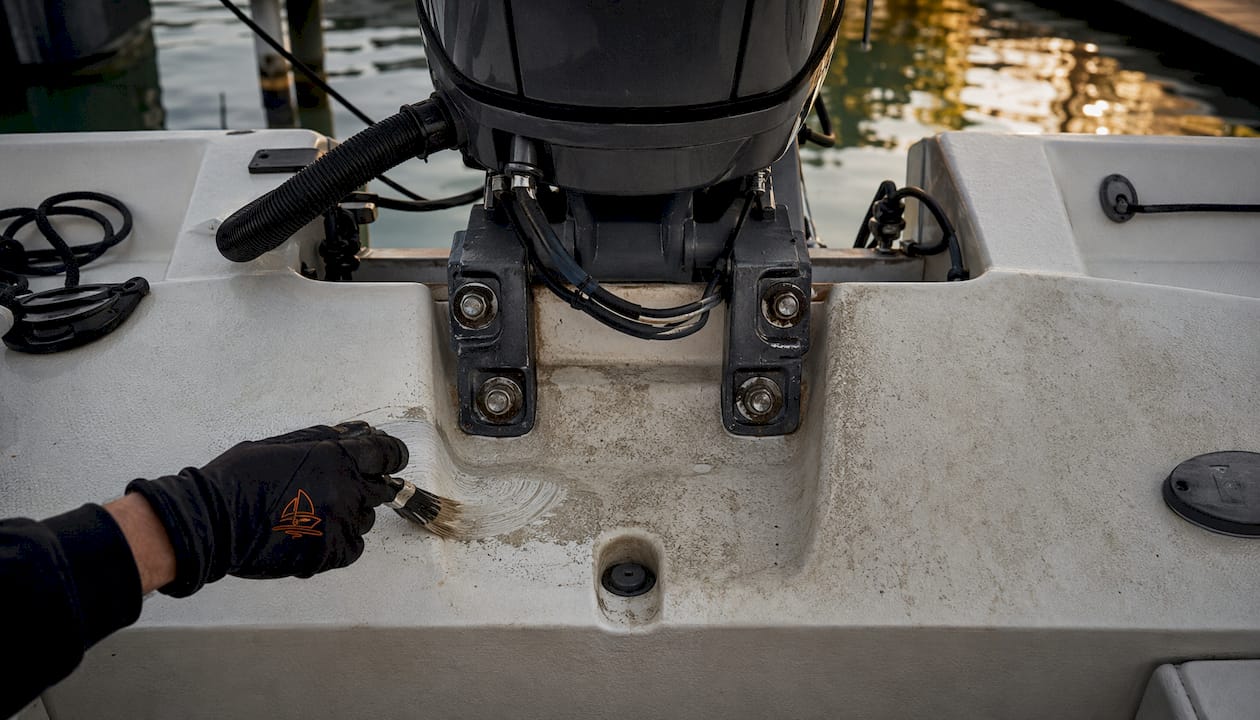
Pro Tip: Ask the host for a photo of the engine mount area specifically, not just a wide stern shot. The bolts and the fiberglass immediately around them tell you more than anything else.
What transom types and materials should you recognize?
Common transom shapes:
- Full/flat transom. The most common on powerboats. Vertical, spans the full beam, easy to inspect.
- Notched transom. Has a cutout at the centerline for an outboard. Normal on many fishing boats.
- Reverse/retroussé transom. Slopes aft and outward. Common on modern yachts; the motor mounts lower, under the hull.
Materials and what damage looks like:
- Fiberglass skin over wood core (marine plywood). The most common construction. Rot enters through fastener holes and spreads through the plywood core. Exterior signs: soft spots, blistering gelcoat, rust stains from fasteners.
- Composite cores (foam or balsa). Lighter than plywood, but delamination from water intrusion shows as a hollow sound on the tap test.
- Aluminum. Found on aluminum fishing boats and some commercial vessels. Corrosion shows as white oxidation or pitting around welds and fastener holes.
Modern full-beam transoms are wider and often incorporate integrated swim platforms, which shifts where the engine mounts and where you should focus your visual check. On these boats, the platform itself is structural, so look at its attachment points, not just the main panel.
Pro Tip: If the listing shows an integrated swim platform, ask whether it's solid or hollow-core. A hollow-core platform that's taken water is a boarding hazard.
Why the HIN on the transom matters for your rental
U.S. federal regulation requires the Hull Identification Number to be permanently marked on the transom, typically on the starboard side. It's a 12-character code that identifies the vessel's manufacturer, serial number, and model year. For renters, it's your primary proof that the boat you're on matches the boat in your booking agreement.
Photograph the HIN before you leave the dock. If there's a dispute about damage, insurance coverage, or vessel identity, a time-stamped photo of the HIN is your clearest piece of evidence.
Before departure, photograph and keep:
- The HIN (close-up, starboard transom)
- The vessel name (usually centered on the transom)
- Any pre-existing visible damage on the transom surface
- The engine make and model plate
Knowing your boat licensing and documentation rights as a renter makes this step faster and less awkward to request.
How transom condition affects your safety on the water
A weak transom doesn't just look bad. It changes how the boat behaves. When the structural core is compromised, the engine mount flexes under acceleration, which affects steering response and can cause the motor to cavitate or shift angle unpredictably. In rough water, that's a serious handling problem.
Renter-specific risks from a damaged transom:
- Motor detachment. Mount bolts pulling through a rotted core is rare but catastrophic.
- Water ingress. Cracks or gaps around fittings let water into the hull, especially at speed.
- Compromised towing points. Many tow rings and anchor cleats attach at or near the transom. A soft core means those points can't hold rated loads.
If you notice any flex, soft spots, or unusual sounds from the stern area during use, reduce speed immediately, return to shore, and contact the host or Sailorix support before continuing. Avoid high-thrust maneuvers entirely until the issue is assessed.
Your pre-booking and on-site transom inspection checklist
Before you book — request these in your message to the host:
- A wide-angle photo of the full transom from outside the boat
- A close-up of the HIN on the starboard side
- A photo of the engine mount bolts and the fiberglass immediately around them
- Date of the last transom inspection or any recent resealing work
On-site at pickup:
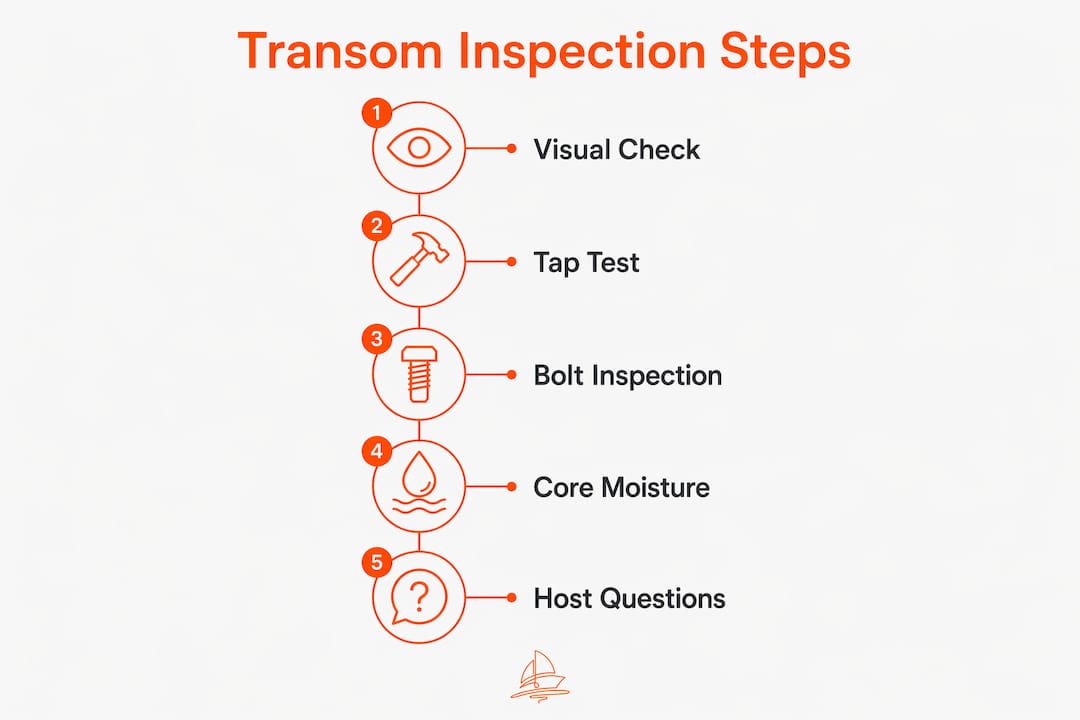
- Visual scan. Look for cracks, crazing, or discoloration in the gelcoat around mount points.
- Tap test. Knock firmly across the transom surface with your knuckle or a small mallet. A solid, high-pitched sound means healthy core. A dull thud means delamination or rot.
- Press test. Push firmly on the transom surface near the motor mount. No flex should be detectable.
- Fastener check. Look for rust staining, lifted bedding compound, or gaps in sealant around any bolt or fitting.
- Motor alignment. The engine should sit flush and level. Any tilt or wobble at rest suggests mount failure.
- Swim platform attachment. Pull gently on any ladder or platform. It should feel solid, with no creak or give.
Script to use with the host: "Can you confirm when the transom bolt holes were last sealed or inspected? And has there been any soft-spot repair in the last two seasons?"
Pro Tip: If the host can't answer the sealing question or gets defensive, that's information. A well-maintained boat has a maintenance history the owner can describe.
Follow the full boat rental workflow to make sure transom checks fit into your broader pickup routine.
How to recognize common transom damage
| Damage sign | Probable cause | Urgency |
|---|---|---|
| Soft spot near mount bolts | Water intrusion, core rot | High — do not rent |
| Dull tap test sound | Delamination | Medium-High — get host confirmation |
| Crazing or cracked gelcoat | Impact or stress fracture | Medium — inspect depth |
| Rust stains around fasteners | Corroded hardware, water path | Medium — check for rot |
| Sagging or bulging surface | Advanced delamination | High — structural failure risk |
| Gaps in sealant/bedding | Maintenance neglect | Medium — water entry point |
Outboard loads concentrate on the fiberglass skin and core at mount locations. Moisture that enters through a single poorly sealed bolt hole can spread through the entire core before the exterior shows any sign. That's why soft spots and dull tap sounds matter even when the gelcoat looks fine.
Early-stage soft spots can often be repaired with targeted core replacement. Waiting lets delamination spread until a full transom replacement is required, which is a major structural job.
Pro Tip: Ask for photos of the inside of the stern locker or bilge near the transom. Repairs are often done from the inside, and a host who's had recent work done will have photos of it.
What to do if you find transom damage during your rental
Immediate steps:
- Reduce speed to idle or stop entirely.
- Check for water in the bilge. If water is entering, head to shore immediately.
- Keep passengers away from the stern area.
- Anchor safely if returning to shore isn't immediately possible.
Communication steps:
- Photograph the damage with your phone, including a frame that shows the HIN in the same shot when possible.
- Note the time, GPS location, and conditions (sea state, speed you were traveling).
- Contact the host immediately and describe what you found. Ask specifically whether the vessel has rental insurance or a damage waiver that covers this situation.
Escalation:
- If the host is unresponsive or disputes the damage, contact Sailorix support with your time-stamped photos, HIN, and booking reference.
- Request a replacement vessel or a refund based on the documented condition.
- Retain all communication records.
Quick glossary of terms you'll encounter
- Transom. The flat or curved panel closing off the stern; the engine mounts here.
- Stern. The entire rear section of the boat, not just the transom panel.
- HIN (Hull Identification Number). 12-character code on the starboard transom; your vessel ID for disputes.
- Gelcoat. The outer resin layer on fiberglass boats. Crazing or cracks here are the first visible sign of stress.
- Delamination. Separation of the fiberglass skin from the core material. Sounds hollow on a tap test.
- Backing plate. A metal or composite plate behind the transom skin that spreads the load of a mount bolt. Missing or corroded backing plates are a common failure point.
- Transom saver. A support bar used when trailering to prevent the outboard's weight from stressing the transom during transport.
- Outboard vs. stern drive. An outboard motor clamps or bolts to the exterior transom. A stern drive (inboard/outboard) passes through the transom. Both create penetrations that need sealing.
For a broader reference on maritime terminology, the Sailorix glossary covers the terms you'll see in listings and host communications.
Key Takeaways
The transom is the single structural component most likely to affect your safety and your rental agreement if it's damaged — inspect it before you leave the dock.
| Point | Details |
|---|---|
| Definition | The transom is the stern-closing panel that holds the engine and provides hull stiffness. |
| Top inspection check | Tap test plus a press near mount bolts; a dull sound or any flex means escalate. |
| HIN location | Photograph the starboard transom HIN before departure for dispute protection. |
| When to refuse | Visible soft spots, sagging, or rust-stained mount bolts are grounds to decline the rental. |
| Sailorix support | Sailorix accepts time-stamped photo evidence for damage disputes and can arrange alternative vessels. |
Transoms reveal more than most renters realize
Most renters look at the engine, the upholstery, and the fuel gauge. The transom gets a glance, if that. That's a mistake, and it's one that experienced boaters don't make.
A transom in poor condition is almost always the result of deferred maintenance, not a sudden event. The rot starts at a bolt hole that wasn't resealed after a fitting was replaced. It spreads slowly, invisibly, for a season or two. By the time you can feel a soft spot, the core is already compromised across a wider area than the exterior suggests. The host may not know, or may know and hope you don't check.
The tap test takes thirty seconds. The question about recent sealing work takes one message. Neither is confrontational. Both give you information that changes what you do next. A host who maintains their boat well will answer immediately and specifically. That response alone tells you something about the condition of everything else on board.
Sailorix helps you rent with confidence, not guesswork
Knowing what to look for is only half the equation. The other half is booking through a platform that gives you the tools to act on what you find.

Sailorix listings surface maintenance information when hosts provide it, including recent survey dates and transom inspection records. The platform's photo requirements encourage hosts to document the HIN and stern area, which means you often have visual evidence before you even message anyone. If something goes wrong on the water, Sailorix's dispute-reporting workflow accepts time-stamped photos and booking records as evidence for refund or replacement requests.
The membership model keeps costs low: €100 per year for access to bookings with roughly 1% service fees, compared to the 10–20% typical elsewhere. Less friction on the booking side means more budget for the trip itself, and more confidence that the platform has your back if the transom doesn't.
Browse available boats and check listing details before you commit to a booking.