
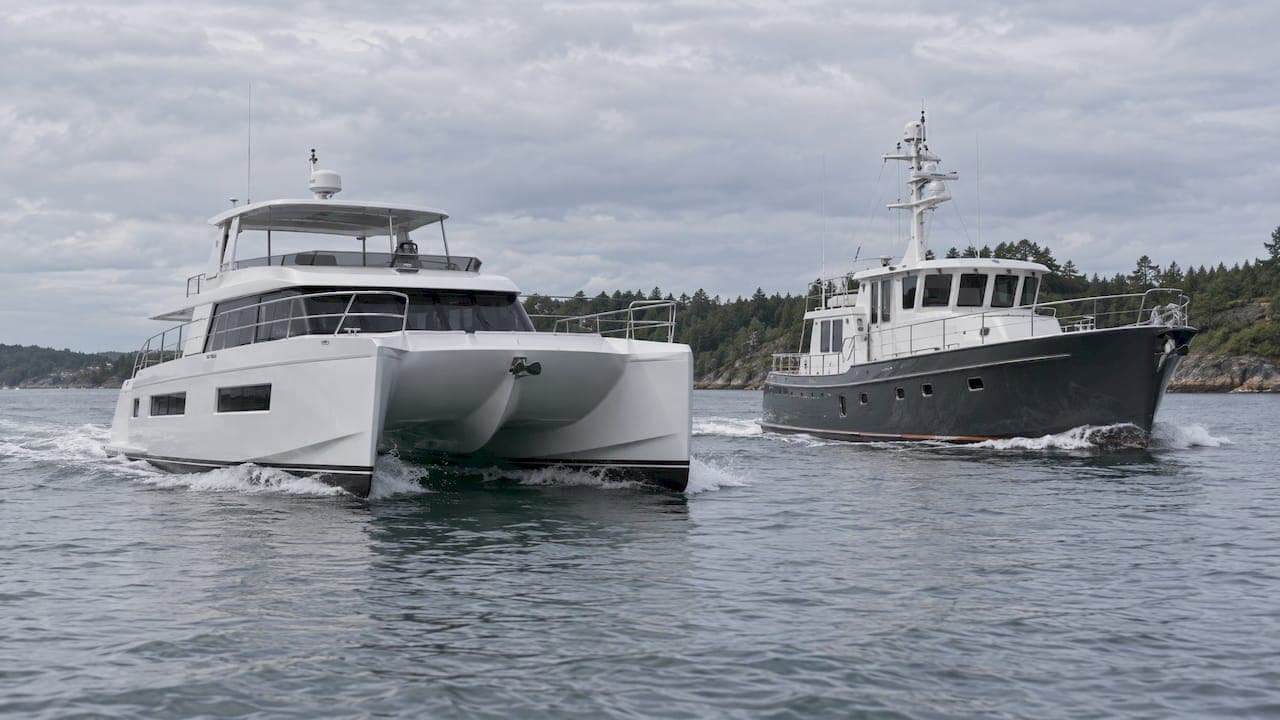
A power catamaran gives you more deck space, a flat ride at anchor and access to shallow water. A trawler gives you a more predictable ride in a seaway, strong fuel economy at slow speeds and a classic yacht layout. If you plan short hops, anchorages and shoal-draft cruising grounds, lean toward the cat. If you plan long passages at a steady 7 to 8 knots, lean toward the trawler. The rest of this guide shows where each boat wins, with real numbers, so you can decide before you book.
TL;DR
- Space and social life: power cats offer more deck space, a wider salon and a big cockpit. Trawlers stack their living space vertically and are strong on storage.
- Motion: cats sit flat at anchor. Trawlers roll at anchor unless they carry stabilizers, but move more predictably in a seaway.
- Fuel and range: a 40 to 50 foot trawler at 7 to 8 knots burns roughly 6 to 8 gallons per hour. Cats match that at displacement speed and burn more as they speed up.
- Shallow water: most power cats draw far less than a trawler, which opens skinny anchorages and creeks.
- Charter pick: choose by budget, route, tolerance for motion at anchor and the onboard lifestyle you want.
Table of Contents
- What a trawler is, and what a catamaran is
- Space and layout: horizontal vs vertical living
- Motion: at anchor and underway
- Fuel burn and range
- Speed, draft and shallow-water access
- How to choose for a U.S. charter
- Our perspective
- Find your boat on Sailorix
- Questions charter guests ask
- Sources
What a trawler is, and what a catamaran is
A trawler is a full-displacement (or semi-displacement) single-hull motor yacht built for slow, efficient, long-distance cruising. Trawlers are designed for slow, efficient cruising, and the hull is deep, heavy and traditional in its lines.
A catamaran has two slim hulls joined by a bridge deck. Catamarans come in two forms: sailing and power. When people compare a cat with a trawler, they almost always mean the power catamaran, which has two engines and no mast. Many large charter fleets now offer power cats, and their popularity as cruisers has grown in recent years.
If you are still deciding between sail and engine, our guide to sailing vs motor yacht charters covers that earlier choice.
Space and layout: horizontal vs vertical living
This is the difference you notice first when you step aboard.
On a power cat, living space spreads out on one level. Power cats offer more deck space, a wider salon and a cockpit for outdoor living. The salon often opens straight onto the cockpit, so meals, drinks and conversation flow between inside and out. Cabins sit in separate hulls, which gives two couples or two families real privacy.

A trawler uses a traditional layout. Trawlers use vertical living, often prioritizing efficient storage and classic yacht styling rather than the open plan of a cat. Expect an upper helm or pilothouse, a galley and salon on the main level, and cabins below. A trawler can still offer generous interior volume. It just comes in stacked rooms rather than one wide social space.
What this means for a charter:
| Your group | Likely better fit |
|---|---|
| Two couples or a family who want separate cabins and a shared outdoor lounge | Power catamaran |
| One couple who like a snug pilothouse and a classic feel | Trawler |
| Guests who spend most of the day outdoors | Power catamaran |
| Guests who want lots of storage for a week or more aboard | Trawler |
Cabin arrangement matters as much as hull type. Our cabin configuration checklist for charter walks through what to ask before you confirm a boat.
Motion: at anchor and underway
Most charter regrets come from motion, not from size or looks. The two boats behave differently in two situations.
At anchor. A cat's wide stance makes it stable by design. At anchor, cats sit flat while trawlers roll. If you or your guests are sensitive to rolling at night, this alone may decide it. Some trawlers narrow the gap. They may use a stern anchor, a gyrostabilizer or zero-speed stabilizers to match a catamaran's at-anchor stability. If you are chartering a trawler, ask whether it has any of these fitted.
Underway. Here the picture flips a little. Heavy full-displacement trawlers move more predictably in a seaway, and modern trawlers with active stabilizer fins can compete with cats while moving. Low-clearance cats can slam in head seas, which is tiring over a long day. Both types can handle offshore conditions when properly designed and handled, so skipper experience and weather planning count for more than the label on the hull.
Practical tip: if your itinerary has an exposed crossing, ask the charter company about the boat's bridge-deck clearance (cats) or stabilization system (trawlers), and about the weather window the skipper prefers.
Anchoring technique also affects how any boat sits at night. Our step-by-step yacht anchoring guide is worth a read before your first night on the hook.
Fuel burn and range
The fuel question depends on speed, and the honest answer is that speed changes the ranking.
At slow speeds the two are close. A 40 to 50 foot full-displacement trawler at 7 to 8 knots burns roughly 6 to 8 gallons per hour, and well-designed power cats match that at displacement speed. Above displacement speed, cat fuel burn climbs quickly, so trawlers make sense for long offshore passages on a tight fuel budget.
At higher cruising speeds the twin-hull design pays off. Power cats generally keep better fuel efficiency at higher cruising speeds because of lower hydrodynamic resistance. A couple who cruised the Great Loop aboard a 34-foot power catamaran reported burning under 4 gallons per hour in total at 12 knots. That is one owner's report on one small boat, not a rule for every cat, but it shows how a light twin hull can behave at moderate speed.
Rule of thumb for planning:
- Long days at 7 to 8 knots, few stops: a trawler is hard to beat for range and simplicity.
- Mixed days with a faster run to the next anchorage and slow cruising in between: a cat gives you flexibility without a large fuel penalty.
- Fuel is usually billed separately on charters, so ask how it is charged before you compare boats. For a wider look at what a week costs, see our catamaran charter cost breakdown.
Speed, draft and shallow-water access
Speed and draft shape which places you can actually reach.
Speed. A displacement trawler is limited by its hull. It cruises at a steady, slow pace and cannot be pushed much faster without a steep fuel penalty. A power cat is faster. The same Great Loop couple report a top speed of about 17 knots on their 34-footer. For a charter, that means a cat can cover more water in a day if the weather turns or you want to reach a distant anchorage before dark. Faster is not always better, though. Many protected waterways have wake and speed restrictions, so top speed matters less there.
Draft. Here the cat has a clear advantage. Trawlers usually have substantial keels that extend deeper than their propellers and rudders, while most power cats' propellers and rudders are their deepest parts. The same 34-foot cat above draws just 2 feet 4 inches. Shallow draft means you can anchor closer to a beach, tuck into a shallow bay and worry less about sandbars. A deeper-draft trawler needs more caution in coastal and island waters.
There is a flip side. A wide cat needs a wider berth. On the Great Loop, for example, the Trent-Severn Canal in Canada has a maximum width of 20 feet, which wide power cats cannot transit. On a charter you will rarely face that, but ask about beam if your route includes locks, narrow marinas or tight slips.
| Factor | Power catamaran | Trawler |
|---|---|---|
| Living space | Open, one level, big cockpit | Stacked, strong storage |
| At anchor | Sits flat | Rolls unless stabilized |
| In a seaway | Can slam if low clearance | Predictable, heavy |
| Fuel at 7 to 8 knots | Comparable if well designed | Roughly 6 to 8 gph (40 to 50 ft) |
| Fuel at higher speed | Lower resistance, better efficiency | Penalty climbs |
| Draft | Shallow | Deeper keel |
| Beam | Wide, can limit slips and locks | Narrower |
How to choose for a U.S. charter
Start from the trip, not the boat. The sources point to four decision points: budget, cruising range, tolerance for motion at anchor and the onboard lifestyle you prefer. Here is how to turn those into a choice.
- Where will you cruise? Bahamas-style flats, Florida Keys backcountry or shallow Gulf anchorages favor a shallow-draft cat. Longer coastal legs, such as the Pacific Northwest or Maine, can favor a trawler's seakeeping and range.
- Who is aboard? More couples or kids mean more outdoor space and separate cabins, which points to a cat.
- How much do you move? A different anchorage every night means fuel and speed matter. One base and day trips means comfort at anchor matters more.
- How sensitive is your crew to motion? If anyone dislikes rolling at night, a cat or a stabilized trawler is the safer choice.
- Do you want a skipper? An experienced captain who knows local waters can make either boat feel easier. Confirm what is included and what you can add before you pay.
The choice often comes down to traditional yacht styling and layouts versus open layouts and shallow-water access. Neither is wrong. They suit different trips.
Our perspective
We see this question from the booking side, and the pattern is consistent: guests who pick a boat for its hull type and not for its itinerary are the ones who end up disappointed.
A power catamaran or a large motor yacht is the stronger match for most leisure charters, where the group wants room to spread out, steady nights at anchor and access to quiet bays. A heavier, slower motor yacht earns its place when the plan is distance and a classic feel.
That is why we built SAILORIX around search by destination and boat type, real-time availability and add-ons such as a skipper, equipment or early check-in, so you can shape the boat to the trip. Our membership model is designed to keep service fees at around 1% per booking, against the 10 to 20% we see elsewhere, so more of your budget goes to the boat and the days on the water.
Compare two or three boats against your route before you commit. The right hull is the one that fits your week.
SAILORIX
Find your boat on Sailorix
If you already know your route, you can search catamarans, power catamarans, motor yachts and motor boats by destination on SAILORIX. Membership is €100 per year, and our bookings carry a service fee of around 1%. You can add a skipper, equipment or insurance options when you book.

Start your search and see how membership works, or explore our member programs. If you are still comparing platforms, our shortlist of top yacht charter websites shows what to look for.
Questions charter guests ask
Is a catamaran better than a trawler?
Neither is better in every case. A power cat wins on deck space, at-anchor stability and shallow-water access. A trawler wins on predictable seakeeping and fuel economy on long, slow passages. Match the boat to your route and group.

Which is more stable in rough water?
At anchor, a cat is more stable. Underway, heavy trawlers move more predictably in a seaway, and trawlers with active stabilizer fins can compete with cats while moving. Low-clearance cats can slam in head seas, so ask about bridge-deck clearance.
Which uses less fuel?
At 7 to 8 knots they are close: a 40 to 50 foot trawler burns roughly 6 to 8 gallons per hour, and well-designed cats match that. At higher speeds, the cat's twin hulls generally give it the efficiency edge.
Can I charter a trawler-style boat or a cat for a family trip?
Yes. Many large charter fleets offer power catamarans, and motor yachts with traditional layouts are also available. For families, check the cabin layout and safety features, and consider adding a skipper if you are new to the area.
Sources
- Trawler or Power Catamaran: Don't Make the Wrong Liveaboard Call, BoatTEST
- Power Catamaran vs Trawler: Which Is Right for You?
- Power Catamarans: A Comprehensive Guide, Boat Trader
- The Perfect Boat for Cruising on the ICW, Aqua Map
- A Veteran Skipper's Guide to Catamaran Cruising, PassageMaker
- Everything you need to know about Great Loop boats