
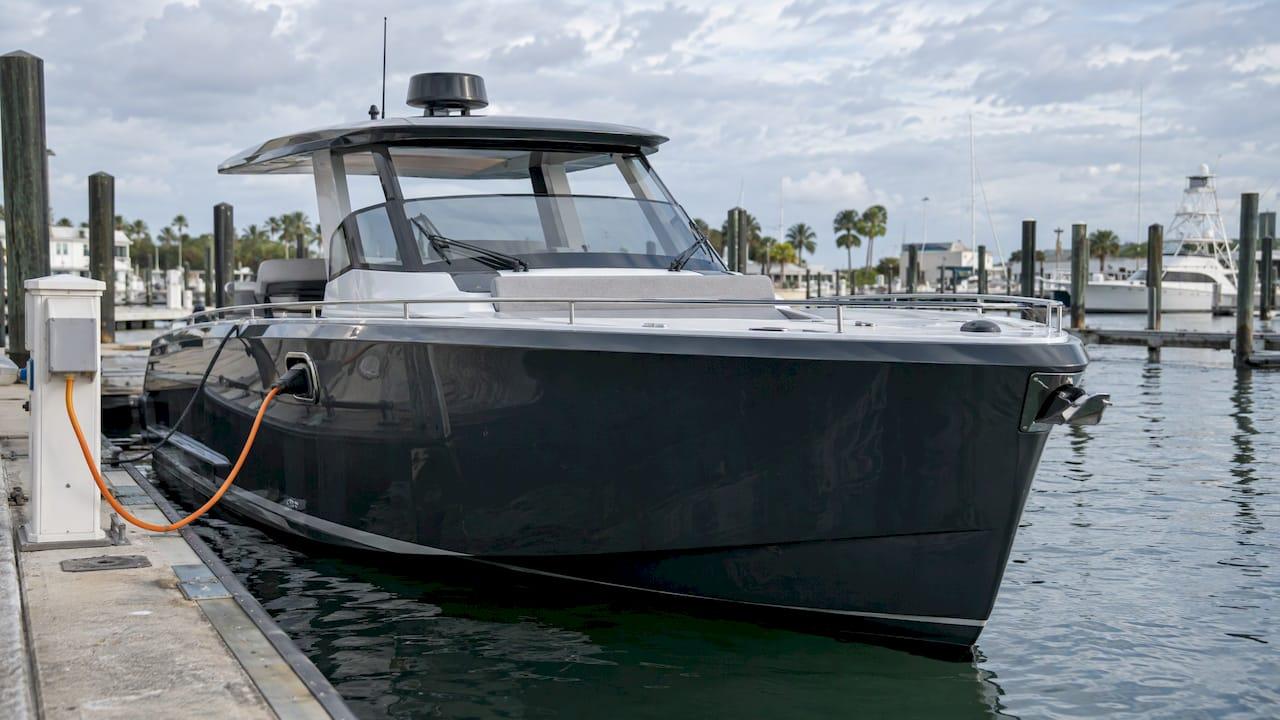
Electric yacht charter is real, but it is a small corner of the market. Most of it is day boats, tour vessels and crewed charters rather than the bareboat fleets most vacationers rent. If you want a silent, zero-emission trip, plan around three things: range, where you will plug in, and a crewed or day-trip format. Then book through a channel that keeps the fee on top of the charter price low. That last part is where we come in: SAILORIX membership is €100 per year, with service fees of about 1% on bookings, against the 10–20% typical elsewhere.
TL;DR
- Electric charter today is mostly crewed yachts, day boats and tour vessels. A Q1 2026 review found no pure electric yachts for bareboat hire at the three largest charter operators.
- Range depends on speed. One US maker lists up to 100 miles at 4–7 mph but up to 40 miles at 25–30 mph.
- Charging sets the itinerary. Dockside power at a standard marina means a long layover, not a quick top-up.
- Budget for the extras, not just the base rate. Charter experts put the advance provisioning allowance (APA) at roughly 25–35% on top.
- The fee you pay the booking platform is part of the cost. A low-fee membership model protects your budget on any charter.
Table of Contents
- What an electric yacht charter actually is
- Why you rarely see electric yachts in standard charter fleets
- Range, speed and charging: how they shape your trip
- Where to look in the United States
- What an electric charter costs
- How to book an electric yacht charter, step by step
- Perspective
- Book with the fee in mind
- Questions people ask
- Sources
What an electric yacht charter actually is
An electric yacht charter is a boat rental where the main propulsion is battery-electric, often topped up by solar panels. Some boats are fully electric. Others are hybrids: electric motors with a generator or a conventional engine as backup. The listing should tell you which one you are booking.
The vessels fall into a few groups:
- Small electric day boats. One example is a 25-foot, fully electric open-bow boat in the fleet of Baywatch Boat Charters at South Lake Tahoe and two other locations. These are hourly or daily rentals on lakes and sheltered water.
- Electric tour boats. In Key West, Honest Eco's SQUID is a battery-powered vessel that runs daily tours from the Old Town marina, with an upper deck for viewing dolphins and quiet running through the wildlife refuge. It is an excursion, not a multi-day charter.
- Crewed electric or hybrid yachts. Larger catamarans and sailing yachts with electric drive and solar. This is where the multi-day experience lives.
- Conversions. Some builders now offer battery packs, motors and solar panels so that operators can electrify existing yachts.
If you read "electric" in a listing, check which of these you are looking at before you build a vacation around it.
Why you rarely see electric yachts in standard charter fleets
The mainstream bareboat model needs a boat that any competent skipper can run all day and refuel or service at nearly any yard. One 2026 industry review explains that this is exactly why pure electric yachts are absent from the big bareboat fleets. It adds that electric and hybrid options are concentrated in crewed charter, where hybrid catamarans run roughly €18,000–25,000 per week including crew.
The economics follow. A very expensive electric yacht would have to charge far more per week than a conventional catamaran to pay for itself, and demand at that price is thin. The practical result for you: the electric yachts you can book tend to come with a captain, a fixed itinerary or both.
That is not a bad thing. A crew who knows the boat's battery, the nearest charging point and the weather will plan the days properly. It also means your decision is less "which boat" and more "which trip".

Range, speed and charging: how they shape your trip
This is the part that surprises first-time electric charterers. Range is not one number. It falls sharply as speed rises.
Speed is the range dial
Voltari, a US electric boat maker, states that its all-electric models deliver up to 100 miles at 4–7 mph and up to 40 miles at 25–30 mph. It also notes that the average North American day of boating is about 8 miles. So for a relaxed cruise to a sandbar, a lunch stop and back, range is rarely the limit. For a fast run between distant harbors, it is.
Larger yachts follow the same logic. A 2026 review reports that pure electric range tops out at 20–40 nautical miles per charge, with solar adding 5–15 nautical miles a day. It describes one 60-foot solar-electric yacht that can hold 6–7 knots on solar alone in ideal Mediterranean summer conditions, with range falling to roughly 100 nautical miles at 8 knots without solar.
What that means for a charter:
- Slow cruising, short hops and anchoring early suit electric well.
- Overcast weather or a headwind cuts solar gain, so build in a spare day.
- Ask how many hours of running per day the itinerary assumes.
Charging is the itinerary
Charging infrastructure is the second constraint. The same review says that, as of early 2026, fewer than 40 marinas across Greece, Croatia, Turkey and Italy offer dedicated high-power shore charging at 50 kW or above. On ordinary 16A/230V marina power, a 100 kWh battery takes about 27 hours to fill. That is a layover, not a pit stop.
In the US, Voltari says its boats charge from 220V hookups found on most docks, and that its mobile charger works with an existing 50-amp marine connection. For day-boat rentals on a lake or coastal marina, that is simple. For a week-long cruise, the charging plan has to be written into the route.
A practical rule: choose a plan where you sleep at a dock with power, run during the day at cruising speed, and finish each leg with battery to spare.
Where to look in the United States
The US market is strongest in sheltered, short-range settings:
- Lakes and inland water. Lake Tahoe has a fully electric rental boat from Baywatch Boat Charters. Its operator cites roughly $3,000 a year in maintenance savings and cheaper charging than gas.
- Florida and the Keys. Quiet, wildlife-oriented tours such as the Key West battery-powered boat, which is Coast Guard-inspected.
- Intracoastal routes. Slow-speed intracoastal running is where electric range is at its most generous.
One point from that Tahoe coverage is worth knowing as a guest: the operator notes that only the manufacturer can service the boats. That is a reason to book with an operator who has its own support in place, and to keep your plans flexible in case a boat is out of service. One local official put it in context by comparing today's electric boats to electric cars 10–12 years ago: the technology is developing quickly, and availability is growing with it.
For bigger yachts, much of the electric and hybrid charter inventory is in Europe, notably the Mediterranean. If your dream is a week on an electric catamaran in Croatia or Greece, treat it as a crewed charter and plan for limited availability, especially in peak summer.
What an electric charter costs
Small electric day boats price like any day rental: by the hour or day, and the cost is modest next to a yacht. Multi-day crewed charters are the expensive end. As noted above, hybrid catamarans with crew run roughly €18,000–25,000 per week according to a March 2026 review. Larger, custom electric yachts cost far more.
Whatever the propulsion, the base rate is not the whole bill. On crewed charters you usually pay the APA, an advance sum the captain holds against fuel, food, dockage and other running costs. It is commonly 25–35% of the charter fee. On an electric yacht, the fuel line shrinks, but dockage, shore power, provisions and the crew gratuity do not. For the full list of extras, see our guide to yacht charter hidden costs and the overview of what yacht charters cost in 2026.

A worked example
Say you find a crewed hybrid catamaran at €20,000 for the week. Using the 25–35% APA range as a planning figure, set aside another €5,000 to €7,000 for the allowance, then add gratuity and any add-ons. Your real budget is closer to €27,000 or more than to €20,000. Now add the booking fee. At a typical 10–20% platform fee, that adds €2,000 to €4,000 on the base price alone. At about 1%, it is about €200. On a charter this size, the fee gap alone can pay for the extras.
How to book an electric yacht charter, step by step
- Decide the format. Day trip, weekend or full week? Electric suits shorter, slower, closer-to-port plans. For longer trips, expect crewed charter. If you are still weighing hull types, our comparison of sailing vs motor yacht charters helps.
- Set a daily distance. Work out how many miles you want to cover per day and at what speed. Compare that with the boat's stated range at that speed, not at its best figure.
- Plan the charging. Ask where the boat charges each night, what hookup it needs and how long a full charge takes. Your route should end each day at a port with power.
- Check the weather window. Solar gain and headwinds change your margin. Leave a buffer day.
- Confirm what is included. Crew, dockage, shore power, provisioning, water toys and insurance. Our platform lets you add a skipper, early check-in, equipment and insurance options to a booking, so you can see the total before you commit.
- Compare the all-in total. Base rate, APA, gratuity and the booking fee together.
- Read the cancellation terms. Because electric inventory is limited, the boat you want may not have a substitute. Know what happens if the boat is out of service.
At step 5 and 6, a platform with real-time availability and a clear fee structure saves you the back-and-forth. We built our search around destination and boat type with live availability, so you see what is open before you plan around it.
Perspective
Electric charter is exciting, and it is also a reminder of how a vacation budget really works. The boat is one line. The fees, the extras and the booking commission are the others, and the last one is the easiest to shrink.
We built SAILORIX around that idea. For €100 a year, members book with service fees of about 1%, where the typical figure elsewhere is 10–20%. On a quiet, crewed week aboard a premium yacht, that difference is real money you can spend on the trip instead.
Our search is by destination and boat type, with real-time availability and add-ons such as a skipper, early check-in and equipment. Our categories include power catamarans, motor yachts, luxury motor yachts and sailing yachts. Whichever type you choose, we stand behind a best price guarantee and give members premium support.
The best electric charter is the one planned around its range and its charging. The best booking is the one where you know the total before you commit.
SAILORIX
Book with the fee in mind
If you are ready to compare boats and fees, the SAILORIX membership costs €100 per year. It unlocks bookings with service fees of about 1%, access to a global inventory and real-time availability by destination and boat type. You can add a skipper, equipment, early check-in or insurance to your booking.

For premium options, our Luxury Motor Yacht Stardom and Viga Luxury 900 are examples of what members can book, and our programs are there for those who want more from membership.
Questions people ask
Can I charter an electric yacht without a captain?
Rarely. A 2026 review found no pure electric yachts available for bareboat hire at the three largest charter operators, with electric and hybrid options concentrated in crewed charter. Small electric day boats on lakes and coastal marinas are the common exception.
How far can an electric charter boat go in a day?
It depends on speed. One US maker lists up to 100 miles at 4–7 mph and up to 40 miles at 25–30 mph. Most leisure days on the water are short, around 8 miles on average, so a well-planned day stays comfortably inside range.
How long does it take to charge?
On standard marina power, a 100 kWh battery takes about 27 hours, according to a 2026 industry review. Higher-power chargers are far faster but scarce. Plan to charge overnight at a dock with power.
Is an electric yacht charter more expensive?
Often, for larger yachts, because the technology is costlier to build. Crewed hybrid catamarans run roughly €18,000–25,000 per week including crew. Compare the all-in total, including the APA and the booking fee, rather than the base rate alone.
Sources
- Electric & Hybrid Yachts Reviewed, Boat Tomorrow
- Discover Voltari Marine Electric Range, Power & Speed
- Voltari Electric Performance Boats
- Electric boat and flying car highlight Lake Tahoe forum, Sacramento Bee
- Sail Around Key West on This Battery-Powered Boat, InsideHook