
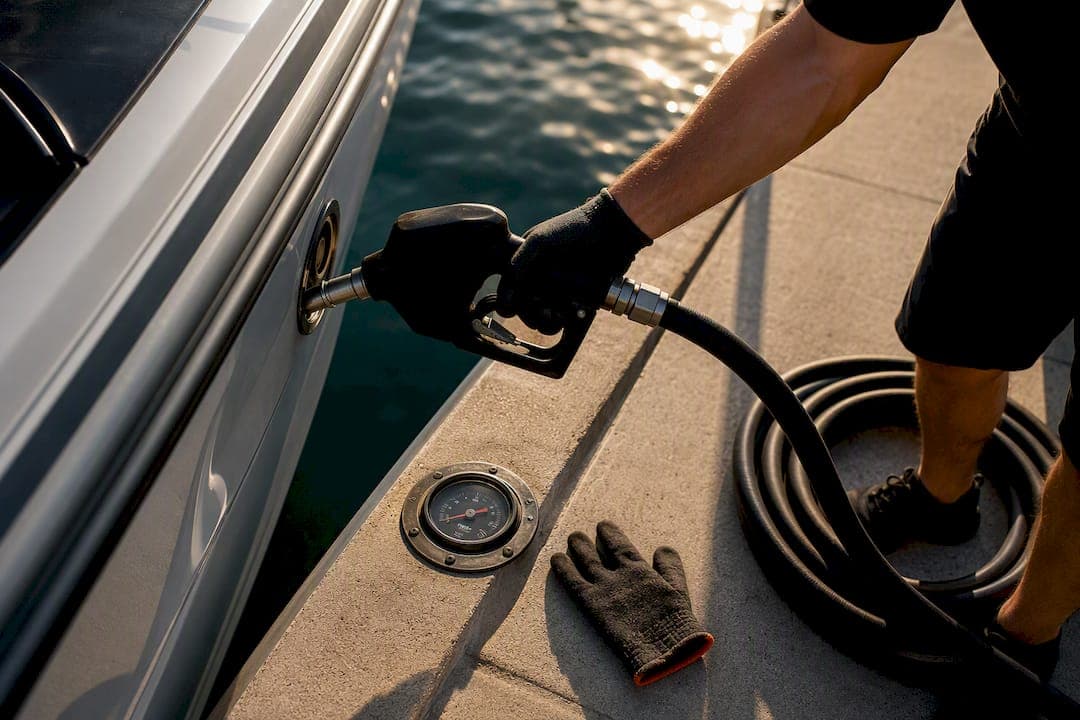
Fuel on a crewed charter is either folded into your weekly rate or billed through an Advance Provisioning Allowance, and which one applies changes your budget by thousands of dollars. All-inclusive contracts cover normal cruising fuel in the price you already paid. Plus-expenses contracts collect an APA worth roughly 25 to 35% of the charter fee, and fuel is usually the biggest single line inside it. Motor yachts burn significantly more fuel than sailing boats, and your itinerary influences the fuel costs further.
TL;DR:
- Motor yachts tend to have higher APA percentages, around 35%, because their engines run constantly and fuel costs dominate the account.
- Sailing catamarans usually have APA rates near 30%, since wind propulsion reduces the reliance on engine fuel, lowering overall costs.
- Longer trips, older vessels, or those with extensive water toy fleets can push fuel-related expenses above standard APA percentages, sometimes up to 40%.
- Fuel costs are mainly influenced by vessel type, cruising speed, and auxiliary power use, with motor yachts burning significantly more fuel than sailing boats.
- Clarifying contract terms, including APA percentage, inclusivity, and reconciliation procedures, helps prevent unexpected fuel-related charges on settlement day.
Table of Contents
- Fuel Costs Charter: All-Inclusive vs. APA Explained
- What Actually Drives Fuel Costs on a Charter
- How Much Should You Budget? APA Percentages by Vessel Type
- How Fuel Charges Get Billed, Tracked, and Refunded
- A Simple Way to Estimate Your Own Fuel Budget
- How to Keep Charter Fuel Charges Under Control
- The Sailorix Take on Fuel Transparency
- Book With Fewer Fuel Surprises
- Where This Information Comes From
- Sources
- FAQ
Fuel Costs Charter: All-Inclusive vs. APA Explained
Two contract structures dominate the charter market, and they handle fuel in opposite ways.
An all-inclusive rate (sometimes called CTI) is a flat weekly price that covers fuel for standard cruising, plus crew, meals, and house wine or beer. You know your total cost before you board. The catch: burn beyond a "normal" cruising allowance, or premium extras like top-shelf liquor, can still get billed on top.
A plus-expenses charter separates the base fee from running costs. You pay an APA, a pre-funded account the captain draws from for fuel, provisioning, dockage, and similar expenses. It does not cover crew gratuity or charter taxes, which are handled separately. The APA is typically collected before boarding and reconciled once the trip ends.
Before signing anything, check these contract details:
- Whether the listing says "all-inclusive," "CTI," or "plus-expenses" (some brokers bury this in fine print)
- The exact APA percentage and whether it's calculated on the base fee or the total charter cost
- What counts as a fuel receipt versus an estimate in the settlement clause
What Actually Drives Fuel Costs on a Charter
Four variables decide whether your fuel bill is modest or massive, and vessel type tops the list. Motor yachts push heavy hulls through the water using engine power alone, while sailing yachts and catamarans rely on wind for most of their movement and only run engines for maneuvering or calm patches. That difference alone can separate a $200 fuel day from a $5,000 one.
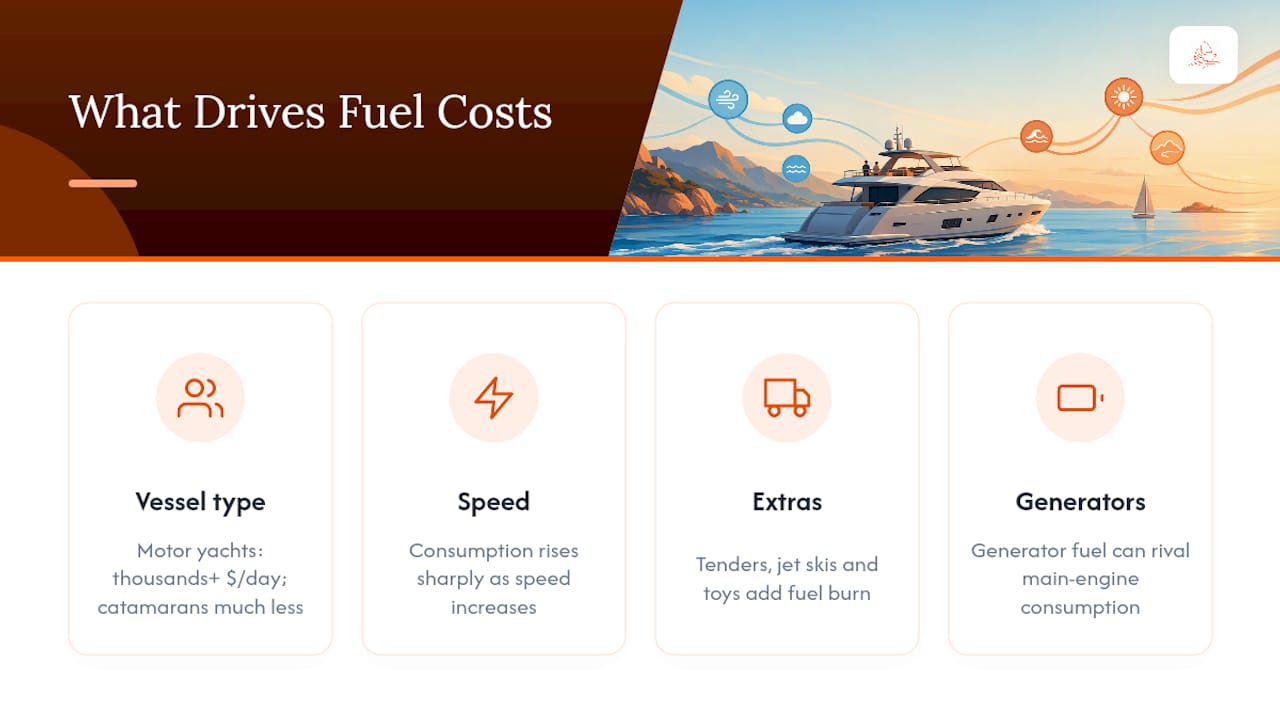
Speed matters almost as much as vessel type. Cruising at 10 knots instead of 20 can cut hourly burn dramatically, since fuel consumption rises sharply, not proportionally, as a hull pushes through water faster. A captain who plans long, high-speed transits between islands will torch far more fuel than one who plans shorter hops and lets guests enjoy slower passages.
Then there are the secondary consumers: tenders running back and forth to shore, jet skis and other water toys, and generators keeping air conditioning and stereo systems running at anchor. On a hot week with the AC running around the clock, generator fuel can rival main-engine consumption.
Fuel burn by vessel type: Large motor yachts can burn thousands to tens of thousands of dollars in fuel per active cruising day, depending on size and speed. Sailing catamarans covering the same itinerary at a relaxed pace often spend a small fraction of that, since wind does most of the work and engines only fill in the gaps.
How Much Should You Budget? APA Percentages by Vessel Type
APA norms follow a fairly consistent pattern across the industry, and once you know the percentage, translating a base charter fee into a fuel and expenses budget takes seconds.
| Vessel type | Typical APA (% of charter fee) | Why |
|---|---|---|
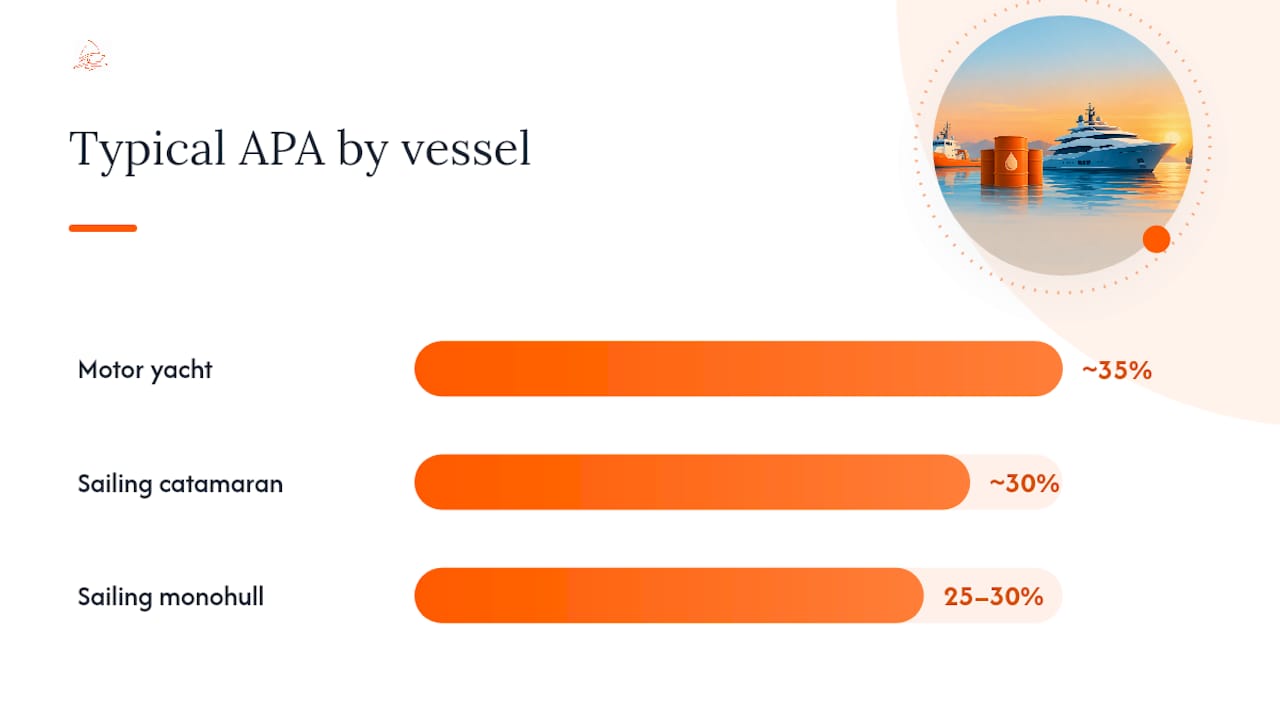
| Motor yacht | ~35% | Engines run constantly; fuel dominates the account |
| Sailing catamaran | ~30% | Wind covers most propulsion; APA leans toward provisioning |
| Sailing monohull | 25–30% | Similar to catamarans, slightly lower guest counts |
Motor yachts commonly state 35%, and sailing catamarans commonly state around 30%, which lines up with how much of each account actually goes toward fuel versus food and dockage.
Longer itineraries push these numbers higher, as do older or higher-consumption hulls and boats carrying large tender fleets or multiple water toys. A two-week Mediterranean run on an older 40-meter motor yacht might see the broker request 40% rather than the standard 35.
All-inclusive listings flip this entirely. Roughly 97.8% of current all-inclusive rate listings carry zero mandatory APA for standard cruising, since fuel is already baked into the price you paid.
How Fuel Charges Get Billed, Tracked, and Refunded
The APA cycle follows a predictable sequence, and knowing it in advance saves you from awkward settlement-day surprises.
- Collection. The broker or owner's agent typically requests the APA a few weeks before embarkation, often as a wire transfer separate from the base charter fee.
- Tracking. The captain keeps a running expense log throughout the week, covering every fuel purchase, provisioning run, and marina fee, backed by receipts for each transaction.
- Settlement. At disembarkation, the captain presents the full account. Unspent funds get refunded, usually by bank transfer.
- Overage billing. If costs exceeded the APA, you're invoiced for the difference, ideally with itemized receipts attached.
Ask your broker three questions before you pay a deposit: Can you see itemized fuel receipts, not just a total? Is the refund issued by bank transfer rather than cash on the dock? And is there a cap or notification requirement before the captain authorizes spending beyond the original APA? Industry guidance consistently recommends locking these answers in writing before you board.
A Simple Way to Estimate Your Own Fuel Budget
You don't need a marine engineer to build a workable fuel estimate. Three steps get you close enough to budget with confidence.
- Get the burn rate. Ask the captain or broker for gallons per hour at cruising speed. Motor yachts might run 40 to 100+ gallons per hour; sailing catamarans under engine power often sit closer to 5 to 10.
- Estimate cruising hours. Separate active transit time from hours spent anchored. A week with three long transit days and four relaxed anchor days burns far less than one with daily long-distance hops.
- Multiply and add a buffer. Burn rate × hours × local fuel price gives your core number. Add 20 to 30% for tender fuel, generator use, and provisioning if APA isn't already covering it.
Worked example: A motor yacht burning 60 gallons per hour, cruising 25 hours across the week, at $6 per gallon, comes to $9,000 in main-engine fuel alone.
Pro Tip: Ask for the vessel's burn rate at both cruising and maximum speed. Brokers sometimes quote the lower figure, and the gap between the two can double your estimate on a fast-paced itinerary.
How to Keep Charter Fuel Charges Under Control
Fuel spend is one of the few charter costs you can actually influence once you're aboard.
- Build an anchor-heavy route with shorter transits instead of long point-to-point runs between distant harbors.
- Agree on a target cruising speed with the captain before departure; even a modest reduction cuts hourly burn.
- Limit tender and water-toy use to what you'll genuinely enjoy, and ask the captain to track tender fuel separately from main-engine costs.
- Use shore power when docked instead of running generators overnight for air conditioning.
- Request an APA cap or a clause requiring your authorization before the captain spends beyond a set threshold.
Hull condition affects fuel efficiency too. A boat with heavy marine growth on the hull drags harder through the water, which raises fuel consumption noticeably regardless of how carefully you plan the route, so it's worth asking when the vessel was last cleaned.
The Sailorix Take on Fuel Transparency
Fuel confusion on charters almost always traces back to one thing: contract terms nobody read closely before the deposit went out. The percentage isn't the problem. A 35% APA on a motor yacht is completely reasonable given real fuel burn. The problem is booking without knowing which model applies until the invoice lands.
Sailorix charges roughly 1% in service fees for members, against the 10 to 20% common elsewhere, which means more of your budget goes toward the actual charter and its running costs rather than platform markup. Before paying anything, members can review listing terms directly and request itemized contract language covering APA percentage, fuel allowance, and reconciliation practice. Our breakdown of charter pricing and guide to hidden costs go deeper on what tends to surprise first-time charterers.
— SAILORIX
Book With Fewer Fuel Surprises
Most charter fuel disputes happen because the terms weren't clear before booking, not because the fuel itself cost more than expected. Sailorix membership gives you a direct line to listing terms, contract structure, and pricing before you commit a deposit, instead of discovering the APA percentage buried in a broker's follow-up email.

Membership runs €100 per year and unlocks roughly 1% service fees on bookings across the Sailorix platform, well below the 10 to 20% charged elsewhere. That difference alone can offset a meaningful share of your fuel budget on a week-long charter. Members can also compare tiers on the program pages if a managed booking experience with clearer contract visibility fits how they charter. Check current listings and their stated fuel terms on Sailorix before your next booking, and read the contract line for "all-inclusive" or "plus-expenses" before you pay a deposit.
Where This Information Comes From
Contract norms and APA percentages here draw from MYBA and CYBA-aligned industry guides covering current charter rate listings, along with detailed breakdowns of what APA actually covers and how contract terms differ between all-inclusive and plus-expenses agreements. Sailorix's own posts on charter fees and APA budgeting cover the same ground with member-specific guidance.
Sources
- Yacht Charter Costs Explained: Rates, APA & Add-Ons (2026)
- APA Explained: What the 30% Charter Surcharge Really Covers
- Yacht Charter Contracts: Key Terms Explained
FAQ
Is Fuel Included in a Yacht Charter Price?
It depends on the contract type. All-inclusive rates usually bundle fuel for normal cruising into the price, while plus-expenses charters bill fuel through the APA instead.
How Much APA Should I Budget for Fuel?
Plus-expenses charters commonly request 30 to 35% of the base charter fee as APA, with motor yachts at the higher end and sailing catamarans closer to 30%. Fuel is usually the largest component of that account.
What Happens to Unused APA Funds?
The captain presents an itemized expense log at the end of the charter, and any unspent APA is refunded, typically by bank transfer. If expenses exceeded the APA, you're billed for the difference.
Do Day Charters Use an APA for Fuel?
Usually not. Day charters typically bundle fuel into the day rate, since APA is mainly a mechanism for week-long crewed charters with more variable running costs.
Does Sailorix Membership Affect Fuel Costs?
Membership doesn't change how much fuel a boat burns, but its lower service fees mean more of your total budget goes toward the actual charter and its running costs. Membership costs €100 per year with roughly 1% service fees on bookings.