
Martinique, the British Virgin Islands, Grenada, St. Martin, and Antigua top the list of the safest Caribbean islands to live aboard, based on marina density, haul-out access, protected anchorages, and how fast you can reach a hospital or a mechanic when something goes wrong. Each earns its spot for different reasons, and each comes with a catch worth knowing before you commit your home to it. Le Marin in Martinique has one of the region's thickest concentrations of marinas and shore services, which matters more for liveaboard safety than crime statistics ever will. The BVI offers a mooring-buoy system that takes the guesswork out of anchoring. Grenada sits below the main hurricane belt and hosts a large, organized cruiser community that watches out for its own. Sailorix tracks availability across all of these bases, and NOAA's National Hurricane Center remains the non-negotiable reference for timing any of these moves.
What actually makes an island "safe" for someone living aboard has almost nothing to do with tourist crime rankings. It comes down to whether a marina can haul your boat before a storm, whether the anchorage holds in a squall, and whether a cruiser net will notice if you go quiet on the radio.
- Infrastructure and cruiser community: active yacht services and a resident fleet mean faster help and better local intelligence.
- Marinas and haul-out: can you get lifted out before hurricane season closes in?
- Anchorages and hurricane holes: protected water with real holding, not just a pretty bay.
- Seasonal exposure: hurricane season and winter swell shift the safety math by month.
- Maritime theft risk: mostly dinghy and outboard theft, not violent crime.
- Provisioning and medical access: hospitals, pharmacies, and grocery stores within a reasonable dinghy or taxi ride.
Pro Tip: Before you pick a base, pull up the current NHC forecast cone and call the local capitainerie or marina office directly. A five-minute phone call about mooring rules and haul-out slots tells you more than any online cruiser review.
Key Takeaways
The safest Caribbean islands for liveaboards combine dense marina and haul-out infrastructure, protected anchorages with real holding, active cruiser networks, and fast access to hospitals or medevac.
| Point | Details |
|---|---|
| Top shortlist | Martinique, the BVI, Grenada, St. Martin, and Antigua lead on marina access, moorings, and medical infrastructure. |
| Season shapes safety | Hurricane season runs June through November while winter swell peaks in December and January, and both change which anchorage is actually safe. |
| Theft is low-level, not violent | Dinghy and outboard theft is the main maritime crime risk; locking gear at every stop is the standard defense. |
| Anchorage checks matter | Verify holding, fetch, bottom type, and swing room with current charts before dropping anchor, not after. |
| Test before relocating | Sailorix lets boaters book short-term charters or local skippers to scout marinas and anchorages before committing to a permanent base. |
Table of Contents
- Which Islands Have the Best Marinas and Haul-Out Services?
- What Makes an Anchorage or Hurricane Hole Safe?
- When Is Hurricane Season the Biggest Risk?
- How Common Is Maritime Crime in the Caribbean?
- How Do You Judge an Anchorage Before Dropping Anchor?
- Where Can You Get Emergency Help or a Medevac?
- How Should Liveaboards Prepare a Hurricane Plan?
- How Strong Are the Cruiser Communities Across These Islands?
- What Residency and Permit Rules Apply to Liveaboards?
- What Does It Cost to Live Aboard in the Caribbean?
- Are Hospitals and Clinics Accessible From the Water?
- How Reliable Is Internet and Phone Coverage at Anchor?
- What a Boater Actually Learns From Living This Life
- Test a Base Before You Commit Your Boat to It
- Frequently Asked Questions
- Sources
Which Islands Have the Best Marinas and Haul-Out Services?
Le Marin, on Martinique's southern coast, is the closest thing the eastern Caribbean has to a one-stop yacht service hub. It has multiple marinas, several travel lifts, riggers, sailmakers, and provisioning within walking distance, and the surrounding bay stays calm even when trade winds pick up outside. Boaters plan long-term haul-outs here specifically because the trades run reliably from late November through June, giving a wide window for scheduled work.
The BVI runs a different model. Marinas at Nanny Cay, Village Cay, and Soper's Hole handle routine repairs well, but heavy haul-out capacity is thinner than Martinique's, so booking ahead during peak season matters more.
Grenada's Prickly Bay and Port Louis area combine haul-out yards with a dense expat and cruiser population, which keeps mechanics, riggers, and parts suppliers in steady business. Antigua's English Harbour and Falmouth Harbour area supports a full refit industry built around superyacht traffic, meaning even smaller cruising boats benefit from spillover access to skilled labor and parts inventory.
St. Martin, split between French and Dutch sides, offers Bobby's Marina and Simpson Bay facilities, though hurricane damage has periodically knocked out capacity there, so confirming current operational status before committing is worth the phone call. A marina's true capability shows up in whether it can actually schedule your haul-out, not just whether it lists the service online.
What Makes an Anchorage or Hurricane Hole Safe?
Good holding ground and real wind protection separate a working hurricane hole from a bay that only looks sheltered on a chart. Mangrove creeks like those in Grenada's south coast and parts of Trinidad have historically served as storm refuges, but recent hurricane seasons have shown that some traditional mangrove holes no longer hold up, particularly when storms track through with unusual intensity or angle.
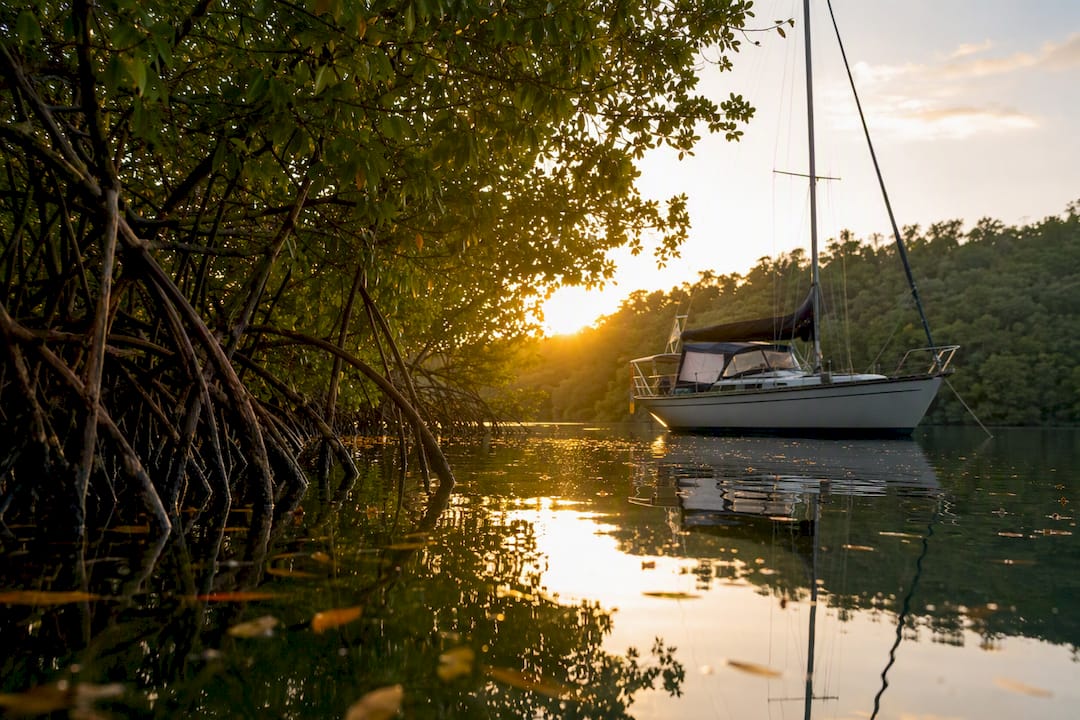
Cruisers with experience riding out storms increasingly favor short-fetch leeward anchorages with a sandy bottom over the classic mangrove hole, since swells and breaking seas cause more damage in a blow than wind alone. A hurricane hole needs land or reef breaking the fetch from every likely storm direction, not just the prevailing one.
Moorings change the calculation. The BVI's extensive National Parks Trust mooring field removes anchor-holding uncertainty entirely in many popular bays, though it also means fewer anchoring options during peak season when moorings fill up fast.
Rodney Bay in St. Lucia, Marigot Bay, and Prickly Bay in Grenada all function as reliable working anchorages most of the year, but "reliable" still means checking depth, swing room, and bottom composition every time you drop the hook. No anchorage stays universally safe across every month and every storm track.
When Is Hurricane Season the Biggest Risk?
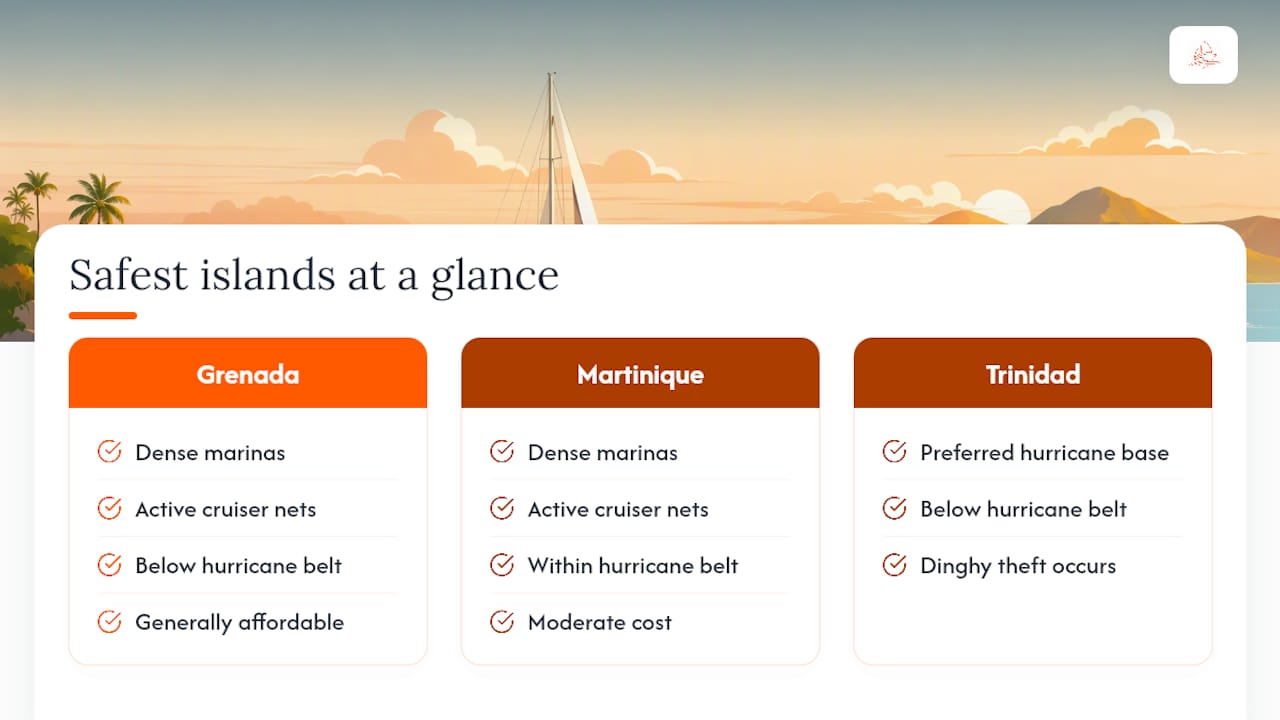
Hurricane season runs June through November, with the sharpest risk window from mid-August through early October, and that single fact should drive where you base your boat more than any other variable on this list. Grenada, Trinidad, and the southern Grenadines sit below the historical hurricane belt, which is exactly why Grenada has become the default hurricane-season base for so much of the cruising fleet.
Winter brings a different hazard. North swells running through December and January can turn a calm, protected, north-facing bay into an untenable anchorage overnight, even on islands with no hurricane exposure at all. A mooring field that feels bombproof in July can be miserable and even dangerous in January if it faces the wrong direction.
Timing your season around these two separate risk patterns, storm season in the south and swell season everywhere, matters more than picking a single "safest" island and staying put year round. Plenty of experienced liveaboards migrate seasonally between a summer base in Grenada or Trinidad and a winter base further north, treating the calendar as part of their safety plan, rather than as an afterthought.
How Common Is Maritime Crime in the Caribbean?
Violent crime against liveaboards is genuinely rare across the islands on this list, but dinghy and outboard theft is common enough that experienced cruisers treat it as a near-certainty rather than a risk. Locking the dinghy and outboard at every stop is the single most repeated piece of advice in Caribbean cruiser forums and guides, and it applies even in islands widely considered low-risk.
Grenada, despite its reputation as a safe, cruiser-friendly base, has documented patterns of opportunistic dinghy theft in certain anchorages, which is exactly why local cruiser nets share real-time alerts about specific bays to avoid at night. The lesson isn't that Grenada is unsafe. It's that even the safest bases need basic precautions treated as routine, not optional.
Minimizing visible valuables ashore, using a cable lock rated for marine use, and avoiding isolated anchorages after dark cuts most of the remaining risk. Islands with active marina communities tend to see less theft simply because more eyes are on the water and more staff are around at night. That's part of why infrastructure and community matter as much as any crime statistic when judging a truly safe base.
How Do You Judge an Anchorage Before Dropping Anchor?
Holding, fetch, bottom type, and swinging room are the four things to check before you commit an anchor to any bay, and skipping any one of them is how most drag incidents happen. Nautical charts from NOAA or Imray show bottom composition and depth, but current cruising guides and local knowledge fill in what's changed since the chart was surveyed.
Fetch, the open distance wind can build waves across before reaching you, determines whether a bay stays flat or turns rough in a squall. A half-mile of fetch from the wrong direction can put a boat through an uncomfortable, gear-straining night even in otherwise protected water.
Bottom type dictates anchor choice. Sand holds a plow or spade anchor well; turtle grass and rubble often don't, which is why experienced cruisers carry more than one anchor type rather than trusting a single design to handle every seabed in the islands.
Practical steps before settling in for the night:
- Check the chart and a current cruising guide for the specific bay, not just the general area.
- Arrive early afternoon while the sun is high enough to read the water and spot coral heads.
- Pay out adequate scope, roughly 5:1 in calm conditions and 7:1 or more if weather is building.
- Dive on the anchor in clear water to confirm it's actually set, not just resting on the surface.
- Leave enough swing room for wind and tide shifts, factoring in every other boat already anchored nearby.
Getting this sequence right, using the same step-by-step anchoring approach every time, removes most of the guesswork that leads to 2 a.m. dragging alarms.
Where Can You Get Emergency Help or a Medevac?
Martinique and Guadeloupe run French territorial healthcare systems with hospitals capable of handling serious trauma, and both islands have functioning medevac coordination through French coast guard and medical services. That single fact pushes both islands higher on any safety list for liveaboards who worry about a medical emergency at sea.
The BVI relies on Tortola's Peebles Hospital for initial care, with serious cases typically evacuated to Puerto Rico or the US Virgin Islands, so response time runs longer than on the French islands but remains workable given the BVI's proximity to US territory. Antigua's Mount St. John's Medical Centre covers most emergencies locally.
Grenada's General Hospital in St. George's handles routine and moderate emergencies, though the most serious trauma cases still get referred off-island, a reality worth knowing given Grenada's popularity as a hurricane-season base. VHF channel 16 remains the first call in any on-water emergency across every island in the region, and knowing your exact position and the fastest route to shore before you need it, not after, is what actually shortens response time when minutes matter.
How Should Liveaboards Prepare a Hurricane Plan?
A hurricane plan built in June is worth infinitely more than one improvised in August, and the plan needs three parts locked in before the season starts: a haul-out or safe-mooring arrangement, a mangrove or hurricane-hole option as backup, and a clear personal evacuation trigger point.
Book a haul-out slot early. Yards in Grenada, Trinidad, and Martinique fill up months ahead of peak season, and showing up in July looking for a last-minute lift-out during an active storm watch is a losing position. If staying afloat, short-fetch leeward anchorages with sandy bottom now outperform many traditional mangrove holes, according to cruisers who've ridden out recent storms in both.
Rig for a blow before the forecast forces your hand: extra chafe gear on every rode, a second anchor deployed at a wide angle, hatches and windows secured, and the dinghy either stowed on deck or hauled well clear of the water. Set a personal wind-speed or forecast-cone trigger for leaving the boat entirely, and stick to it regardless of how the boat looks that morning. Monitor the NHC forecast daily starting in June, not just when a named storm appears.
How Strong Are the Cruiser Communities Across These Islands?
Grenada runs one of the most organized cruiser communities in the region, with daily VHF nets covering weather, security alerts, and local services that function as an informal early-warning system no government agency provides. Martinique's Le Marin has a similarly dense expat and cruiser population built around the marina itself, where information travels fast simply because everyone shares docks and chandleries.
The BVI's cruiser scene skews more transient, dominated by charter guests rather than long-term liveaboards, so the deep local knowledge networks found in Grenada or Martinique take longer to access there. Antigua's English Harbour, built around its superyacht and classic-boat culture, has a smaller but highly experienced resident sailing community, useful if you need specific technical knowledge rather than general local intelligence.
These networks matter for safety in ways that don't show up in any brochure. A cruiser net that flags a dinghy theft pattern in a specific bay, or shares which mechanic actually shows up when he says he will, functions as real-time risk intelligence that no chart or guidebook provides. Community reports and local infrastructure consistently outperform generic crime statistics as a safety signal, precisely because they reflect what's happening on the water this month, not last year's data.
What Residency and Permit Rules Apply to Liveaboards?
Martinique and Guadeloupe, as French territories, fall under EU-adjacent rules for non-EU visitors: most cruisers enter on a standard tourist stay and need to track their cumulative time carefully if they plan to stay long term, since French territorial rules don't grant indefinite liveaboard status automatically. Formalities run through customs and immigration at designated ports of entry, typically handled quickly at Le Marin or Fort-de-France.
The BVI requires a cruising permit for any vessel staying beyond a short visit, renewed periodically and tied to the boat's length, and long-term liveaboards need to clear immigration status separately from the boat's own paperwork. Grenada issues cruising permits through customs on arrival, generally valid for a set period and renewable, with the process handled at official ports of entry like St. George's.
None of these islands offer a straightforward "liveaboard visa" separate from standard immigration categories, which means most long-term cruisers rely on periodic renewals, occasional trips off-island to reset visitor status, or formal residency applications if they intend to stay indefinitely. Rules shift periodically, so confirming current requirements directly with the relevant customs office before arrival beats relying on secondhand cruiser forum advice, however well-intentioned.
What Does It Cost to Live Aboard in the Caribbean?
Monthly costs for a liveaboard swing widely based on how much time you spend on a mooring or in a marina versus at anchor, and anchoring remains essentially free across most of these islands outside marine parks that charge mooring fees. Marina berths in Le Marin, English Harbour, or the BVI's Nanny Cay carry the highest recurring cost, since you're paying for dockage, shore power, and water on top of provisioning.
Grenada and Martinique tend to run cheaper for groceries and eating out than the BVI or St. Martin, largely because the BVI's economy leans heavily on charter tourism pricing. Fuel, parts, and skilled labor cost more on smaller or more remote islands simply due to import logistics, which is part of why Martinique's larger, France-connected supply chain keeps parts prices more reasonable than islands relying entirely on inter-island shipping.
Budgeting for periodic haul-outs, insurance, and unplanned repairs matters more than the headline monthly cost of groceries or dockage. A realistic cost comparison across candidate islands should weigh haul-out and parts availability alongside daily living expenses, since a cheaper island with poor haul-out access can end up costing more in the long run through delayed repairs and forced trips elsewhere for service.
Are Hospitals and Clinics Accessible From the Water?
Access to real medical care, not just a clinic with a sign out front, separates the islands worth basing on long term from the ones better suited to a short visit. Martinique and Guadeloupe again lead here, with French-standard hospitals in Fort-de-France and Pointe-à-Pitre capable of handling most emergencies without an off-island transfer.
Grenada's General Hospital covers routine needs well, and St. George's has pharmacies and general practitioners accessible by dinghy or short taxi ride from most anchorages in the southern bays. Antigua's Mount St. John's Medical Centre similarly covers day-to-day needs, backed by English Harbour's proximity to English-speaking medical staff, useful for cruisers less comfortable navigating a French-language hospital system.
The BVI leans on Tortola for initial treatment but refers more serious cases onward, which liveaboards with chronic health conditions should factor into their base choice rather than discovering it during an actual emergency. Distance from a capable hospital, not just the presence of a clinic, is the number that should drive this part of the decision.
How Reliable Is Internet and Phone Coverage at Anchor?
Cell coverage reaches most popular anchorages across Martinique, Guadeloupe, the BVI, Grenada, and Antigua, with 4G service generally solid near populated bays and weaker or absent in more remote anchorages further from town. Local SIM cards from carriers operating on each island remain the most reliable and affordable way to stay connected, cheaper than relying on international roaming for months at a time.
Marinas increasingly offer WiFi, though signal quality at anchor a quarter mile offshore often disappoints compared to what's advertised at the dock. Cellular data hotspots, paired with a local SIM, tend to outperform marina WiFi for liveaboards who need consistent connectivity for work or weather routing.
Satellite communicators or a dedicated weather receiver still matter as backup, particularly for checking storm forecasts when out of cell range during an inter-island passage. Coverage gaps show up most in the Grenadines and more remote anchorages away from main towns, so anyone planning to work remotely from the boat should test actual signal strength at a specific anchorage before assuming coverage will match what the carrier's map suggests.
What a Boater Actually Learns From Living This Life
Infrastructure and an active cruiser community protect you more than any crime statistic ever will, because a strong marina network and a resident fleet mean faster help, better local intelligence, and someone who notices when you go quiet. Le Marin's haul-out yards fill months in advance for exactly this reason. Cruisers who book early get lifted before a storm; those who wait get stuck riding it out afloat. The BVI's mooring system removes a huge chunk of anchoring uncertainty for anyone new to the region, while Grenada's dinghy-theft pattern shows up in the same three or four bays, over and over, information you'd only get from someone who's actually anchored there recently.
Pro Tip: Call the local capitainerie or marina office directly before you arrive. A two-minute conversation about current haul-out schedules and hurricane procedures beats anything you'll find in a five-year-old cruising guide.
Test a Base Before You Commit Your Boat to It
The surest way to know if an island fits your liveaboard plans is to spend real time there first, on the water, before you relocate permanently. Sailorix lets you book a short-term charter or local hire in any candidate island, so you can scout anchorages, check how a marina actually handles a haul-out request, and get a feel for the cruiser community before making it your home base.

Three ways this works in practice: book a short charter to spend a few days anchored in the bays you're considering, reserve a marina berth directly through the platform to see firsthand how haul-out scheduling and dockside service actually run, or hire a local skipper for a day to walk you through the hurricane holes and mooring fields nobody mentions in a guidebook.
Check current availability for Martinique, the BVI, Grenada, and the other islands covered here directly on Sailorix, and always confirm depth and haul-out capability with the marina itself before you show up expecting a slip.
Frequently Asked Questions
What is the safest place to live in the Caribbean for a liveaboard boater? Martinique's Le Marin area and Grenada consistently rank as the safest place to live in the Caribbean for liveaboards, thanks to dense marina infrastructure, active cruiser communities, and lower hurricane exposure in Grenada's case.
Which Caribbean islands are safest during hurricane season specifically? Grenada, Trinidad, and the southern Grenadines sit below the main hurricane belt, making them the preferred hurricane-season base for much of the cruising fleet, though no island is entirely storm-proof.
Are there affordable Caribbean islands to live aboard without sacrificing safety? Grenada and Martinique generally cost less for groceries and repairs than the BVI or St. Martin, while still offering solid marina infrastructure and cruiser support networks.
How do I find safe places to live in the Caribbean if I'm new to the region? Start with islands that have established marinas and active cruiser nets, like Grenada or Martinique, and spend time anchored there before committing, ideally through a short-term charter or local skipper hire.
Is petty theft a serious concern on the safest Caribbean islands for liveaboards? Dinghy and outboard theft happens even on the safer islands, so locking your dinghy and minimizing visible valuables ashore remains standard practice regardless of which island you choose.