
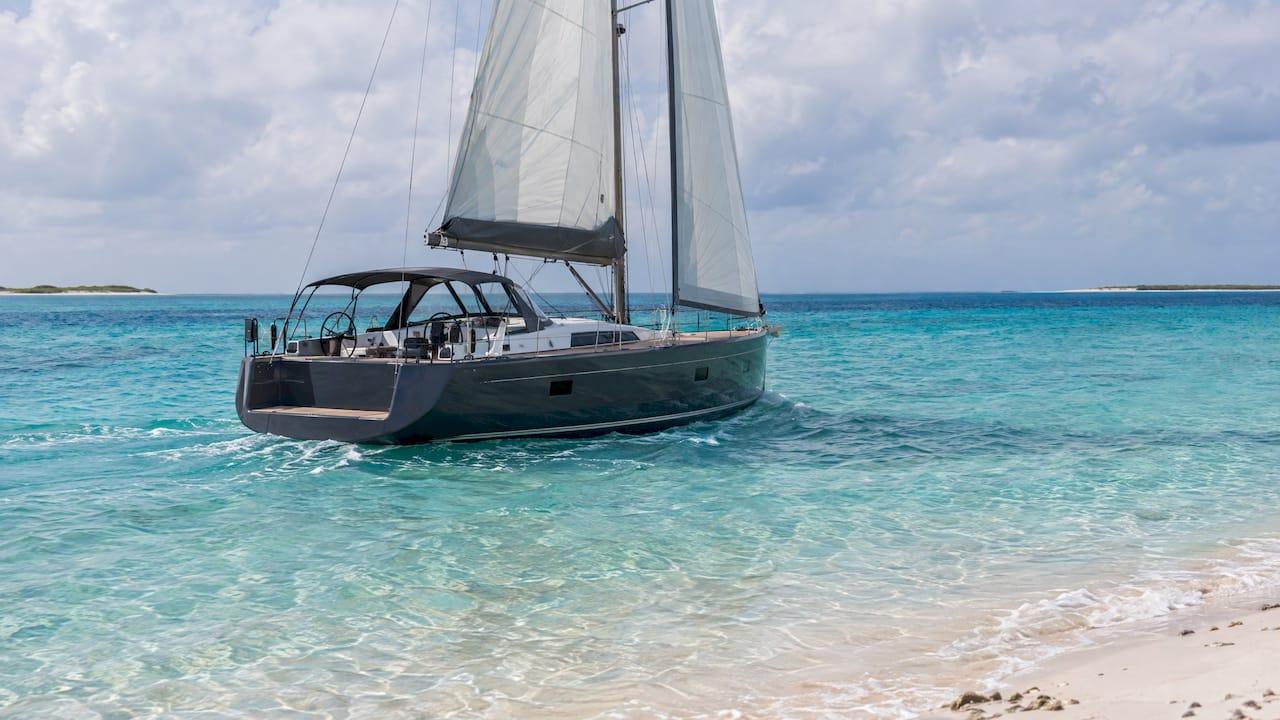
For a Bahamas charter, a draft of about 4 feet or less is the sweet spot, and 5 feet is workable with some planning. Draft is how far the lowest part of the hull sits below the waterline, and in the Bahamas it decides which sandbars, cuts and anchorages you can reach. Charter catamarans, power catamarans and shoal-keel motor yachts are the usual answer. On SAILORIX you can search by destination and boat type, then add a skipper if you want local knowledge on the banks.
TL;DR
- Draft is the depth of water a boat needs. In the Bahamas, vessels drawing 4 feet or less reach sandbars, cuts and anchorages that deeper boats cannot.
- Rule of thumb for charter: under 4 feet is easiest, 4 to 5 feet is fine with tide and route planning, and above 6 feet keeps you mostly to channels and larger harbors.
- Catamarans, power catamarans and RIB tenders give you the shallowest options. A deep-keel monohull is a fine boat that simply suits a different itinerary.
- Always confirm the loaded draft of the exact boat, plus your route and the season, before you book.
- Add a skipper if it is your first time on the banks. Reading water color is a skill that takes seasons to learn.
Table of Contents
- What draft means and why the Bahamas cares
- Draft numbers that work in the Bahamas
- How draft changes your trip
- Boat types that suit shallow Bahamas cruising
- Why the real draft number depends on weight
- Navigating thin water safely
- What to check before you book a Bahamas charter
- Book a shallow-draft Bahamas charter with SAILORIX
- Our view: pick the draft for the trip you want
- FAQ
- Sources
What draft means and why the Bahamas cares
Draft (British sailors write "draught") is the vertical distance from the waterline to the lowest point of the boat. That point may be the keel, but it can also be the rudder, a propeller or a thruster. If the water under that point runs out, you touch bottom.
Most of the world's cruising grounds have deep water almost everywhere you want to go. The Bahamas are different. The islands sit on enormous shallow platforms, and the Bahama Banks run roughly 3 to 15 feet deep across wide areas. The most beautiful spots, such as sandbar picnics, sheltered coves behind cays and turquoise lagoons, are usually in the thin water.
So the question is not whether a boat is "good". It is whether the boat can go where your itinerary goes. A yacht that draws 7 feet is a fine vessel, but it spends much of its Bahamas time in deeper channels and larger harbors, and guests reach the beaches by tender.

Draft numbers that work in the Bahamas
No official body publishes a single "Bahamas draft limit", and charter operators and skippers use rules of thumb. These are the ones that hold up across the cruising guides we reviewed:
| Loaded draft | What it means in practice |
|---|---|
| Under 4 ft | Most freedom: sandbars, shallow cuts and skinny anchorages, with little tide math |
| 4 to 5 ft | Comfortable on the popular Exuma and Abaco routes with route and tide planning |
| 5 to 6 ft | Doable, but you rely on set routes and waypoints and need to time shallow passages |
| Over 6 ft | Marked channels, bigger harbors and deeper anchorages, with tender runs to shore |
There is some room for comfort inside these bands. One Exumas cruising guide notes that most coral heads on the route from New Providence to the Exumas rise only 3 to 4 feet off the bottom, so boats up to about 6 feet can pass over them even at low tide. That is useful context, but it describes the open route. Cuts, banks and anchorages near shore are where the shallower numbers matter.
Tides add a margin you should respect. Southern Boating's Exumas guide reports that tides there are typically three feet or less, while a rally operator's guide puts tidal ranges at 2 to 4 feet, with currents over 3 knots in narrow cuts. So a bank that holds 5 feet at high water may offer 3 feet or less at low.
The figures above are loaded draft, meaning with fuel, water, gear, guests and a dinghy aboard. A boat's brochure draft is often the lightest number.
How draft changes your trip
Shallow draft (about 4 ft or less)
You can anchor closer to the beach, tuck behind a sandbar for protection, and shorten the dinghy ride. You also have more options when the wind shifts and you want a different anchorage. A boat in this range can stop pretty much where the scenery is best.
Moderate draft (4 to 5.5 ft)
This covers many charter boats and works well on a typical week. You read the chart, check the tide and approach key spots at mid-to-rising tide. Most guests never notice any restriction, because the standard anchorages are all open to you.
Deeper draft (over 6 ft)
You will use main channels and deeper holes, and you will anchor farther out. Plan on tender transfers for beach days. It is a perfectly good way to see the Bahamas, especially around Nassau and the larger marinas, but you should choose it deliberately rather than discover it halfway through the week.
The tradeoff goes both ways. Shallow draft usually means a wide, lighter boat, and that gives up some of the upwind performance and offshore feel of a deep keel. For island hopping on the banks, that is rarely a problem. For a long offshore crossing it matters more, so match the boat to the route.
Boat types that suit shallow Bahamas cruising
SAILORIX lists sailing yachts, catamarans, power catamarans, motor yachts, motor boats, gulets, luxury motor yachts and rigid inflatable boats (RIBs). Here is how they tend to line up for the Bahamas:
- Catamarans. Two narrow hulls and short daggerboards or keels keep draft low. Sailing catamarans and power catamarans with 3 to 4 foot drafts are popular here for exactly that reason. They also give you a stable platform at anchor and plenty of deck space.
- Power catamarans. Shallow draft with higher cruising speed, useful when you want to cover several islands in a week and still reach the sandbars.
- Motor boats and smaller motor yachts. Many draw under 4 or 5 feet because planing and semi-displacement hulls sit high. Check the propeller and stabilizer depth, not just the hull.
- Monohull sailing yachts. Draft depends on the keel. Fixed deep keels commonly draw more than 6 feet. Shoal-draft versions, and lifting or swing keel designs, reduce that, but you should check the figure for the specific boat.
- RIBs. Useful as a tender or a day boat for the shallowest stops, though they are not a base for a week aboard.
If you are torn between a catamaran and a motor yacht, our guide to catamaran versus trawler compares how each one lives and cruises. For crew size and cabin layout, the yacht size guide helps you choose without overpaying for space.
Lifting-keel and swing-keel yachts
A lifting keel or swing keel can be raised, so the boat draws much less when you approach shallow water and gains stability when lowered for sailing. That gives you shallow access with sailing performance. The cost is more mechanism to manage and sometimes less ballast. If you charter one, ask how the keel is operated and the draft with the keel up and down, and have the crew show you before you leave the dock.
Why the real draft number depends on weight
A boat sits lower when it is heavier. Water tanks, fuel, provisions, a full guest list, toys and heavy battery banks all push the hull down a little. On a large yacht, a couple of inches can matter on a shallow cut. Systems are heavier than most guests expect: this overview of boat battery weight shows how much different battery types add, which is one reason the draft listed for an empty boat is not always the one you will have when loaded.
So when you compare boats, think in terms of loaded draft with your party aboard, not the lowest figure on a spec sheet.
Navigating thin water safely
Even with a shallow-draft boat, the Bahamas ask for attention. Running aground happens to many cruisers, and a lighter boat simply does it closer to shore, as one forum thread among the top results puts it. These habits keep it rare:
- Read the water in good light. The U.S. Navy's sailing directions for the area advise keeping the sun well overhead or astern so a lookout can spot color changes over sunken dangers, and warn that passing clouds can cast shadows that hide them. Plan your longer moves for midday.
- Wear polarized sunglasses. They cut surface glare so you can see the bottom. A navigation-app guide to the Bahamas calls them essential for reading the water.
- Use good charts, and trust your eyes over them. The same guide recommends having Explorer Charts on your chartplotter or phone, while the rally guide cited above notes that actual depths can differ from charted depths and that coral heads and shifting sandbars demand constant attention. Stand a lookout on the bow or flybridge.
- Time the cuts. Passages between islands can see strong tidal current. The Southern Boating guide warns that current against wind or swell can create dangerous conditions in a cut. Go near slack water, and skip it if the sea looks angry.
- Approach slowly and on a rising tide. If you touch, it is soft and you can float off.
When you anchor in shallow water, scope and swing room matter as much as depth. Our step-by-step anchoring guide walks through setting the hook so you stay put through a tide change.
What to check before you book a Bahamas charter
A short pre-booking routine saves a lot of stress. Run through it for each boat on your shortlist:
- Loaded draft of the exact boat. Ask for the figure with a typical load, and for keel up and down if it is a lifting keel. Do not rely on the draft of a sister ship.
- Your route. Decide whether you want the Exumas, the Abacos, Eleuthera or a mix. Each has its own shallow spots. Our Bahamas sailing itinerary lays out routes for 7 to 10 days.
- Tender and beach plan. If the boat draws more than 5 feet, decide what you will do about the tender runs.
- Skipper or bareboat. If you have never navigated coral-studded banks, a skipper changes the week. SAILORIX offers a skipper among its add-ons.
- Insurance and add-ons. Look at the insurance options and the extras you actually need, such as equipment and early check-in.
- Season. Hurricane season affects which weeks make sense. Read when and where to sail during hurricane season, and if price matters, the shoulder season guide shows when rates soften.
A packing list helps too, because weight and space matter on a smaller shallow boat. Use our charter packing list to keep the load honest.
Book a shallow-draft Bahamas charter with SAILORIX

SAILORIX is a boat booking platform with global inventory, real-time availability and search by destination and boat type. Membership is €100 per year, and members book with a service fee of around 1%, compared with the 10 to 20% we see quoted elsewhere. On a week-long yacht rental, that gap can be a meaningful amount of money, and it is money you can put toward a skipper or better provisioning.
To start, filter for the Bahamas and the boat type you want, whether a catamaran, power catamaran or motor boat, and compare what is open on your dates. You can see the membership details or browse our fleet.

Members also have access to a best price guarantee, and add-ons such as a skipper, equipment and insurance can be chosen when booking.
Our view: pick the draft for the trip you want
We think draft is the most underrated line on a Bahamas charter listing. Guests choose boats for cabins and decks, then find out on day three that the best sandbar is a tender ride away.
Our advice is simple. Decide what a perfect day looks like: anchoring off a white beach, hopping a new cay every morning, or a more comfortable base with a nightly marina. Then pick the boat whose draft allows it, and book a skipper if the banks are new to you.
That is also why we built SAILORIX around a membership. Our service fee is around 1% instead of the 10 to 20% that is typical elsewhere, so a skipper, insurance and the right boat fit in the same budget. Booking should help you spend on the trip, not on the fee.
SAILORIX
FAQ
What draft is considered shallow for the Bahamas?
About 4 feet or less is considered shallow and gives the most freedom on the banks. Boats drawing 4 to 5 feet are common on charter and work well with tide and route planning. Above 6 feet, you will mostly stay in channels and deeper anchorages.
Can a deep-draft yacht still cruise the Bahamas?
Yes. Deeper boats use main channels, larger harbors and deeper anchorages, and guests reach shallow beaches by tender. It is a different style of trip with less beach-hopping, so choose it knowingly and plan your itinerary around it.
Are catamarans the best shallow-draft charter option?
For most guests, yes. Catamarans and power catamarans are widely used in the Bahamas because their drafts are commonly in the 3 to 4 foot range, which opens sandbars and shallow cuts. They also offer stable living space at anchor.
Do I need a skipper in the Bahamas?
Not required in every case, but it is worth considering if you have not navigated coral heads and shifting sandbars before. The Navy's directions describe the shoal water as remarkably transparent but full of sunken dangers, and a local-minded skipper reads it daily. You can add one when booking on SAILORIX.
Sources
- Bahamas by Boat: What You Need to Know Before You Go (Yacht Sales International)
- Cruising Guide to the Exumas (BoatTEST)
- Bahamas Exumas digital edition (Southern Boating)
- Bahamas cruising guide (Ocean Posse)
- Sailing Directions, Pub. 147 (U.S. Navy, via GPO)
- How to Read the Water in The Bahamas (Aqua Map)