
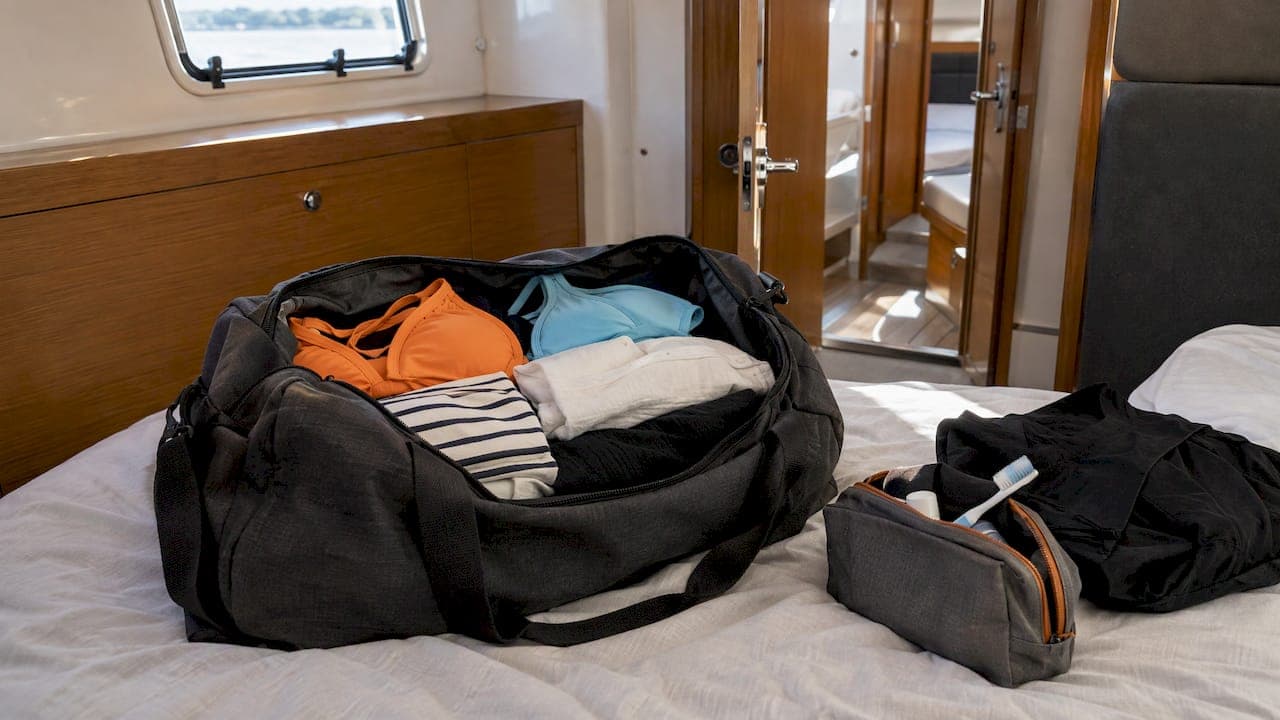
Pack light, soft and practical. For a week on a charter yacht, that means a soft-sided duffel or backpack, swimwear and quick-dry layers for most of the trip, non-marking deck shoes, broad-spectrum sun protection, your documents, and a small dry bag for the dinghy. Leave hard suitcases, heels, and anything you would hate to see wet at home. The full list is below, organized so you can pack in one evening.
TL;DR
- Choose a soft duffel, backpack, or foldable sports bag. Cabin storage is tight, and a rigid suitcase has nowhere to go once you are aboard.
- Plan on swimwear, sun-cover layers, one warm layer, and one nicer evening outfit. Shoes should be non-marking deck shoes plus flip flops.
- Carry your passport, any prescriptions, charter paperwork, a card, and some local cash in a waterproof pouch.
- Bring water-resistant SPF 30+ sunscreen, a hat, and polarized sunglasses. Check what safety gear the charter provides and confirm life jackets fit everyone.
- Skip bulky towels, hard luggage, and valuables you cannot afford to get wet, and confirm the rest with your charter company before you fly.
Table of Contents
- Start with the bag, not the clothes
- Documents, money, and medication
- Clothing: less than you think
- Sun protection and swim gear
- Safety gear: check what is aboard, and bring what fits you
- Electronics and useful extras
- Toiletries and personal care
- What to leave at home
- Adjust the list for trip length, weather, and destination
- Our perspective
- Book the boat, then pack for it
- A simple packing routine
- FAQ
- Sources
Start with the bag, not the clothes
The luggage decision shapes everything else. Yacht cabins, especially on sailing yachts and catamarans, have narrow hanging space, shallow lockers, and berths that double as storage. A hard-shell suitcase ends up on the cabin floor for the whole week, and it can scuff decks and trim.
What works instead:
- A soft duffel or weekender. It squashes into a locker and folds flat when empty.
- A backpack. Good if you are changing boats, flying through a connecting airport, or taking a ferry to the marina.
- A foldable day bag. Use it for the beach, a town stop, or a snorkel outing. Waterproof is best.
- Packing cubes or a couple of zip bags. One for swimwear, one for dry evening clothes, one for dirty laundry. Wet and dry should never share a bag.
If you are traveling with a group, split the load. One person brings the speaker and the games, another the first-aid kit and snacks. Our guide to group yacht trip ideas for friends and families covers how to divide up a shared trip, and if you are coordinating a group ride to the marina, a party bus safety checklist is a handy template for keeping everyone and their bags accounted for.
Documents, money, and medication
These are the items you cannot replace at a marina, so keep them together in one waterproof pouch and carry it in your day bag, never in checked luggage.
- Passport. The U.S. Department of State advises that your passport be valid for at least six months while you travel and have at least two blank pages, so check yours well before departure. The advice sits on its boating safety guidance for international travelers, and individual countries set their own entry rules, so confirm the specific one for your destination.
- Charter confirmation and contact numbers. Print or screenshot the booking, the base manager's phone number, and the marina address. Signal at anchor can be patchy.
- Skipper or sailing credentials. If you are chartering bareboat, bring your original license or certificates as the charter company requested. If you booked with a skipper, you do not need them for yourself.
- Cards and cash. Bring at least two payment cards and a modest amount of local currency. Small island marinas, fuel docks, beach bars, and tips are often easier in cash.
- Prescription medication. Pack it in original labeled containers, with a few extra days' supply in case of delays. The State Department also suggests checking whether you need a doctor's letter for prescription medication in the country you are visiting, so ask your doctor or the destination's embassy.
- Travel and medical insurance details. Keep policy numbers on paper and on your phone.
Clothing: less than you think
Most people overpack clothes. On a boat you live in swimwear, a cover-up, and a few light layers. A good rule is one top per day, one or two bottoms, and swimwear you can rotate so one is always dry.
Daytime on the water
- 2 to 3 swimsuits, so a dry one is always ready
- 3 to 5 quick-dry T-shirts or tank tops
- 1 to 2 long-sleeve UV-protection shirts for midday sun
- 2 pairs of quick-dry shorts
- A sarong or light cover-up
- A wide-brim or strapped sailing hat
Evenings ashore
- One or two casual outfits: linen shirt, sundress, or light trousers
- A light sweater or fleece. Nights on the water can be cooler than you expect, especially under way and in shoulder seasons.
- A packable rain jacket. Even in the tropics, a squall is more of a wind and spray issue than a washout, and a jacket doubles as a windbreaker.
Shoes
Shoes are where charter etiquette matters most. Many yachts ask for non-marking, soft-soled deck shoes or bare feet on board. Black-soled sneakers leave scuffs on white decks. Pack:
- Non-marking deck shoes or clean white-soled sneakers
- Water shoes if you plan to swim from rocky beaches or walk on coral rubble
- Flip flops or sandals for shore
Leave heels at home. If a restaurant ashore needs smarter shoes, a pair of flat leather sandals will do. Whether to bring walking shoes depends on your itinerary. If you plan a hike on an island stop, one pair of light trail shoes earns its space.
Sun protection and swim gear
On the water, sun reflects off the surface and hits you from below the hat brim, so sun protection is its own category.
- Sunscreen. Mayo Clinic advice is to use water-resistant, broad-spectrum sunscreen with SPF 30 or higher, wear a hat and sunglasses, and reapply every two hours, and more often after swimming or sweating. See its water safety Q&A. Bring more than you expect to use and a stick for your face and lips.
- Lip balm with SPF and after-sun lotion. Aloe gel gets used by about day three.
- Polarized sunglasses with a keeper strap. Polarized lenses cut surface glare, and a strap saves them from the sea.
- Hat with a chin strap. Wind takes unstrapped hats quickly.
- Snorkel gear. A well-fitting mask is personal. Many charters supply masks and fins, but if you have a mask that fits, bring it. Ask the charter company what is on board.
- Rash guard. Useful for snorkeling and paddleboarding, and it saves sunscreen.
Be aware that some destinations restrict the sale of sunscreens with certain ingredients to protect reefs. If you are sailing in a reef area, buy a mineral or reef-conscious formula at home and check the local rules before you go.
Safety gear: check what is aboard, and bring what fits you
Charter yachts are required to carry safety equipment, but the details vary by boat and place, so ask your charter company for the list before you go. Some points apply on any U.S.-flagged recreational boat and are good habits anywhere.
The U.S. Coast Guard says a recreational vessel must carry a U.S. Coast Guard-approved, correctly sized, serviceable wearable life jacket for each person aboard, readily accessible. It also recommends wearing the life jacket rather than just carrying it, because a life jacket stowed where you cannot reach it quickly does not help. Mayo Clinic also advises that everyone in a watercraft wear a Coast Guard-approved PFD.
What that means for your packing:
- Children and non-swimmers. Bring a properly sized, Coast Guard-approved life jacket for each child if you can. Charter fleets do not always have the right size for small children, so ask in advance.
- Personal inflatable vest. Optional, but if you have a comfortable one that fits you, it is worth bringing.
- Motion sickness remedies. If you are prone to it, talk to your doctor or pharmacist about what is suitable for you before the trip, and test it at home.
- Small first-aid kit. Bandages, antiseptic wipes, blister plasters, antihistamine, pain relief, and any personal medicines. The yacht will have a kit, but a personal one is faster to reach.
- Weather awareness. The National Weather Service advises checking the forecast before you leave and while you are out, using marine forecasts or weather radio, and heading to shore or a safe harbor if threatening weather approaches. See its water safety guidance. Your skipper makes those calls, so do not push to stay out.
Electronics and useful extras
The goal is to keep power and water apart.
- Waterproof phone pouch and a dry bag. The dinghy ride to a beach is the most common moment a phone gets soaked.
- Power bank and a short charging cable. Outlets on board are limited, and you will share them. A 12V USB adapter is a good idea if the boat has a cigarette-style socket, so check with the charter company.
- Offline maps. Download your region before you leave, since coverage drops at anchor.
- Camera or action camera with a floating strap. A wrist strap and a zip-lock pouch protect it.
- Bluetooth speaker. Compact and waterproof, but be mindful of neighbors in anchorages.
- Headlamp or small flashlight. Handy for night trips back from shore.
- Binoculars. Great for spotting landmarks and wildlife.
- Reusable water bottle. Cuts down on waste on board.
- Playing cards, a book, or downloaded shows. Rainy afternoons and slow passages need entertainment.
For the more technical kit that experienced renters carry, see nautical tools every yacht and boat renter needs.
Toiletries and personal care
Space and fresh water are limited, so go small.
- Travel-sized shampoo, conditioner, and body wash. Biodegradable if possible.
- Toothbrush, toothpaste, deodorant, and any contact-lens supplies with spare glasses
- Hairbrush and ties, since wind and salt make long hair unmanageable
- Insect repellent for evenings ashore
- A small quick-dry microfiber towel for the beach. Boats usually supply bed and bath linens, but confirm beach towels.
- Hand sanitizer and wet wipes
Hairdryers and heavy appliances are not worth bringing. Power is limited, and humid air and salt win anyway.
What to leave at home
Trimming the list is half of good packing.
- Hard-shell suitcases. There is no place to stow them.
- Heels and black-soled shoes. They mark and damage decks.
- Valuable jewelry and expensive watches. Salt and swimming are hard on them, and a small piece falling into the sea cannot be recovered.
- Large towels. Bring only what you need for the beach.
- Too many outfits. If you did not need it on day two, you will not need it on day six.
- Glass containers. Many yachts restrict them on deck.
- Hairdryers, straighteners, and other heat tools.
- Items that stain. Dark dyes, red wine on white sailcloth, and sunscreen on light upholstery are a poor mix.
Also ask your charter company about restrictions on specific items such as drones, paddleboards, or fishing gear. Rules differ by destination and by operator.
Adjust the list for trip length, weather, and destination
Trip length
For a weekend, you need two swimsuits, three tops, and a toothbrush. For a week, double the tops and add an evening outfit. For two weeks or more, do not double again: plan one laundry stop at a marina and keep the bag the same size.

Weather and season

Tropical summers need extra sun cover and rain gear, while shoulder seasons and northern destinations need a fleece, long trousers, and a warmer hat. In every season, expect cooler temperatures at night and in wind. Check the forecast a few days before packing.
Destination
| Destination type | Add to the list | Leave out |
|---|---|---|
| Caribbean or Bahamas | Extra UV shirts, snorkel gear, rain jacket | Heavy sweaters |
| Mediterranean | One smart-casual outfit for dinners ashore, light scarf | Beach-only attire for restaurants |
| Pacific Northwest or New England | Fleece, windproof jacket, wool hat, waterproof boots | Multiple swimsuits |
| Hawaii or Florida Keys | Mineral sunscreen, water shoes | Hard luggage |
Your type of boat matters too. A sailing yacht has less space and more spray than a motor yacht, so pack more waterproof layers and fewer clothes. Our comparison of sailing vs motor yacht charters helps you decide what suits your trip. If you are bringing children, five decisions that make family yacht charters work covers layout and planning, and a boat rental checklist covers what to check before you leave the dock.
Our perspective
Most packing mistakes begin with booking, not packing. People pick a boat first, then discover that the cabin layout, the crew, and the included equipment decide what they actually need to bring.
We think the best way to pack is to ask three questions before you buy a single sunscreen: what is already on board, what the cabins look like, and who is coming. A boat that supplies snorkel gear, linens, and paddleboards turns a long list into a short one.
That is why we built SAILORIX around transparency. Members see availability in real time by destination and boat type, and can add what the trip needs when they book, such as a skipper, early check-in, or equipment, so you carry less and arrive better prepared. Our model is built to keep costs low: membership is €100 per year, and we aim for service fees of around 1% on bookings, compared with the 10 to 20% we see elsewhere. Money you do not spend on fees is money for better provisioning and a better dinner ashore.
Pack for the water. Let the booking take care of the rest.
SAILORIX
Book the boat, then pack for it
A packing list is easiest once you know the boat. With a SAILORIX membership at €100 per year, you can search real-time availability by destination and boat type, from sailing yachts and catamarans to motor yachts and gulets, and add options like a skipper or equipment at booking. Our stated aim is around 1% in service fees, and we back it with a best price guarantee. You can also browse our fleet to see the boats before you choose.

If you are comparing cabin layouts before you pack, read about cabin configurations for charter, and for a longer stay, sleeping aboard a yacht charter helps you plan comfort and storage. Before you commit, our essential boat booking tips and yacht rental standards explain what to expect.
A simple packing routine
- A week before: check passport validity, order sunscreen, and confirm with the charter company what is on board.
- Three days before: lay out everything, then remove a third of the clothes.
- The night before: pack documents, medication, and electronics in your carry-on day bag. Put swimwear on top of the duffel.
- At the dock: keep your waterproof pouch and sunscreen within reach, not buried in a locker.
- Once aboard: ask the skipper to show you where the life jackets are stored and how they fit.
FAQ
Can I bring a suitcase on a yacht charter?
It is best not to. Cabins have limited storage, and a rigid suitcase has nowhere to go. Soft-sided duffels, backpacks, and foldable bags squeeze into lockers and fold flat when empty.
How many outfits do I need for a week on a yacht?
Plan one top per day, two or three swimsuits, two pairs of shorts, a cover-up, and one or two evening outfits. You will spend most of your time in swimwear, and laundry stops are usually possible at marinas.
Do I need to bring my own life jacket?
The boat should carry an approved life jacket for each person aboard, and the U.S. Coast Guard advises wearing it rather than only carrying it. If you have children or a specific fit need, ask the charter company in advance whether they can supply the right size, or bring your own.
What documents do I need for an international charter?
You need a passport, and the State Department advises it be valid for at least six months with two blank pages. Bring your charter confirmation, payment cards, insurance details, and any sailing credentials the charter company requires. Check entry rules for your specific destination.
Sources
- U.S. Department of State: Boating Safety and Piracy
- Mayo Clinic: Tips for summer water safety
- U.S. Coast Guard: Wearing your life jacket
- National Weather Service: Water Safety