
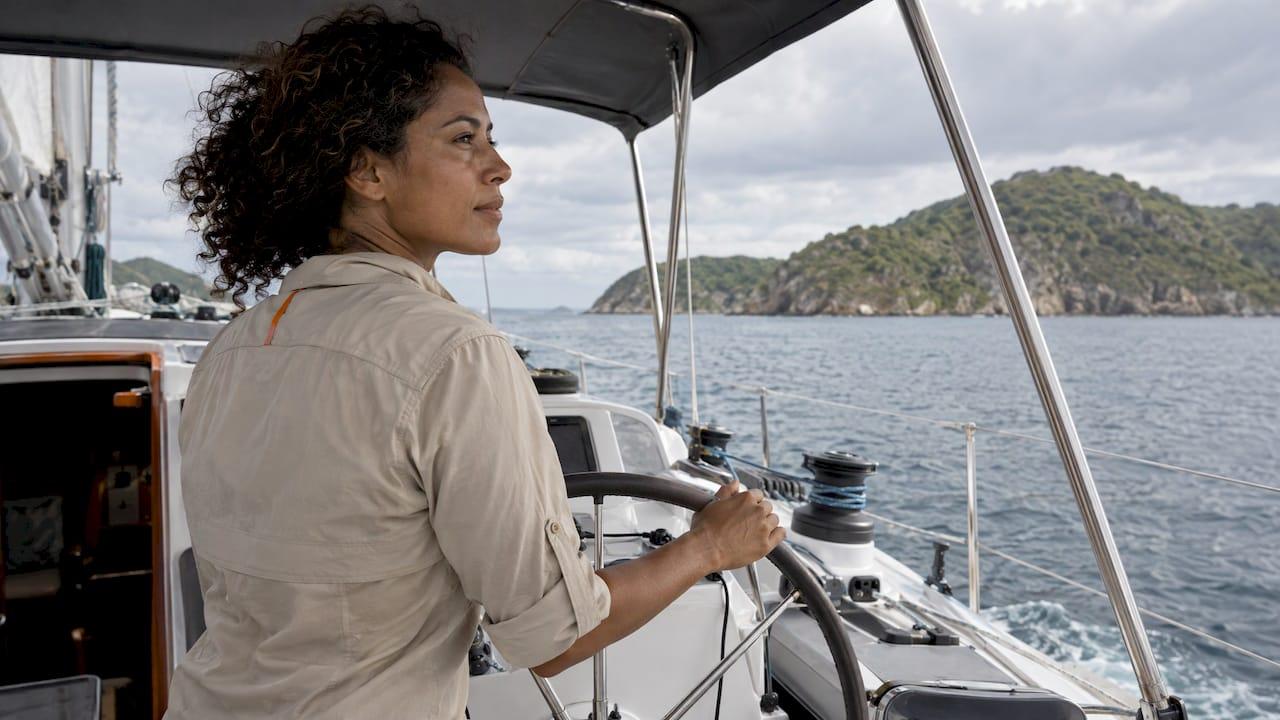
Yes, you can charter a yacht during hurricane season, but you should do it with eyes open. The Atlantic season officially runs from June 1 to November 30, and the real danger sits in a narrower window: mid-August to mid-October. Charter in the shoulder months, keep the itinerary flexible, pick a boat and a booking that let you change plans, and you can enjoy quiet anchorages and lower crowds without gambling your vacation.
This guide covers when the risk is highest, how to plan a trip that bends around a forecast, what to check in your booking terms, and what to do if a storm is heading your way.
TL;DR
- The Atlantic hurricane season runs June 1 to November 30. Activity peaks around September 10, with most of it from mid-August to mid-October.
- Early season (June) and late season (November) are generally calmer than the peak, but storms can form at any time in the official window.
- Build slack into your plan: shorter hops, known shelter, two options for every leg, and a written go/no-go rule.
- Read the rescheduling and cancellation terms before you pay, and consider travel insurance that covers the destination and the activity.
- If a storm threatens, move early. Never ride out a hurricane aboard a boat at anchor, on a mooring or at a dock.
Table of Contents
- When hurricane season actually bites
- Can you sail or charter during hurricane season?
- Planning an itinerary that bends around the forecast
- Availability and prices in the shoulder months
- What to check in your booking terms
- Safety basics for charter guests
- If a hurricane threatens before or during your charter
- Where Sailorix fits in
- Perspective
- FAQ
- Sources
When hurricane season actually bites
The Atlantic hurricane season runs from June 1 to November 30, a span that NOAA's Atlantic Oceanographic and Meteorological Laboratory says encompasses over 97% of tropical activity. That does not mean every week of it carries equal risk.
The National Hurricane Center's climatology puts the statistical peak on September 10. NOAA also reports that from mid-August through mid-October the basin sees 78% of tropical storm days, 87% of Category 1-2 hurricane days and 96% of major hurricane days. In other words, the two edges of the season are far quieter than the middle.

For a sense of scale, the NHC's 1991-2020 average season has 14 named storms, 7 hurricanes and 3 major hurricanes (Category 3, 4 or 5). Individual seasons swing well above or below that. NOAA's Climate Prediction Center, for example, gave the 2025 season a 60% chance of being above normal, a reminder that the outlook for any given year is worth reading before you book.
A simple way to read the calendar
| Window | Typical risk profile | How to approach it |
|---|---|---|
| June to mid-August | Season is open, activity is building | Workable with a flexible plan and short legs |
| Mid-August to mid-October | Peak: most storm days and most major hurricane days | Highest risk. If you go, keep the plan very short-hop and have a firm backup |
| Mid-October to November 30 | Activity tapering, season still officially open | Often a calmer window, but still check the forecast daily |
This table is our summary of NOAA's climatology, not a guarantee. A storm can form outside the peak, and a quiet week inside it is possible.
Can you sail or charter during hurricane season?
You can. Many charter areas stay open and operate through the official season. The question is not "is it allowed" but "how much uncertainty are you willing to plan around?"
Two things make the difference:
- Timing inside the season. A June or late-autumn week is a very different proposition from the first half of September.
- Flexibility. A charter fixed to one island chain with a hard return date is fragile. A charter with several nearby harbors, a spare day or two and a booking that can be adjusted is resilient.
If your dates are fixed and fall in the peak, the honest advice is to choose a destination outside the Atlantic hurricane basin for those weeks. Our guides on the Mediterranean sailing season for U.S. planners and the best time to sail Greece show how June and September work in those waters.
How risk varies by destination
Not every island is equally exposed, and not every harbor offers the same protection. The NHC notes that the South Florida Atlantic coast is the most hurricane-vulnerable area in the United States, averaging two land-falling hurricanes a year along the Atlantic and Gulf coasts. For a charter, three things matter more than the name on the map:
- Distance between safe harbors. Short hops let you reach shelter in hours, not a day.
- Quality of protected anchorages and marinas. Deep, enclosed harbors with good holding beat open roadsteads.
- Your exit options. Can you fly out from a nearby airport, or are you on a small island with limited flights?
Our pages on the safest Caribbean islands for living aboard and on what yacht renters should know about riskier Caribbean islands go into island-by-island detail.
Planning an itinerary that bends around the forecast
The core idea is simple: decide what you will do before the weather forces you to decide.
The NHC's marine safety guidance tells mariners to review regional tropical cyclone climatology, plot danger areas, determine at least two possible courses of action and evaluate nearby ports and hurricane havens. That works as a charter planning checklist too.
Build the plan in five steps
- Choose a compact cruising area. Stay within a day's sail of shelter wherever you can.
- Mark your bolt-holes. For each leg, name one harbor you would run to if conditions turn. Professional guidance from the Shipowners' Club says to have alternative routes, destinations and shelter ports in the voyage plan before departure.
- Keep a rolling five-day forecast. The same source recommends a rolling five-day forecast before departure and notes that conditions can change fast, so the latest forecast can quickly become out of date.
- Compare models. A skipper's habit worth copying, per Yacht Trading's passage planning guide, is comparing several weather models and making a deliberate go/no-go decision with contingency plans.
- Set change triggers early. Agree with your skipper or crew, while everyone is calm, what forecast would send you to shelter or end the trip.
Make the go/no-go call early
The NHC advises mariners to never plan to cross the track of a hurricane and to make leave-port decisions very early. It also says that avoiding a hurricane's 34-knot wind field is paramount at sea, because by that point sea state approaches critical levels and maneuverability drops quickly.
The same Yacht Trading guide observes that the most experienced skippers are the most willing to wait. A delayed departure costs you an afternoon. A bad arrival can cost far more.
Consider a skipper
If you are not an experienced offshore sailor, a professional skipper is the most practical piece of hurricane-season risk management. A skipper reads the forecast daily, knows local harbors and makes calls on your behalf. On Sailorix you can add a skipper to a booking as a custom add-on, along with options like early check-in and equipment. Our guide to nautical tools every yacht renter needs covers what else to have on board.
Availability and prices in the shoulder months
Demand for charters usually eases outside the winter high season in the Caribbean, which tends to open up boats and give you more room to negotiate on dates. We have not found a published, reliable price table for hurricane-season weeks we can quote here, so rather than quote a number we would suggest you compare the same boat across several weeks on the booking page. Our guide to saving on yacht charters in the shoulder season covers the pattern in more detail, and the catamaran charter cost guide shows how to build a realistic weekly budget.
A few practical points when comparing weeks:
- Look at the total, not just the base rate. Service fees, skipper, fuel, provisioning and insurance all add up.
- Watch service fees. Typical marketplace fees of 10 to 20% on a charter can quickly cancel out a shoulder-season saving. With a Sailorix membership the service fee is around 1%.
- Value flexibility. A slightly higher rate on a booking that lets you reschedule can be worth more than a deep discount on a rigid one.
What to check in your booking terms
Before you pay, read the terms the way you would read them if a storm were already on the map. Look for:
- What counts as a weather event. Does the booking name hurricanes, tropical storms or official warnings, or does it leave the decision to the operator?
- Rescheduling versus refund. Is there a date change, a credit or a partial refund, and by when must you ask?
- Who decides to cancel. The operator, the skipper or you?
- Mid-trip changes. What happens if you must end the charter early or relocate to a safer harbor?
- Related costs. Flights, hotels and transfers are usually separate bookings with their own rules.
Travel insurance is a separate layer. Not every policy treats a charter the same way, so read what it says about named storms and about boating. Our guide to travel insurance for a yacht charter explains what to buy and when. Sailorix also offers insurance options as part of a booking.
Safety basics for charter guests
On a crewed or skippered charter, the skipper carries the seamanship. As a guest, you should still know the essentials.
- Radio and weather. The U.S. Coast Guard urges mariners to monitor weather and VHF-FM channel 16 before and during a voyage.
- Escape plan and float plan. The National Weather Service advises having an escape plan, listening to NOAA Weather Radio, checking the weather before departure and filing a float plan at your marina.
- Written plan. NOAA recommends a detailed written hurricane plan with a checklist of procedures, equipment and supplies, with options such as securing the boat in its berth, mooring in a pre-identified area or hauling out.
- Anchoring skills. Good ground tackle and technique matter more when the wind rises. See our guides to anchoring safely and a step-by-step approach to yacht anchoring.
If a hurricane threatens before or during your charter
Your options depend on how much time you have.
Before you leave home
Watch the National Hurricane Center outlook in the week before departure. If a system is forecast near your cruising area, contact the operator early about rescheduling under your booking terms, and look at alternative dates or a different base. Early conversations tend to have more options than last-minute ones.
While you are on the water
- Move early. Head for the pre-selected shelter well before conditions deteriorate. NOAA notes that about 25% of hurricane fatalities result from boaters trying to secure vessels in worsening conditions, which is why early action matters.
- Follow the operator and skipper. They know the local hurricane plan and the nearest safe berth or haul-out.
- Prepare the boat for the berth. The Florida Fish and Wildlife Conservation Commission advises that a vessel in a marina berth should have all lines doubled and cross-spring lines rigged fore and aft. At anchor, it says to move to the most protected area and set multiple anchors with at least 10:1 scope.
- Leave the boat. The same agency says never to ride out a hurricane or tropical storm aboard an anchored, moored or docked vessel. Arrange shore accommodation and transport.
- Respect marina rules. In Florida, state law requires marina evacuations, and other places have similar orders.
After the storm
FWC warns that water conditions can be hazardous after a major storm, with debris, new shoals or sandbars and missing or damaged navigation markers. Do not resume cruising until the operator confirms the area is safe to navigate.

Where Sailorix fits in
If you want to charter in the shoulder months, the booking is where flexibility starts. With a SAILORIX membership at €100 per year, our service fee is around 1% per booking, compared with the 10 to 20% charged elsewhere, which leaves more of your budget for a skipper, insurance or a few extra buffer days. You can search real-time availability by destination and boat type across sailing yachts, catamarans, motor yachts, gulets and more.

See how it works on the membership page, browse our fleet or start from the Sailorix home page.
Perspective
Hurricane season does not need to cancel your charter. It needs to change how you plan it.
We see the same pattern with travelers who enjoy the shoulder months: they treat the weather as part of the itinerary, not an afterthought. They choose compact routes, add a skipper where it makes sense and keep dates with some give.
That is also where cost matters. When a platform takes 10 to 20% on top of the charter, there is little budget left for the things that make a trip resilient. Our membership model, with a service fee of around 1%, is built so that your money goes into the boat, the crew and the cover, not into fees.
Pick your window deliberately, use the real-time availability to compare weeks and book the version of the trip that leaves you options.
SAILORIX
FAQ
What is the worst month for hurricanes?
September is the statistical peak, with the peak day falling on September 10 according to the National Hurricane Center. Most activity occurs between mid-August and mid-October.
Is it safe to sail in the Caribbean during hurricane season?
It can be, with careful timing and planning. Sail in the quieter edges of the season, stay close to protected harbors, follow daily forecasts and leave early if a system forms. Never stay aboard a boat in a hurricane.
Can I get a refund if a hurricane cancels my charter?
That depends on your booking terms and any travel insurance you hold. Read the weather, rescheduling and refund wording before paying, and ask about date changes as soon as a system appears on the forecast.
Do I need a skipper in hurricane season?
If you are not an experienced offshore sailor, a skipper is a sensible choice. They monitor forecasts, know local shelter and make go/no-go decisions. You can add one to a booking on Sailorix.
Sources
- NHC Tropical Cyclone Climatology
- NOAA AOML Tropical Cyclone FAQ: When is hurricane season?
- NOAA: The peak of the hurricane season
- U.S. Coast Guard: preparedness for the Atlantic hurricane season
- NHC Marine Safety
- NHC: Tropical Cyclone Concerns for Marine Interests
- Shipowners' Club: Weather forecasts, safe passage and safe berths
- Yacht Trading: Yacht Weather Forecasting and Passage Planning
- Florida FWC: Storm Prep Resources
- NWS Marine Weather Safety Rules