
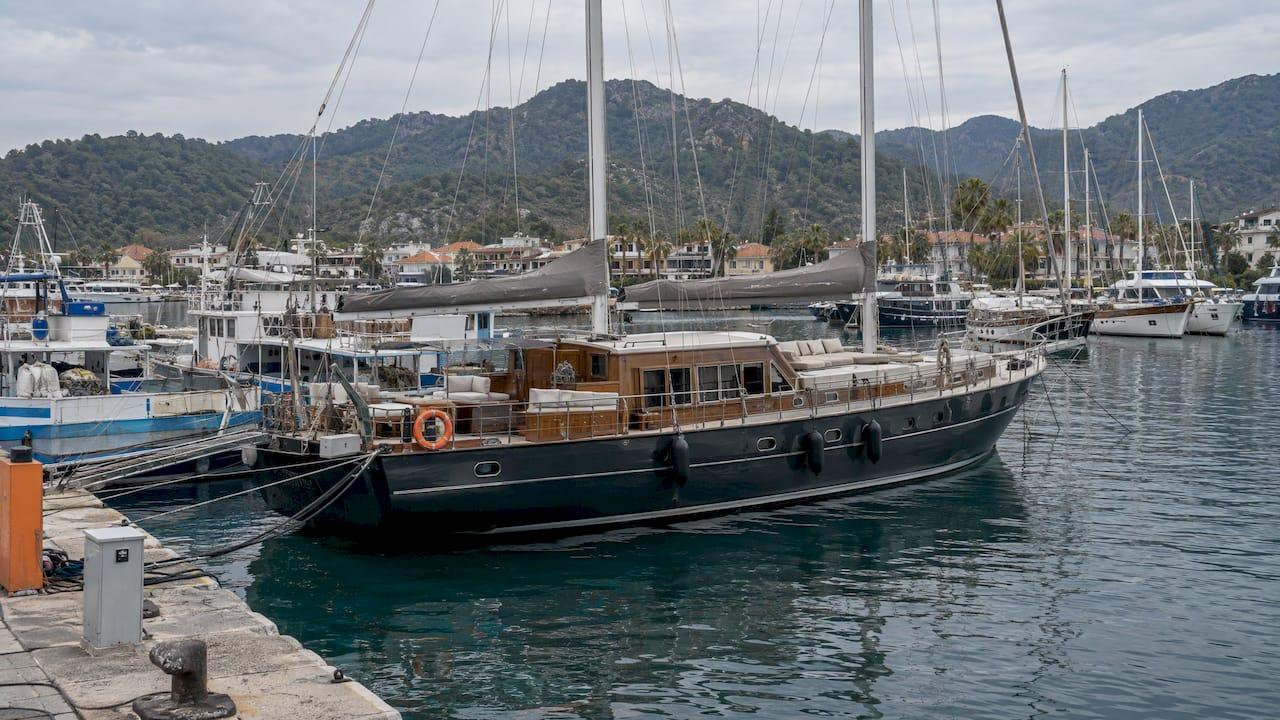
A week on a yacht in Turkey typically runs from about €1,200 for a bareboat sailing yacht to €15,000 or more for a gulet, and the quoted price is rarely the final one. Fuel, food and tips can add 25 to 40 percent on top, and the booking platform's fee comes on top of that. This guide shows the ranges by boat type and season, the extras to budget for, and why the service fee is the one line you can shrink before you pay it.
TL;DR
- Typical weekly prices in Turkey: bareboat sailing yacht €1,200 to €2,500, skippered sailing yacht €2,500 to €6,000, crewed sailing yacht €5,000 to €20,000+, gulet €4,000 to €15,000+.
- July and August run 20 to 40 percent above the quietest months. May, June, September and October run 15 to 30 percent below peak.
- Budget an Advance Provisioning Allowance (APA) of 20 to 30 percent of the base fee, plus a crew tip of 5 to 10 percent, unless the quote is all-inclusive.
- Platform service fees commonly run 10 to 20 percent. Our membership brings them to around 1%.
- Book early for summer weeks: the best boats and rates go first.
Table of Contents
- What a Turkey yacht charter costs by boat type
- How season changes the price
- The costs that sit outside the base price
- A worked example: one week, six guests
- Why luxury charters cost so much
- The 12-person rule
- Deposits, payment schedule and cancellation
- Compare charter versus ownership
- Where the booking fee fits
- Our perspective
- How to price your own Turkey charter in five steps
- FAQ
- Sources
What a Turkey yacht charter costs by boat type
There is no fixed market price for chartering in Turkey. One 2026 Turkey guide says exactly that, and reports a gulet range of €5,000 to €80,000 per week for fully crewed, full-board packages that include the vessel, captain and crew, meals, standard non-alcoholic drinks, itinerary fuel and Turkish port and marina costs. That span tells you the real driver of cost: how much service comes with the boat.
A more usable picture comes from typical weekly prices reported for Turkey in October 2026:
| Charter type | Typical price per week | Who it suits |
|---|---|---|
| Bareboat sailing yacht | €1,200 to €2,500 | Licensed, experienced skippers |
| Skippered sailing yacht | €2,500 to €6,000 | Couples and families who want a captain |
| Crewed sailing yacht | €5,000 to €20,000+ | Guests who want captain, cook and hostess |
| Gulet | €4,000 to €15,000+ | Groups sharing cabins on a traditional wooden boat |
Three things move you inside each band.
Size and age. More cabins, a newer hull and better equipment push the price up. A 40-foot catamaran and a 60-foot motor yacht do not belong in the same budget.
Crew. A skipper adds a salary to the bill. A full crew adds a cook and deckhand, and food becomes part of the package. This is why a gulet looks cheap per person when eight guests split it, and expensive when two people book it.
Season. This is the lever you control, and it gets its own section below.
For a wider view of how Turkey compares with other destinations, our Mediterranean per-person budget guide and our Croatia weekly cost breakdown use the same logic of base fee plus extras.
How season changes the price
Peak season in Turkey is July and August. Rates in those months run 20 to 40 percent above the quietest months, while the shoulder months of May, June, September and October sit 15 to 30 percent below peak.
One example makes the gap concrete. A 40-foot catamaran out of Göcek is reported at €1,800 per week in June and €3,200 per week in August, a 78 percent premium for the same boat. The weather in June and September is warm and the water is swimmable, so for many travelers the shoulder months are the better value, not a compromise. Our shoulder-season guide goes through how to pick the dates.
If your dates are fixed by school holidays, the next best lever is booking early. The same source advises booking six to twelve months ahead for August, and notes that Turkey offers slightly more last-minute availability than some neighbors, but fewer choices and higher prices if you wait past February. Treat that as a planning rule: for a July or August week, decide in the autumn or winter before.
The costs that sit outside the base price
The base charter fee is the number in the headline. It is not the number on your credit card statement at the end of the week. Four extras do the damage.
Advance Provisioning Allowance (APA)
On "plus expenses" quotes, the APA is a prepayment to the captain for fuel, groceries, drinks and dockage. It typically runs 20 to 30 percent of the base fee, is paid before departure, and any unused balance is refunded at the end of the trip. Ask for the final accounting with receipts. Our guide on how charterers control APA costs covers how to estimate it before you sign.
Crew tip
Gratuities are not in the quoted price. The customary tip is 5 to 10 percent of the base charter fee, handed to the crew in cash at the end of the week. Carry euros for this, because the crew will not take a card tip.
All-inclusive versus plus expenses
A quote arrives in one of two forms. An all-inclusive quote already covers fuel, food and drinks. A plus-expenses quote lists the base fee and leaves the APA to you. A lower plus-expenses number can end up above an all-inclusive one once the APA lands, so ask which form each quote takes before comparing boats. Compare them on the same footing: base fee plus APA plus tip.
Add-ons and booking fees
Skipper, early check-in, equipment and insurance are priced separately on most boats. And if you book through a platform, a service fee applies. In the broader market that fee commonly sits at 10 to 20 percent of the booking, and unlike the APA you never get any of it back. Our guide to hidden charter costs lists the rest.
A worked example: one week, six guests
Take a skippered sailing yacht at €4,000 for the week, a mid-range number inside the band above. Here is how the real total builds up, using the APA and tip percentages reported for Turkey.
| Line | Low estimate | High estimate |
|---|---|---|
| Base charter fee | €4,000 | €4,000 |
| APA at 20 to 30 percent | €800 | €1,200 |
| Crew tip at 5 to 10 percent | €200 | €400 |
| Subtotal before platform fee | €5,000 | €5,600 |
That is 25 to 40 percent above the headline price, before the platform fee. The APA is partly refundable, so your true spend may land lower. Split six ways, the subtotal is roughly €830 to €930 each for a week of accommodation, transport between bays and a captain. Remember that the platform fee applies to the booking itself, and the fee rate is where we can help, as the next sections show.
If you are planning for a bigger party, our group cost-per-person guide shows how splitting costs changes the math.

Why luxury charters cost so much
Readers often ask why the top end reaches into the tens of thousands. The honest answer is that a luxury crewed yacht is a hotel, restaurant, transport service and private crew in one booking. You pay for a vessel that is expensive to build and maintain, a professional crew paid for the full season, fuel for a boat that burns far more per hour than a sailing yacht, and marina berths in the most sought-after harbors. Peak weeks are limited, and those boats can be booked solid. That is also why a gulet at the low end of its range, in May or October, can feel like a very different product from the same hull in August.
For a closer look at crewed pricing, we have a planner's breakdown of crewed yacht costs, and of catamaran weekly budgets if you prefer a multihull.
The 12-person rule
You will see "the 12-person rule" mentioned on charter sites. It refers to the widely used threshold in yacht regulation: a vessel carrying more than 12 passengers is generally treated as a passenger vessel, with stricter certification and crew requirements than a private yacht. Most charter yachts are built and licensed to carry 12 guests or fewer for exactly this reason, and gulets with more cabins often operate under their own certification. When your group is large, confirm the maximum guest count on the specific boat's documents, and make sure the price is quoted for the number of guests you actually have aboard.
Deposits, payment schedule and cancellation
Terms vary by owner and operator, so read them before you pay. A common pattern in Turkey is a deposit of around half the charter fee to hold the dates, with the balance due before or at embarkation. Cancellation fees typically climb as the date approaches, so a booking made early and then cancelled late can cost a lot. Check three things in the contract:
- The deposit share and its due date.
- When the balance and the APA are due.
- The cancellation schedule, and whether rebooking to another date is allowed.
Travel insurance for the trip, and boat-specific insurance options at booking, are worth pricing at the same time as the charter.
Compare charter versus ownership
If you find yourself chartering in Turkey every year, it is reasonable to ask whether owning would cost less. The answer depends on how many weeks you sail, so it helps to see the numbers on both sides. This breakdown of charter versus ownership costs sets out what a yacht really costs each way, which is a useful frame for judging whether a yearly week or two on the water is better paid by the week.
Where the booking fee fits

Every extra above depends on the boat, the crew and the season, and none of them is yours to negotiate on a booking site. The platform service fee is different: it is set by the platform and it is charged on the whole booking. On a €4,000 charter, a fee of 10 to 20 percent is €400 to €800. At around 1%, the same booking carries roughly €40.
That is the model we built at SAILORIX. Membership costs €100 per year and unlocks bookings with service fees of around 1%, against the 10 to 20 percent typical elsewhere. On the €4,000 example, the membership plus a 1% fee is about €140 in total, and a single week already covers it. You can search real-time availability by destination and boat type, add a skipper, early check-in or equipment, and choose insurance options at booking.

See how it works on the SAILORIX membership page, or browse our fleet to see what is on offer before you pick dates.
Our perspective
Most budget overruns on a charter do not come from the boat. They come from the numbers that were not in the first quote: the APA, the tip, the add-ons and the booking fee. You can compare boats all day, but if you compare them on base fee alone you are comparing the wrong number.
The booking fee is the one cost that has nothing to do with the boat, the crew or the season. It is a margin. That is why we built our membership around it: a flat €100 a year and service fees of around 1%, so more of what you pay goes to the boat and the week itself. Our positioning is simple: the lowest service fees on the market, a best price guarantee, and access to a global inventory with support for members.
Our advice for Turkey is the same as for any destination. Pick shoulder-season dates if you can, ask each quote whether it is all-inclusive or plus expenses, add the APA and the tip to your budget before you decide, and book early for July and August. Then choose the booking route with the lowest fee.
SAILORIX
How to price your own Turkey charter in five steps
- Pick the type. Bareboat if you hold the right qualifications, skippered if you want to sail with a captain, crewed or gulet if you want full service.
- Pick the week. Compare a shoulder-season week with your peak-season option. A 15 to 30 percent cut on a €4,000 boat is €600 to €1,200.
- Ask the quote form. All-inclusive or plus expenses, and what is covered in each.
- Build the full total. Base fee, APA at 20 to 30 percent, tip at 5 to 10 percent, add-ons, and the service fee.
- Book through the lowest fee. With SAILORIX, the membership fee and a service fee of around 1% replace a typical 10 to 20 percent charge. See our current pricing guide for how the numbers look across destinations.
FAQ
How much does a luxury yacht charter in Turkey cost?
A crewed sailing yacht is typically reported at €5,000 to €20,000 or more per week, and gulets reach €15,000 or more. Top-end full-service packages are reported up to €80,000 per week. Add the APA and a tip of 5 to 10 percent unless the quote is all-inclusive.
When is the cheapest time to charter in Turkey?
The shoulder months of May, June, September and October run 15 to 30 percent below peak, while July and August run 20 to 40 percent above the quietest months. Booking six to twelve months ahead for summer weeks also gives you more boats to choose from.
What is the APA on a Turkey yacht charter?
The Advance Provisioning Allowance is a prepayment, usually 20 to 30 percent of the base charter fee, that covers fuel, groceries, drinks and dockage. Unused money is refunded at the end of the trip, so ask for receipts and a final accounting.
Is the tip included in the charter price?
No. The customary tip is 5 to 10 percent of the base fee, paid in cash directly to the crew at the end of the week. Budget for it from the start.
Sources
- How Much Does It Cost to Charter a Yacht in Turkey?
- Turkey Yacht Charter Guide: Best Routes, Yachts and Prices for 2026
- Where to Sail in August: Best and Worst of the Med