

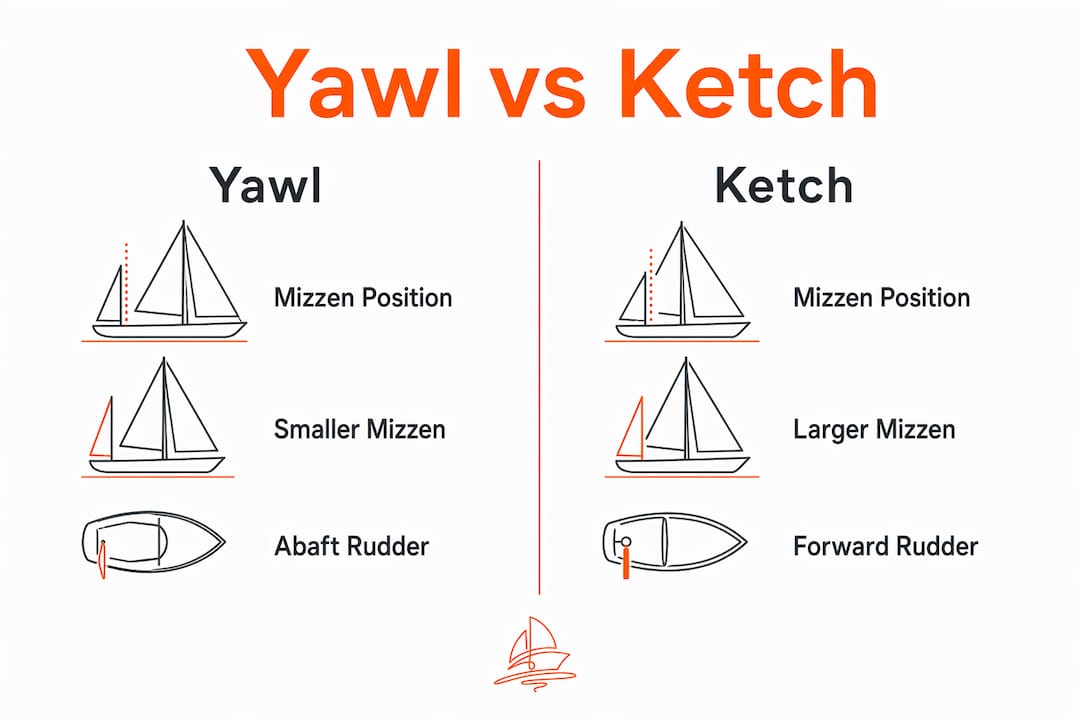
A yawl is a two-masted, fore-and-aft sailing rig with a small mizzen stepped abaft the rudder stock — that single positional detail is what separates it from a ketch, where the mizzen sits forward of the rudder post and carries enough area to contribute real drive. On a yawl, the mizzen is deliberately small, and its job is balance, not horsepower.
Here is the quick version of what that means in practice:
- Mizzen position: behind the rudder stock (abaft), not in front of it
- Mizzen size: proportionally smaller than a ketch's; typically a smaller percentage of total sail area
- Primary function: helm balance and weather helm control, not forward drive
- Best fit: cruisers, single-handers, and classic yacht enthusiasts who want manageable sail area and a forgiving helm
Choose a yawl when you want a rig that is easier to balance and reef than a sloop of the same size, and when you are willing to accept a modest performance trade-off in exchange for that control.
Table of Contents
- What does a yawl sail plan actually look like?
- How does the mizzen actually change how a yawl handles?
- Yawl vs ketch: which rig suits you better?
- How do you handle a yawl in heavy weather?
- When does a yawl make sense — and when does it not?
- Rigging and trim checklist for a balanced yawl
- Where did the yawl come from, and where is it now?
- The mizzen as an air rudder: what experienced sailors know
- Key Takeaways
- Sailorix's take on the yawl in practical sailing
- Sailorix: charter a classic cruising yacht at a fair price
- Useful sources for further reading
What does a yawl sail plan actually look like?
The standard yawl carries three working sails: a mainsail, one or more headsails (typically a jib or genoa, sometimes a staysail on larger boats), and the mizzen. The mainsail does most of the work. The headsail handles the rest. The mizzen, set on a short mast positioned aft of the rudder post, fills in the corners of the sailplan without dominating it.

On a cruising yawl, the mizzen mast typically sits close to the stern, sometimes nearly over the transom. That placement is not accidental. It keeps the mizzen's center of effort well aft, which is precisely what gives it leverage over the helm. The sail itself is small enough that it rarely backwinds the mainsail, which is one reason the mizzen does not significantly interfere with mainsail airflow on a well-designed yawl.
The running rigging for the mizzen is straightforward: a halyard, a sheet led to a traveler or cleat on the stern, and sometimes a vang or checkstay to control the boom. On smaller yawls, the mizzen sheet often leads to an outrigger or a boomkin extending past the transom, which improves the sheet angle and keeps the boom from fouling the backstay.
The mizzen on a yawl is not there to push the boat forward. It is there to steer it — not with the rudder, but with the wind. Think of it as a weather vane you can trim.
A labeled sailplan illustration is worth having on board or bookmarked. Look for one that marks the rudder post position clearly, because that single reference point is what distinguishes a yawl from every other two-masted rig at a glance.
How does the mizzen actually change how a yawl handles?

The mizzen's position abaft the rudder stock creates what experienced sailors call an "air rudder" effect. When you sheet the mizzen in, it pulls the stern downwind and pushes the bow up into the wind, increasing weather helm. Ease it, and the effect diminishes. That relationship gives you a surprisingly fine-grained tool for balancing the helm without touching the tiller or wheel.
In practice, this means a well-trimmed yawl can hold a course with less rudder input than a comparable sloop. Before GPS autopilots became standard equipment, this was a genuine advantage on long passages. The mizzen trimmed for balance rather than drive is the defining characteristic of the rig.
A few handling traits follow from that geometry:
- Weather helm control: easing the mizzen sheet reduces weather helm almost immediately; useful in a building breeze before you commit to a reef
- Anchoring and mooring: sheeting the mizzen amidships while the main is down helps the boat weathercock and hold its head into the wind, making anchoring calmer
- Tight quarters: the mizzen gives you a small but real moment arm to swing the stern in close-quarters maneuvering without engine power
- Upwind: a yawl is slightly less efficient than a sloop of equal waterline length because the mizzen adds windage and weight aft without contributing much drive
- Reaching: this is where the mizzen earns its keep most visibly; a mizzen staysail set between the two masts on a reach can add meaningful area that a sloop simply cannot carry
Pro Tip: When the breeze builds and you are not ready to reef the main, try easing the mizzen sheet two or three inches first. On most yawls, that alone will take a pound or two of weather helm off the tiller and buy you another 10–15 minutes before the reef becomes necessary.
Yawl vs ketch: which rig suits you better?
The difference between a yawl and a ketch is not just where the mizzen mast sits. It shapes the entire character of the boat.
| Feature | Yawl | Ketch |
|---|---|---|
| Mizzen position | Abaft the rudder stock | Forward of the rudder stock |
| Mizzen size | Small; primarily for balance | Larger; contributes meaningful drive |
| Primary purpose | Helm balance, heaving to | Sail area distribution, drive |
| Single-handed suitability | High; smaller, simpler sail plan | High; more flexible combinations |
| Upwind performance | Slightly behind a sloop of equal size | Similar trade-off, more sail area options |
| Downwind/reaching | Mizzen staysail option adds area | More mizzen drive available |
| Classic racing history | Benefited from old rating rules | Less affected by rule changes |
The ketch is the better choice when you want the mizzen to actually drive the boat. A ketch's larger mizzen, stepped forward of the rudder post, carries enough area to matter on a reach or a run. Cruising ketches in the 35–50 foot range use that mizzen area to split the sail plan into manageable pieces without sacrificing speed.
The yawl wins in a different scenario. For a coastal cruiser or a single-hander who wants a forgiving, balanced helm and a simple reefing sequence, the yawl's smaller mizzen is an asset, not a limitation. You are not trying to drive the boat with it. You are using it to steer the boat through the wind without touching the helm.
- Yawl wins: classic aesthetics, helm balance, heaving to, anchoring control, boats under 40 feet
- Ketch wins: offshore passages where mizzen drive matters, larger boats where splitting sail area is a priority, heavy-weather sailing with a full crew
For a deeper look at how multi-masted rigs compare in practice, the Sailorix guide to sailing a schooner covers similar handling trade-offs across rig types.
How do you handle a yawl in heavy weather?
The yawl's real advantage shows up when the wind climbs past 20 knots and you need to reduce sail without losing control of the boat. The sequence is more forgiving than on a sloop because you have more options at each step.
Standard sail combinations, lightest to heaviest conditions:
- Full sail: main, headsail, and mizzen — your everyday sailing configuration in moderate air
- Reefed main, full headsail, mizzen — first reduction; the mizzen stays up to maintain balance
- Reefed main, smaller headsail, mizzen — second reduction; roll in the genoa or swap to a working jib
- Jib and jigger (headsail plus mizzen, main down) — the yawl's signature heavy-weather combination
- Mizzen only — rarely used for sailing, but useful for holding head-to-wind at anchor or when hove to
Reducing to jib and jigger, step by step:
- Bear away slightly to take pressure off the main
- Ease the main halyard and drop or furl the mainsail
- Sheet the mizzen amidships or slightly to leeward
- Trim the headsail for the point of sail
- Adjust mizzen sheet until weather helm feels neutral
Sailing under headsail and mizzen is a stable, comfortable configuration that preserves balance and control in stronger winds. The boat moves a little slower, but the motion is steadier and the loads on every piece of gear drop considerably.
For heaving to, the yawl is particularly well suited. Sheet the mizzen amidships, back the headsail, and the boat will weathercock into the wind and drift slowly astern. It is one of the cleanest heave-to sequences of any rig type.
Pro Tip: When single-handing and dropping the main in a seaway, clip a line from the boom to a midship cleat before you ease the halyard. The mizzen will hold the bow up enough to keep the main from flogging, and that one extra line means you can take your time securing the sail without the boat rounding up on you.
When does a yawl make sense — and when does it not?
The yawl is not the right rig for everyone. It rewards sailors who value comfort and control over outright speed, and who appreciate a rig with a certain visual elegance that a sloop simply cannot match.
Practical advantages:
- Helm balance is easier to achieve and maintain across a wider range of conditions
- Heaving to is simpler and more reliable than on most sloops
- Anchoring and mooring control is improved by the mizzen's weathercocking effect
- The smaller mainsail is easier to handle shorthanded
- Classic aesthetics — the proportions of a yawl are widely considered among the most pleasing of any sailing rig
- A mizzen staysail on a reach adds drive that a sloop cannot replicate
Common disadvantages:
- The mizzen adds a second mast, extra standing rigging, and more hardware to maintain
- Upwind performance trails a sloop of equal waterline length
- The mizzen contributes little forward drive, so the extra complexity has a modest performance return
- Cockpit space aft can be reduced by the mizzen mast and its associated gear
Who should seriously consider a yawl:
Coastal cruisers in the 30–45 foot range who sail shorthanded or solo, classic yacht enthusiasts restoring or commissioning a traditional design, and sailors who spend time at anchor and want a rig that holds the boat head-to-wind without constant attention. The yawl remains preferred by cruisers who value easier sail management and classic lines over racing performance.
Who should probably look elsewhere:
Racers, performance cruisers who prioritize upwind speed, and anyone who wants the simplest possible rig. A sloop is faster and cheaper to maintain. A ketch gives you more mizzen drive if you want the second mast to actually work for you.
Rigging and trim checklist for a balanced yawl
Getting the most from a yawl rig comes down to a handful of tuning habits that most sailors skip. The mast tuning principles that apply to any sloop apply here too, with the added layer of the mizzen's own setup.
Mizzen setup checklist:
- Halyard tension: snug but not bar-tight; the mizzen luff should be smooth with no horizontal wrinkles
- Sheet lead position: the lead should produce a sheet angle that closes the leech without over-twisting the head; a traveler gives you more range than a fixed cleat
- Vang or checkstay: if fitted, use it to control boom lift on a reach; without it, the mizzen leech will open and spill drive
- Mast rake: a slight aft rake on the mizzen increases its weather helm effect; rake it forward to reduce that effect if the boat is chronically over-pressed
- Shroud tension: the mizzen's shrouds are often lighter than the main rig; check them seasonally for stretch and corrosion, especially at the chainplates
Trim by point of sail:
- Close-hauled: sheet the mizzen in firmly; it contributes little drive but helps balance; watch for backwinding on the main's leech
- Beam reach: ease the mizzen sheet and let it draw; this is where a mizzen staysail, if you carry one, earns its keep
- Running: the mizzen is largely useless dead downwind and may increase rolling; consider dropping it or gybing it to the windward side
Maintenance note: the mizzen's standing rigging is often overlooked because it is smaller and less obviously stressed than the main rig. Inspect the swage fittings, toggles, and chainplates on the same schedule as the main rig, not less frequently.
Pro Tip: If your mizzen sheet lead is fixed and you find the sail consistently over-trimmed at the head on a reach, move the lead block one or two inches forward along the track. That small adjustment opens the leech, reduces backwinding on the main, and noticeably improves boat speed on a reach without any other changes.
Where did the yawl come from, and where is it now?
The yawl's roots predate its use as a sailing rig. Originally it described a double-ended, clinker-built open boat with Viking or Norse design influence, worked under sail or oar from beaches and small harbors. The Norfolk and Suffolk Beach Yawls were among the fastest open boats of their era, reportedly reaching 14 knots in the right conditions. The rig designation came later, as the two-masted configuration became associated with a specific sail plan.
The yawl's popularity as a racing rig spiked because of a quirk in historical rating rules. Early measurement formulas did not count the mizzen's area, which meant designers could add a small mizzen and gain sail area for free under the rating. Once rating formulas changed to count mizzen area, the racing incentive evaporated and designers largely abandoned the rig for competition. That rule-driven rise and fall explains why so many classic American racing yachts from the mid-20th century were yawls, and why almost none of the modern racing fleet is.
Today, yawls persist in a few specific contexts:
- Classic cruising yachts from the 1950s–1970s, many of which are still actively sailed on the East and West Coasts
- Small gaff yawls, like the Golant Yawl, designed for shorthanded coastal sailing
- The Drascombe Lugger, rigged as a yawl with a gunter mainsail and a leg-o'-mutton mizzen sheeted to an outrigger
- Traditional restorations where the yawl rig is part of the boat's original character
The evolution of ship design that produced the modern yawl is a long story, but the rig's current niche is clear: it belongs to sailors who want a connection to traditional seamanship and a rig that rewards careful, attentive sailing.
The mizzen as an air rudder: what experienced sailors know
The most useful reframe for anyone new to a yawl is this: stop thinking of the mizzen as a sail and start thinking of it as a control surface.
Experienced practitioners, including Don Street and others who have written extensively on cruising rigs, consistently describe the yawl's mizzen as functioning primarily as an air rudder. Its value is not in the knots it adds but in the helm load it removes — and in the stability it provides when the boat needs to hold a heading without constant input from the helm.
That framing changes how you trim it. You are not trying to maximize the mizzen's drive. You are using it to offload work from the rudder, which reduces drag, steadies the motion, and makes the boat easier to steer for hours at a time.
For single-handed sailors, the practical workflow looks like this: set the headsail for the point of sail, sheet the mizzen until the helm goes neutral, then adjust both until the boat tracks without constant correction. On a well-balanced yawl, this can produce a surprisingly stable self-steering state even without an autopilot or windvane.
Pro Tip: When heaving to in a yawl, do not rush to back the headsail. Sheet the mizzen amidships first and let the boat come up on its own. The mizzen's weathercocking effect will do most of the work, and you will end up in a more stable hove-to position with less flogging and less drama than forcing the headsail across.
Key Takeaways
A yawl's mizzen is an air rudder first and a driving sail second — that single distinction explains every handling advantage and every performance trade-off the rig carries.
| Point | Details |
|---|---|
| Defining feature | The mizzen is stepped abaft the rudder stock, making it smaller and balance-focused compared to a ketch. |
| Primary mizzen role | Trim it for helm balance, not drive; easing it reduces weather helm, sheeting it in increases it. |
| Best sail combination | Jib and jigger (headsail plus mizzen) gives stable, controlled sailing in heavy weather with the main down. |
| Heaving to | Sheet mizzen amidships, back the headsail, and the yawl weathercocks reliably into the wind. |
| Sailorix | Sailorix lists classic cruising yachts and charter boats globally, including yawl-style vessels, bookable at low service fees. |
Sailorix's take on the yawl in practical sailing
At Sailorix, we see the yawl come up most often among sailors who have already moved past the beginner stage and are thinking seriously about what kind of sailing they actually want to do. The rig attracts a specific type: someone who has single-handed a sloop in a building breeze and thought, "there has to be a more comfortable way to manage this." There usually is, and the yawl is often the answer.
The mizzen-as-air-rudder concept is one of those ideas that sounds abstract until you feel it on the water. Once you have trimmed a mizzen to take weather helm off the tiller in 25 knots of breeze, the rig's logic becomes immediately obvious. The yawl does not make you faster. It makes you less tired, which on a long passage or a shorthanded coastal cruise is worth considerably more than an extra half-knot.
For sailors who want to experience a yawl-style rig without committing to ownership, chartering a classic cruising yacht is the most direct path. Sailorix connects sailors with yacht membership advantages that make that kind of charter genuinely affordable.
Sailorix: charter a classic cruising yacht at a fair price
If reading about the yawl's handling has made you want to actually sail one, Sailorix is the most direct way to get there without the cost and commitment of ownership.

Sailorix is a global boat booking platform built around one straightforward idea: sailors should pay for the boat, not the middleman. A Sailorix membership costs €100 per year and cuts the service fee on every booking to approximately 1%, compared to the 10–20% that most charter platforms charge. That difference adds up fast on a week-long charter of a classic cruising yacht.
Search by destination, boat type, and availability in real time. Add a skipper if you want one, or book bareboat if you are ready to handle the rig yourself. Classic cruising yachts, including traditional two-masted designs, are available across Sailorix's global fleet. Browse available yachts and see what is sailing near you.
Useful sources for further reading
These references cover the technical, historical, and practical dimensions of yawl sailing in more depth than any single article can.
-
Wikipedia: Yawl — the most complete encyclopedic overview of the rig, including hull type history, Royal Navy usage, and the defining distinction between a yawl and a ketch. Start here for definitions and diagrams.
-
Rigging Doctor: Yawl — a practitioner-focused explanation of the mizzen's role as an air rudder, with clear guidance on trimming behavior and the historical rating-rule context. Useful for anyone tuning a yawl for the first time.
-
Wave Train: Cruising sailboat rigs — a comparative look at ketches, yawls, and schooners from a cruising perspective, with honest commentary on where each rig wins and where it falls short.
-
American Sailing: What's in a rig? The yawl — a concise, accessible overview aimed at sailors evaluating rig choices, with good coverage of the yawl's current niche among cruisers.
-
Swallow Yachts Association: Heaving to — step-by-step heaving-to instructions specific to yawl-type rigs, with clear explanation of how the mizzen and headsail interact in that maneuver.
-
Practical Boat Owner: Golant Yawl — a sea trial review of a modern gaff yawl that illustrates how the rig performs in real conditions, including jib-and-jigger sailing and shorthanded handling.