
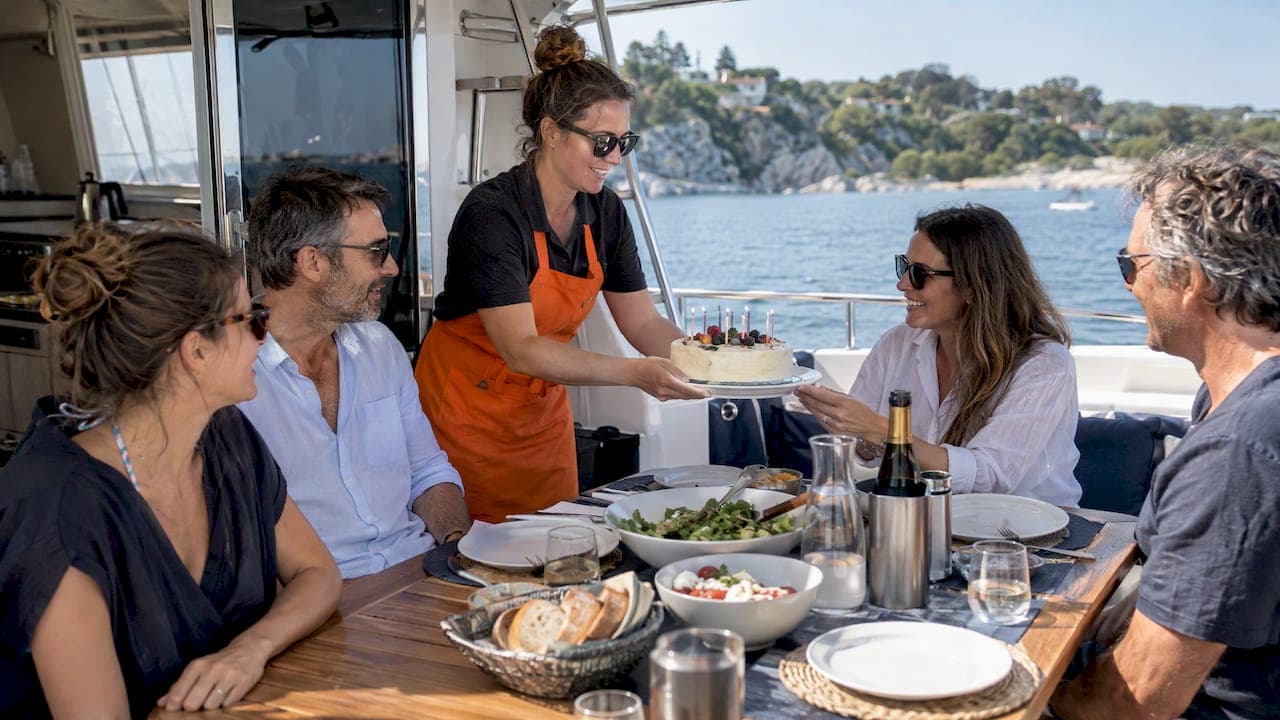
A birthday boat party works best when you choose the boat for your guest list, not the other way around. Settle the headcount, the hours and the mood first. Then match a vessel type, confirm the legal passenger limit with the operator, and plan the safety basics before you plan the playlist. This guide walks through each step, with the U.S. rules that matter and the places where money quietly leaks out of a charter budget.
TL;DR
- Start with guest count and duration. They decide the boat type, and the boat type decides most of your cost.
- Ask every operator for the passenger limit on the vessel's paperwork. Carrying more than six paying passengers generally means a different license and vessel class than a small captained charter.
- Federal rules call for one wearable, Coast Guard-approved life jacket per person aboard, and children under 13 must wear one while underway. Your state may be stricter.
- Pick a rain plan and a return time with buffer. Afternoon thunderstorms form fast.
- Compare total cost, not the headline rate. Service fees and add-ons change the final number.
Table of Contents
- Why a boat works for a birthday
- Step 1: Fix the guest count and the hours
- Step 2: Understand the passenger limit
- Step 3: Match the boat to the party
- Step 4: Build the day around a simple timeline
- Step 5: Food, drinks and decorations
- Step 6: Safety is the part you control
- Step 7: Read the price, not just the rate
- Birthday boat party ideas that work
- What we think at SAILORIX
- Book your birthday charter with lower fees
- A checklist for the week before
- FAQ
- Sources
Why a boat works for a birthday
A boat is a venue with a built-in edge: guests cannot drift off after an hour, there is a view in every direction, and the whole thing has a start and an end. That structure suits birthdays. People arrive together, eat, swim or dance, watch the sunset, and come home at a set time.
The trade-offs are real too. Space is finite, weather is not negotiable, and everyone is committed once the lines are cast off. A good plan takes those three facts seriously.
Step 1: Fix the guest count and the hours
Decide these two numbers before you look at a single listing.
Guests. Count adults, teenagers and small children separately. Children change the safety plan, the food and the type of boat. Count only people who will actually step aboard, not the ones who "might" come.
Hours. Three to four hours is a comfortable birthday: boarding, a meal, an activity window and a sunset or golden-hour finish. Shorter feels rushed once you subtract boarding and docking. Full days suit milestone birthdays with swim stops and a meal ashore.
A useful rule: pick the number of guests you would be happy with if two dropped out, then confirm the boat holds the number if everyone shows up.
Step 2: Understand the passenger limit
This is the part many first-time organizers miss. In the U.S., a captain holding the entry-level commercial license, commonly called a six-pack license, can carry up to six paying passengers. Larger groups on inspected vessels need a higher-level master license and a different class of boat.
What that means in practice:
- Small private yacht or sailing charter with a captain: expect a cap of six guests, even if the deck looks bigger.
- Larger party vessels and dinner-cruise style boats: these are built and certified for bigger groups, usually with fixed capacity, onboard crew and restrooms.
- Bareboat rentals, where you captain the boat yourself, have their own rules and requirements, and they are rarely a good fit for a party where you want to be a guest.
Always ask for the certificate of inspection or the operator's stated maximum for your booking, and get the number in writing. Our guide on how a certificate sets your real guest limit is written for corporate groups, but the logic applies to a birthday of any size.
Step 3: Match the boat to the party
The categories below are the types you will see when searching. Each suits a different kind of birthday.
| Boat type | Best for | Watch out for |
|---|---|---|
| Motor yacht or luxury motor yacht | Milestone birthdays, dinners, lounge-style parties | Guest cap, fuel and crew costs |
| Catamaran | Mixed ages, stable deck, easy swimming | Can feel crowded at the limit |
| Power catamaran | Speed to a swim spot, shaded seating | Engine noise during conversation |
| Sailing yacht | Quiet sunsets, small groups, a classic feel | Heel in wind, less open deck |
| Gulet | Multi-day group trips, long dinners | Mostly found in the Mediterranean |
| Motor boat | Short, active parties, small groups | Limited shade and seating |
| Rubber boat (R.I.B.) | Teens and adventurous friends, short hops | Not for relaxed dining or small children |
For a deeper comparison of layouts, see our checklist on jet and yacht cabin layouts for charter. If the birthday stretches into a weekend, it also helps to read about sleeping aboard a charter yacht.
Matching by age
- Kids' parties: a stable catamaran or a larger vessel with rails and shade, a short route in protected water, and one adult per few children whose only job is watching them.
- Teens: more space to move and a swim stop, with firm rules on swimming and on the swim platform.
- Adult milestone birthdays: a motor yacht or catamaran with a captain and, if the budget allows, a crew member who handles drinks and food service.
- Multi-generation parties: easy boarding is the deciding factor. Check the gangway, the step heights and whether there is a restroom aboard.
Step 4: Build the day around a simple timeline
A party on the water needs a schedule, but a loose one. Here is a four-hour template.
- Boarding (15 to 20 minutes). Ask guests to arrive early. Late arrivals cost you water time, and most captains will not wait long.
- Safety briefing (5 to 10 minutes). The captain covers life jackets, restrooms, where to sit while underway and what to do in an emergency. Treat it as part of the show: ask guests to listen.
- Cruise and food (60 to 75 minutes). Serve food while the boat is moving and the scenery is new.
- Swim or activity stop (45 to 60 minutes). Only where the captain judges conditions safe.
- Cake and toast (15 minutes). Do it at anchor or at slow speed. Candles and wind do not mix, so bring a lighter that handles breeze or use battery candles.
- Return leg and sunset (45 to 60 minutes). Keep a buffer before the contracted return time.
Step 5: Food, drinks and decorations
Policies differ a great deal between operators, so ask these questions before you buy anything:
- Can we bring our own food and drinks, or does the operator cater?
- Is alcohol allowed, and is there a corkage or glass policy? Many boats ban glass on deck.
- Are balloons, confetti and glitter permitted? Loose decorations blow overboard, and operators often prohibit them for that reason.
- Is there a freezer or cooler space, and who supplies ice?
- Is there a speaker system, and can we connect our own device?
Food that holds up well on a boat: wraps, skewers, a grazing board with sturdy items, individually portioned desserts, and a sheet cake in a flat box. Skip anything that needs a plate balanced on a knee, and bring a few extra bags for trash. Everything that goes aboard should be carried back.
If you are planning a birthday trip that includes a boat day abroad, a destination plan matters as much as the boat. This example of planning a group birthday trip to Málaga shows how to structure activities and meals across several days for a mixed group.
Step 6: Safety is the part you control
Birthday guests are relaxed, often dressed for the beach, and sometimes drinking. That is exactly why the planning has to be tight.
Life jackets
The National Weather Service's boating guidance, based on Coast Guard rules, says every recreational vessel must carry one wearable, approved life jacket for each person aboard. Children under 13 must wear one at all times while the vessel is underway, unless below deck or in an enclosed cabin, and state laws can be stricter. The same page notes that drowning is the top cause of boating fatalities and that most victims were not wearing a life jacket.
For your party: confirm the operator supplies enough jackets in the right sizes, including child sizes, and ask where they are stored. Non-swimmers should wear one regardless of the rules. The federal overview, A Boater's Guide to the Federal Requirements for Recreational Boats, explains that the operator is responsible for carrying the required equipment and complying with federal and state rules.

Weather and a rain plan
Do not rely on the morning forecast. The National Weather Service warns that thunderstorms form quickly and can cut off your route back to land, so you should always have an escape plan in mind. Its Water Safety guidance adds that a Special Marine Warning signals gusts above 34 knots (39 mph), enough to capsize smaller vessels, and that boaters should head to the nearest shore or harbor instead of trying to outrun the storm (National Weather Service water safety guidance).
Before booking, ask the operator:
- What is the cancellation or reschedule policy for unsafe weather, and who decides?
- Is the deposit refundable, transferable to another date, or lost?
- Is there a covered area on the boat?
Pick a backup date at the time you pick the first one. Afternoon storms are common in many warm regions, so a morning or early-evening departure often gives more margin.
Cold water
In spring and early summer the water can still be dangerously cold even when the air is warm. The same National Weather Service page says that hypothermia is a mortal threat to mariners in cold water after a capsize. For a birthday in a cooler month, keep swim stops short and optional.
A float plan
Tell a responsible person on land your route, your return time and the passenger list. It takes two minutes and costs nothing. Most captains already file something similar, but a host who knows the details adds a second layer.
Alcohol and the captain
The captain stays sober and in charge. Guests drink, the captain does not, and no guest should take the helm. Set a drink pace with food, keep water available, and keep guests off the bow and swim platform while the boat is moving.
Step 7: Read the price, not just the rate
A headline hourly rate is only part of a charter cost. Ask for an itemized quote that lists:
- The base charter rate and the minimum hours
- Captain and crew gratuity, and whether it is included
- Fuel, which may be extra on larger boats
- Taxes and port or marina fees
- Catering, drinks and decorations
- Insurance or damage deposit
- Platform or marketplace service fees
That last line is the one most people never see until checkout. Many booking platforms add a percentage on top of the rental. We have broken down the full list of line items in our guide on renting a boat for events, and our boat booking tips cover the questions to ask before you pay a deposit.
It also pays to check the vessel itself. A guide to verifying charter boat age, refit and engine hours helps you spot a tired boat before you put your guests on it.
Birthday boat party ideas that work
A theme gives the day a point. These are ideas that fit the format without needing a lot of gear.
- Sunset toast cruise. Short, elegant, and easy to organize. Time the cake for golden hour.
- Swim-and-snack day. A catamaran, a sheltered cove, floating mats if the operator allows them, and a simple lunch.
- Dinner on the water. A motor yacht with a table set on the aft deck. A crew member or caterer serves, so you are a guest at your own party.
- Surprise party. Have a co-host bring the guest of honor to the dock at a set time. Brief the captain so the boat is decorated and the guests are hidden below or on the upper deck.
- Milestone weekend. A multi-day charter for a 40th, 50th or 60th, with a cabin for each couple. Our ideas for group yacht trips for friends and families cover the logistics, and a family yacht charter planning guide helps when children are on board.
- Friends-only celebration. If the birthday doubles as a bachelorette weekend, see our bachelorette boat party ideas and U.S. rules.
For decorations, think low and secure: tablecloth clips, a banner taped to a rail with marine-safe tape, battery candles, string lights that clip to a canopy. Ask the operator before attaching anything.
What we think at SAILORIX
We see the same pattern every season: hosts spend weeks on the cake, the playlist and the outfits, and ten minutes on the contract. Then a surprise shows up. The boat holds fewer guests than expected, the fee at checkout is bigger than the quote, or the storm policy loses the deposit.

Our view is that the booking should be the boring part. Know the guest limit, read the weather policy, and see every fee before you commit. That is why we built SAILORIX around a transparent model: a flat membership and a service fee of around 1% on bookings, instead of the 10 to 20% we see elsewhere in the market. On a birthday charter, that difference is money that can go to food, a better time slot or a longer day on the water.
We also think a birthday boat should be planned like an event, not a casual outing. Give someone the job of host, someone the job of watching children, and someone the job of keeping time. The captain runs the boat. You run the party.
— SAILORIX
Book your birthday charter with lower fees
If you are ready to compare boats, the SAILORIX membership costs €100 per year and gives you access to bookings with service fees of around 1%. You can search by destination and boat type, see real-time availability, and add extras such as a skipper, early check-in or equipment. Insurance options are available as well. Members also get our best price guarantee and support for questions before the trip.
If your plan is bigger than one birthday, such as a recurring group trip or a fleet-level need, take a look at our programs and services.
A checklist for the week before
- Confirm the final guest count and the names for the passenger list.
- Send guests the dock address, parking details, arrival time and what to wear. Soft-soled shoes and layers are the right advice.
- Ask guests about seasickness. Suggest they talk to a pharmacist or doctor about remedies before the trip, and eat lightly beforehand.
- Check the forecast on the National Weather Service marine page for your area the day before and the morning of.
- Confirm food, ice, cake and a trash plan.
- Share your float plan with someone on shore.
- Pack sunscreen, towels, a first-aid kit check with the captain, and a portable charger.
FAQ
How many people can I bring on a birthday boat?
It depends on the vessel and its paperwork, not on how big the deck looks. Small captained charters are typically limited to six paying passengers under an entry-level captain's license, while larger certified vessels carry more. Ask the operator for the written maximum before you send invitations.
Can I bring my own food and drinks on a charter?
Often yes, but policies vary by operator and boat. Some require you to use their catering, some ban glass, and some limit alcohol. Ask in writing before you buy supplies.
What happens if the weather turns bad on the day?
The captain makes the final call, and the contract should say what happens to your deposit. Look for a reschedule option for unsafe conditions and choose a backup date when you book. Thunderstorms can form quickly, so a flexible policy matters.
Do children need life jackets at a boat party?
Under federal guidance, children under 13 must wear an approved life jacket while the vessel is underway, unless they are below deck or in an enclosed cabin. Your state may require more, so ask the operator about local rules and confirm child sizes are on board.
When should I book?
Book as soon as the date is set, especially for summer weekends and holidays, when popular boats fill first. A booking made early also gives you time to compare quotes, read the cancellation terms and arrange a backup date.
Sources
- Be Safe! Prepare for Hazards, National Weather Service
- Marine Weather Safety Rules, National Weather Service
- Water Safety 2018, National Weather Service
- A Boater's Guide to the Federal Requirements for Recreational Boats, U.S. Coast Guard
- Requirements for the OUPV/Six-Pack Captain's License