
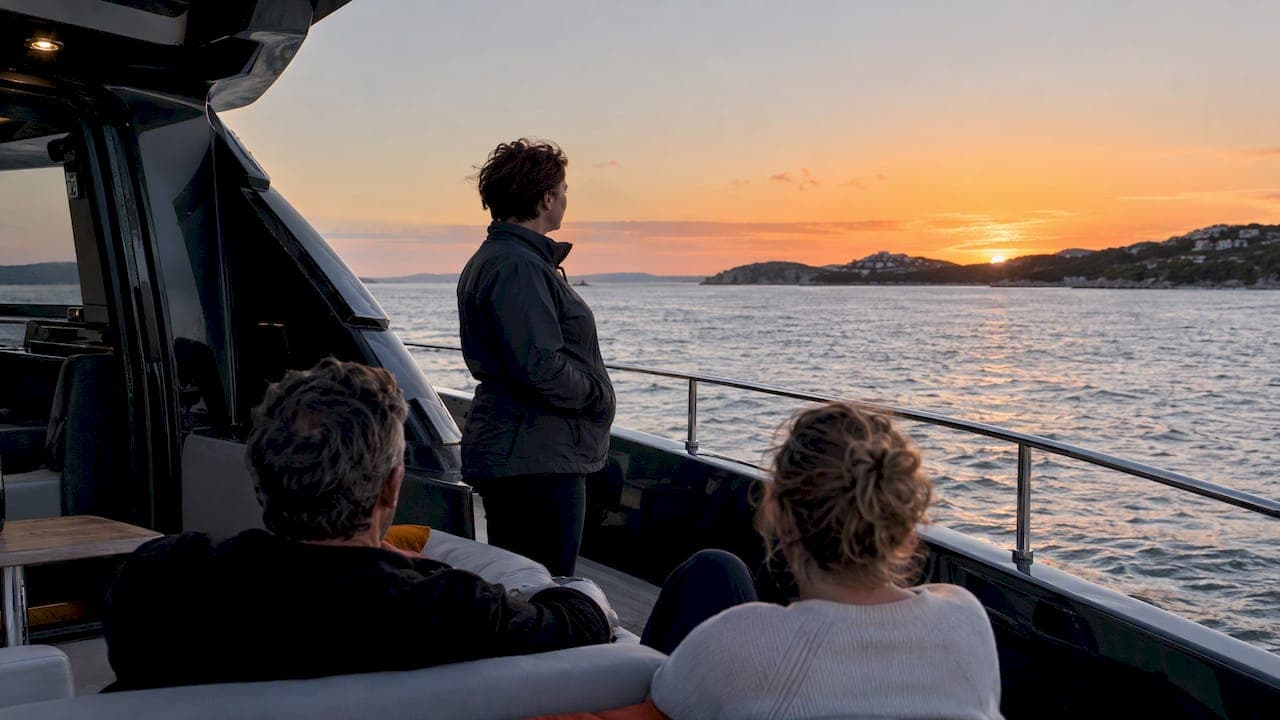
A private sunset cruise gives your group exclusive use of a boat, usually with a captain, timed so you are already on the water when the light turns gold. The best ones run about two to three hours, leave 60 to 90 minutes before sunset, and put every inclusion in writing. This guide covers how to pick the boat, what to ask, what it costs to compare fairly, and how to avoid surprises on the dock.
TL;DR
- Private means the whole boat is yours. Check whether the price is per boat or per person, because the two are easy to confuse.
- Plan on 2 to 3 hours, with departure set from the actual local sunset time, not a fixed clock time.
- Ask for a written list of inclusions: captain, crew, fuel, dockage, taxes, gratuity, drinks and food.
- Verify the operator and the vessel's authorization to carry paying passengers. A marketplace listing alone is not proof.
- Ask what happens in bad weather before you pay, not after.
Table of Contents
- What a private sunset cruise actually is
- Choose the boat for the evening you want
- How long to book and when to leave the dock
- What a private sunset cruise costs, and how to compare quotes
- Safety and credentials: what to ask before you pay
- Weather, route and cancellations
- What to bring and wear
- How to book a private sunset cruise step by step
- Our perspective: the fee is the part you can control
- Book your sunset charter with Sailorix
- FAQ
- Sources
What a private sunset cruise actually is
A shared sunset cruise sells you a seat. A private one sells you the boat. That difference changes everything: the route, the music, the pace, who is on deck and whether you can stop for a swim or a toast.
In the U.S., private sunset outings range widely. Operators advertise small powerboats for around six guests, sailing yachts for a handful of passengers, and larger classic vessels that carry a dozen or more. The spread reflects location and vessel, not a national standard, so treat any single price you see as one data point.
The core questions are the same everywhere:
- Where and when: destination, date, departure marina and exact sunset time.
- Who: group size, including children, and anyone with mobility needs.
- What: boat type, duration and what is included.
- What if: weather, delays and cancellation terms.
Choose the boat for the evening you want
Boat type shapes the experience more than the phrase "sunset cruise" suggests.
| Boat type | Best for | Trade-offs |
|---|---|---|
| Sailing yacht | Quiet, engine-light evenings, couples, small groups | Slower to reposition; sails depend on wind |
| Catamaran | Stable, open deck space, groups that like to move around | Less indoor shelter on some models |
| Motor yacht | Celebrations, larger groups, more interior comfort | Engine noise; usually higher cost |
| Motor boat | Short harbor runs, skyline views, tight budgets | Smaller deck, less shelter if it turns cool |
| Gulet | Slow, social evenings with lots of lounging space | Mostly found in specific destinations |
| R.I.B. | Fast, adventurous trips along a coastline | Exposed, not ideal for dressy occasions |
Whatever you pick, ask about shaded seating, restrooms, a swim platform and somewhere indoors to retreat if the wind picks up after dark. Length and capacity alone tell you little about comfort.
Sailing or motoring?
If the point is silence and an open horizon, sail. If the point is a dinner, a proposal or a birthday with a playlist, a motor yacht gives you faster repositioning and more control over the schedule. A sailing evening can be magical, but it depends on the breeze, and a good captain will tell you honestly when the wind will not cooperate.

How long to book and when to leave the dock
For a full sunset experience, two to three hours is the practical range. You need time to board, settle in, reach the viewing position, watch the sun go down and come back after dusk. A short harbor sail can work in under two hours. Longer charters, around three or four hours, suit dinners, celebrations and returning under city lights.
The common practice is to schedule the departure from the actual sunset time. A two-hour charter typically leaves roughly 60 to 90 minutes before sunset, so you are underway during the strongest light and still on the water for the afterglow. Operators adjust this by season, since winter sunsets arrive earlier and summer ones later. Always ask for the exact sunset time on your date and count backward.
Two practical tips:
- Board early. Late arrivals eat into the golden hour, and most operators will not extend the trip to make up for it.
- If you want a proposal or photos, ask the captain where he or she plans to be at the moment of sunset. The best spot depends on the shoreline, not just the sky.
What a private sunset cruise costs, and how to compare quotes
Advertised U.S. prices for a private sunset charter vary by location, boat and duration. Small boats for up to six guests can start in the mid-hundreds of dollars, while larger classic yachts for a bigger party cost several times that. Do not treat any one listing as a market average.
What matters more is the price basis. Before you compare two quotes, line them up:
- Whole boat or per person? A $126 ticket looks cheaper than a $630 private charter until you divide by the number of guests and note the extras.
- Taxes and online fees. Some listings exclude sales tax or booking fees until checkout.
- Captain and crew. "Captain included" does not automatically cover crew, fuel, dockage, cleanup or gratuity.
- Food and drinks. Some boats are BYOB with a cooler and ice but no cooking capability. Others prohibit outside alcohol or require operator catering.
- Add-ons. Skipper upgrades, early check-in, equipment and extra time are often priced separately.
Ask for the total checkout price and a written inclusions and exclusions list. That one document prevents most surprise charges. For a wider look at budgeting, our guide to yacht charter prices and what you will actually pay in 2026 explains where the extras tend to hide, and our breakdown of Newport Beach charter budgets and hidden fees shows how that looks in one popular U.S. market.
Where fees quietly add up
Platform fees are the least visible line. Many booking sites add a service fee to each reservation, and the amount differs by site. Compare the final number at checkout, not the headline rate. That is the reason we built Sailorix around a flat membership instead of a percentage that climbs with every booking (more on that below).
Safety and credentials: what to ask before you pay
A sunset cruise feels informal. The boat is not. Vessel operation, passenger accountability, navigation, weather awareness and emergency equipment are operational responsibilities, not amenities, according to the U.S. Coast Guard's recreational boating safety material. A good safety briefing and a competent captain matter at least as much as the sound system or the photo package.
Things worth asking, in plain words:
- Who is the operating company, and who is the captain?
- Is the captain properly credentialed for carrying passengers for hire?
- What is the passenger limit for this vessel, and does it include children?
- Is the vessel appropriately documented or inspected for the service it will perform?
- Will there be a safety briefing before departure, and where are the life jackets?
Note that "USCG captain" and "USCG-inspected boat" are not interchangeable phrases. Federal passenger-vessel rules distinguish among small passenger vessels, uninspected passenger vessels, vessel documentation, passenger count and intended service, as the Department of Transportation's passenger-vessel notice shows. Ask the operator exactly which credentials and authorizations apply to your boat. A marketplace listing, ours included, is a starting point for your questions, not a substitute for them.
On smaller powerboats you may also see the captain clip on an engine cut-off link. Under the Coast Guard's engine cut-off device rule, covered recreational boats under 26 feet with engines of 3 horsepower or more must use it while operating on plane or above displacement speed. Follow the captain's instructions on board. A private charter is not a free-for-all.

Weather, route and cancellations
Weather is part of the product. Wind, storms, fog and rough water can change or cancel a trip, and a responsible operator puts vessel and passenger safety ahead of finishing the itinerary. A cloudy evening is not automatically unsafe, and a clear one is not automatically fine.
The NOAA Coast Pilot makes the point that safe coastal navigation depends on current information about weather, tides, currents, hazards, clearances and regulated areas. That is why the "best sunset view" is not only a photography question. Where a captain can safely position the boat depends on all of those factors. In practice, the best operator sells you a safe viewing plan, not an identical route every night.
Before booking, get answers to these:
- Who decides to cancel, and how far ahead?
- Do you get a full refund, a credit or a new date if conditions are unsafe?
- What happens if you cancel for weather you simply do not like?
- Is there a backup date during your stay?
If you like to understand the water yourself, a tool such as a marine forecasting guide on validating tide against wind for nearshore waves can help you see why a captain might shift the route on a breezy evening. For more gear and tools renters find useful, see our rundown of nautical tools every yacht and boat renter needs.
What to bring and wear
The evening cools quickly once the sun drops, and decks can get slippery. Pack for that.
- Government-issued ID if the operator requests it, plus your confirmation details.
- Soft-soled shoes. Skip high heels and ask about barefoot policies.
- A light layer, even in summer.
- Sunscreen and sunglasses for the first hour, a phone or camera for the rest.
- Food and drinks only after you confirm the rules. Avoid glass unless approved, and leave bulky luggage onshore.
Also ask about cooler space, restrooms and accessibility before arrival. Our boat rental checklist covers the broader list, and the guide to smoking rules on yacht charters is worth reading if anyone in your group smokes, since violations can bring fees.
How to book a private sunset cruise step by step
- Fix the date and the sunset time. Look up sunset for your date and location, then plan to depart 60 to 90 minutes earlier.
- Set the group size and the mood. A quiet date and a 12-person birthday need different boats.
- Shortlist two or three boats by type, capacity and departure marina.
- Request the total price in writing, with taxes, fees, gratuity and add-ons spelled out.
- Verify credentials using the questions above.
- Confirm weather and cancellation terms.
- Book with a margin. Popular evenings, especially weekends in peak season, fill early. Our guide to shoulder-season dates shows how timing can also lower what you pay, and our essential boat booking tips cover the rest of the process.
Our perspective: the fee is the part you can control
We built Sailorix because the boat is rarely the surprise on a booking. The fee on top of it is. Many platforms add a service charge in the 10 to 20 percent range, and on a private evening charter that is real money for a few hours on the water.
Our model is different. For €100 a year, members book with a service fee of around 1 percent. If you charter once for a special occasion, you compare that membership against the percentage you would otherwise pay. If you charter several times a year, or plan a longer trip alongside your sunset evening, the gap widens.
What we would tell a friend booking a sunset charter:
- Decide the boat type first, then the price. A beautiful sunset on the wrong boat is a disappointing evening.
- Judge the total, not the headline rate.
- Put every inclusion in writing, including who pays for gratuity and fuel.
- Treat the safety briefing as part of what you are buying.
- Do not let a clock time overrule the sunset time. Leave when the light says so.
We also add a best price guarantee and real-time availability search by destination and boat type, so you can see options without chasing emails. Add-ons such as a skipper, early check-in or equipment can be selected during booking, and insurance options are available too.
— SAILORIX
Book your sunset charter with Sailorix
If you are ready to compare boats, Sailorix membership costs €100 per year and unlocks bookings with a service fee of around 1 percent. You can search real-time availability across sailing yachts, catamarans, motor yachts, motor boats, gulets, power catamarans, R.I.B.s and luxury motor yachts, then add a skipper or other extras as you book. Start on the Sailorix home page and filter by destination and boat type.
FAQ
How far in advance should I book a private sunset cruise?
Book as soon as your date is fixed, especially for weekends, holidays and peak season. Sunset slots are the most requested departure of the day, and smaller boats fill first. If your dates are flexible, a weeknight or shoulder-season evening is easier to find and often easier on the budget.
How long is a private sunset cruise?
Most run two to three hours, which gives you time to board, reach the viewing spot, watch the sunset and return after dusk. Shorter harbor trips exist, and four-hour evenings suit dinners and celebrations. Ask for the departure time based on your date's actual sunset.
What happens if the weather is bad?
It depends on the operator, so ask before paying. A responsible captain monitors conditions and will cancel or move the trip if wind, storms, fog or sea state make it unsafe. Get the reschedule and refund terms in writing.
Can I bring my own food and drinks?
Sometimes. Many private boats are BYOB, others ban outside alcohol or require catering through the operator. Check the rules, ask about cooler space, and avoid glass containers unless the operator approves them.
Is a private sunset cruise worth it compared with a shared tour?
For groups of four or more, a private charter often costs about the same as individual tickets and gives you control of the route, the music and the pace. For a couple on a tight budget, a shared sail can be fine. Compare the per-person total, including fees and tips, before deciding.
Sources
- U.S. Coast Guard, recreational boating safety
- U.S. Coast Guard, engine cut-off devices
- U.S. Department of Transportation, passenger-vessel notice (Federal Register, 2024)
- NOAA Coast Pilot 7
- Nearshore wave planning: tide versus wind