
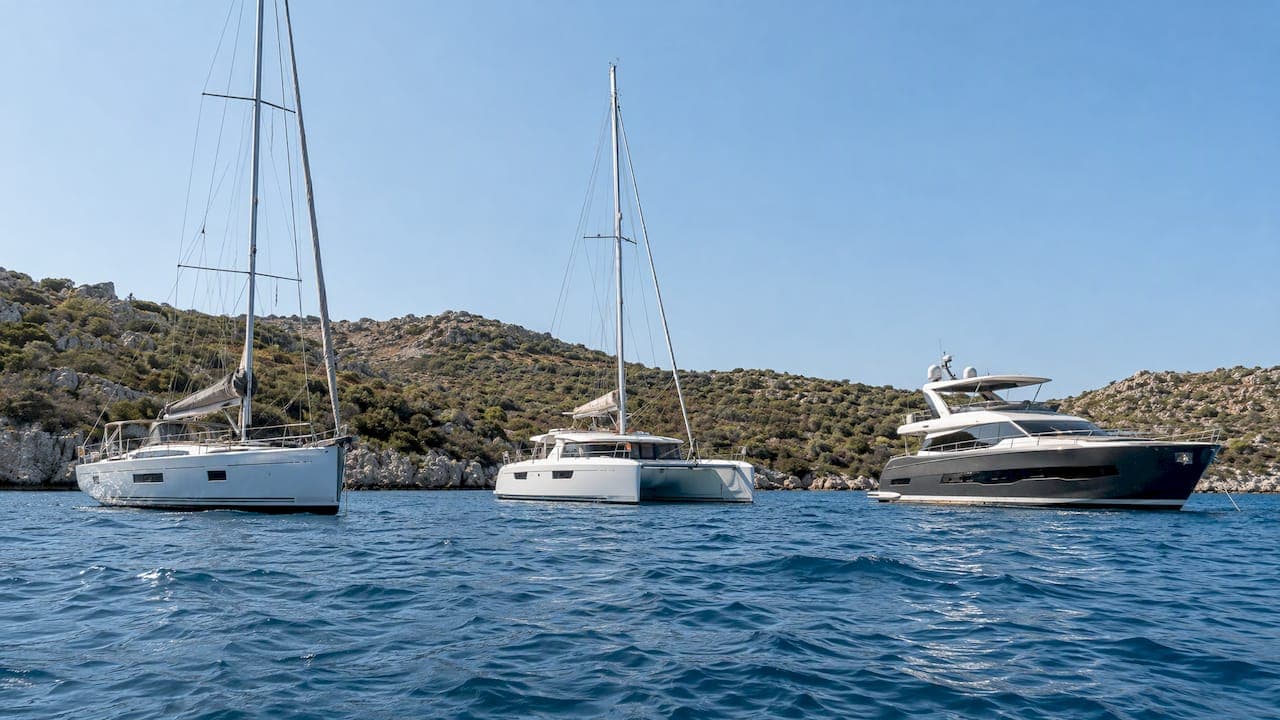
Charter boats fall into two sets of categories, and you pick one from each. The first is the hull and propulsion: sailing yacht, catamaran, motor yacht, power catamaran, motor boat, gulet or rigid inflatable boat (RIB). The second is who runs the boat: you (bareboat), a professional captain only (skippered), or a captain plus crew (fully crewed). Match the two to your group size, experience and the kind of day you want on the water, and most of the decision is made.
TL;DR
- Boat types: sailing monohulls for sailing enthusiasts, catamarans for space and stability, motor yachts for speed and comfort, gulets for traditional cruising with crew, RIBs for short, fast day trips.
- Crew options: bareboat means you are the captain, captain-only means a licensed skipper drives while you relax or help, and fully crewed adds a chef and deckhands on larger yachts.
- In the U.S., a bareboat charter needs a written charter contract, and a paid captain on a passenger-carrying boat must hold at least an OUPV license.
- Choose the crew level first (experience, group size, budget), then the boat type that suits the water you will cruise.
Table of Contents
- The two choices behind every charter
- Main charter boat types
- Crew arrangements: bareboat, captain-only and fully crewed
- U.S. rules that affect charter categories
- How to choose your category
- Common pairings that work
- Our perspective
- Booking your charter with SAILORIX
- FAQ
- Sources
The two choices behind every charter
Search results for this topic are often long lists of recreational boat styles: bass boats, bowriders, cuddy cabins. Those are useful if you are buying. If you are renting for a vacation, you need something different: the handful of vessel categories that charter fleets offer, and the crew arrangement that comes with each.
Think of it as a grid. Across the top are boat types. Down the side are crew arrangements. Not every cell is filled: a RIB is rarely a fully crewed vessel, and a large luxury yacht is rarely offered bareboat. The sections below walk through each axis, then show how they combine.
Main charter boat types
Sailing yachts (monohulls)
The classic charter boat. A single hull, a mast, and a cabin layout built for cruising. Discover Boating notes that bareboat charters are most commonly offered on sailing monohulls or catamarans, which makes the sailing monohull the default entry point for people who want to sail themselves.
Who it suits: travelers who want to actually sail, couples and small groups, and anyone who enjoys the feel of a boat heeling in the wind. The trade-off is that monohulls heel underway and the living space is narrower than on a multihull of the same length, so they favor groups who prioritize the sailing over the lounging.
Sailing catamarans
Two hulls, a wide deck and a spacious saloon. Catamarans sit flatter in the water, which many first-time charterers find more comfortable, and the layout gives cabins a degree of privacy that works well for families and friends traveling together. They are a staple of bareboat and skippered fleets in sheltered cruising areas.
Who it suits: groups of four to eight, families with children, and anyone who plans to spend more time at anchor than under sail. The wide beam can mean fewer marina berth options in some harbors, so ask about docking when you plan stops.
Motor yachts
Power-driven vessels with no sails. They cover more distance in a day, reach anchorages faster and offer air-conditioned interiors, flybridges and swim platforms. Discover Boating says some companies are now offering motor yachts in bareboat service, though larger motor yachts typically come with a captain or a full crew.
Who it suits: travelers with a tight itinerary, groups celebrating an occasion, and anyone who wants comfort without thinking about sail trim. Fuel is usually a separate cost on motor yachts, so confirm what the quote covers.
Luxury motor yachts
The top end of the category: larger vessels with multiple staterooms, a professional crew, and extras such as tenders and water toys. These are almost always chartered fully crewed, with the crew handling navigation, service and meals. They suit milestone celebrations, corporate hospitality and travelers who want a hotel-style experience at sea.
Power catamarans
A motor-driven twin hull. You get the stable platform and deck space of a sailing catamaran with the speed and simplicity of engines. Waypoints lists power catamarans among the vessel types available for bareboat, and they also appear in crewed fleets. They are a strong fit for groups who want space and stability but have no interest in sailing.
Motor boats
Smaller powerboats, usually rented for a day or a few hours rather than a week. They range from open day boats to small cabin cruisers. Capacity is modest, the itinerary is short, and for many renters this is the first step into chartering: a half-day or full-day trip around a bay or lake.
Gulets
A traditional wooden-style cruising vessel associated with Mediterranean coasts, particularly Turkey. Gulets are usually chartered with a crew, which includes a captain, a cook and deckhands, and cruises tend to be slow, social and focused on food and swimming. If you want a cabin-based holiday where someone else handles everything, a gulet is a distinctive option.
Rubber boats (RIBs)
Rigid inflatable boats are light, fast and agile. They are used for short coastal trips, snorkeling stops, reaching beaches that larger vessels cannot approach, and as tenders for bigger yachts. They are not designed for overnight stays, so think of them as a day-trip category.
Quick comparison
| Boat type | Typical use | Best for | Common crew arrangement |
|---|---|---|---|
| Sailing yacht (monohull) | Multi-day cruising under sail | Sailing enthusiasts, couples, small groups | Bareboat or skippered |
| Sailing catamaran | Multi-day cruising, anchoring | Families, friend groups | Bareboat, skippered or crewed |
| Motor yacht | Fast coastal cruising | Comfort-focused groups | Skippered or crewed; some bareboat |
| Luxury motor yacht | Premium week-long charters | Celebrations, hospitality | Fully crewed |
| Power catamaran | Stable, fast cruising | Groups wanting space without sailing | Bareboat, skippered or crewed |
| Motor boat | Hours to a day | First-time renters, day trips | Self-drive or with captain |
| Gulet | Slow cabin cruises | Social groups, food and swimming | Fully crewed |
| RIB | Short, fast excursions | Day trips, beach access | Self-drive or with captain |
If you are still deciding between sails and engines, our guide on sailing vs motor yacht charters goes deeper into how each fits a trip.
Crew arrangements: bareboat, captain-only and fully crewed
Bareboat charter
You reserve the boat and run it. Discover Boating describes it as the most common option: you provision the boat, navigate, berth and command it yourself, so you are effectively the captain and you build the itinerary. It needs real experience, and charter companies will normally ask about it. Our article on a bareboat sailing resume and logbook shows how to present your background.
Bareboat does not mean bare service. Discover Boating says most charter companies help you choose a vessel for your dates, offer partial or full provisioning, and provide charts, a briefing and an equipment walkthrough.
Captain-only (skippered) charter
This is the answer to the query many people type as "captain only charters." You rent the boat and a professional skipper comes with it. The skipper handles navigation, safety and docking, while you and your group handle everything else: cooking, cleaning, and, if you like, taking a turn at the helm or on the sails. Waypoints describes a captained charter as one that pairs you with a professional skipper, and Discover Boating notes that on smaller yachts the crew can be a captain only, or a captain plus a chef.
A captain-only charter is the best fit when:
- you have not sailed or driven a boat of that size before,
- you do not know the local waters, tides or anchorages,
- your group wants to relax rather than navigate,
- your experience does not meet the operator's bareboat requirements.
Budget for the captain's fee, and for the captain's meals. Who pays for what is a common surprise, which is why we wrote a guide to skipper meals and provisions for charterers. Discover Boating also points out that crewed charter costs include a professional captain and may involve tipping.
Fully crewed charter
The all-inclusive end of the spectrum. A captain leads a crew that can include a chef, a steward and deckhands. Waypoints says an all-inclusive crewed charter is available on sailing catamarans, power yachts and luxury yachts. This is the hotel-style option: meals, service and navigation are all handled, and you simply choose the destination and the pace.
How the three compare
| Bareboat | Captain only | Fully crewed | |
|---|---|---|---|
| Who runs the boat | You | Professional skipper | Captain and crew |
| Experience needed | Yes | None | None |
| Meals and cooking | You provision and cook | Usually you (unless a cook is added) | Chef on board |
| Typical boats | Monohulls, catamarans, power catamarans, some motor yachts | Almost any category | Large catamarans, motor yachts, luxury yachts, gulets |
| Privacy | Highest | High, with one extra person aboard | Crew always aboard |
| Extras to budget | Fuel, provisions, security deposit | Captain's fee, captain's meals | Tips, provisioning allowance |
U.S. rules that affect charter categories
If you charter in U.S. waters, the type of arrangement has legal consequences. The Coast Guard Auxiliary's passenger-for-hire guidance explains that a U.S.-flagged vessel can operate as a recreational vessel, as a chartered vessel with no crew provided, or as a vessel carrying passengers for hire. In particular, a bareboat chartered vessel is limited to 12 passengers and requires a written charter contract. A vessel carrying up to six paying passengers operates as an Uninspected Passenger Vessel when under 100 gross tons, and a motorized one must be operated by a Master holding at least an OUPV license.
In plain terms: if a captain is driving and your group is paying, that captain should be properly licensed, and if you are the captain, you need a written bareboat contract. Review the contract terms before signing. Our explainer on key yacht charter terms covers the clauses that matter, and for legal questions about a specific charter, speak with the operator and, for licensing, the Coast Guard.

How to choose your category
Cruising Guides Publications advises that crew size, experience, your appetite for active sailing versus relaxed anchoring time, and budget should drive the choice among fully crewed, bareboat and bareboat-with-skipper options. Turn that into a short sequence.
- Count your group. Four to six people with cabin privacy needs often points to a catamaran. A couple may be happiest on a monohulls. A large celebration may call for a crewed motor yacht.
- Be honest about experience. If nobody aboard has handled a boat of that size, choose captain-only or crewed. Bareboat is for people who can navigate, anchor and berth.
- Decide how active you want to be. Want to sail? Choose a sailing yacht or catamaran. Want to sit on the flybridge with a drink? Choose a motor yacht or power catamaran.
- Set the budget by line item. Charter fee, captain's fee, fuel, provisions, taxes, insurance and tips all add up differently across categories.
- Check the cancellation terms. Plans change; our guide to flexible booking for boat charters lists what to check before you pay.
For trips with friends or extended family, see boat charter websites for groups and group yacht trip ideas. The same decision logic is used in other types of charter. If you are weighing how much of the operating role you want to hand over, how private plane charters work shows the same trade-off between booking a whole vehicle and booking a service.
Common pairings that work
- First family charter, no sailing background: a sailing or power catamaran with a captain only. You get space and stability, and the skipper handles navigation.
- Experienced sailing couple: a monohull, bareboat, with the freedom to set the route.
- Friends celebrating a birthday: a motor yacht with a captain, and a cook added if budget allows.
- Corporate or milestone event: a luxury motor yacht, fully crewed.
- Spontaneous afternoon on the water: a motor boat or RIB, with or without a captain.
Our perspective
Most people who come to us are not asking which boat is the most impressive. They are asking which boat fits their group, their experience and their budget, and what it will really cost them once the booking is done.
We built SAILORIX around that question. Our platform lets you search by destination and boat type, see real-time availability, and add what the trip needs, such as a skipper, early check-in or equipment, directly to the booking. We also offer insurance options, so the extras are not left to the last minute.
Our view is that the cost of a booking should be visible. Many platforms add service fees of 10 to 20 percent. Our membership model is designed to bring that down to around 1 percent per booking, which on a charter-sized budget is a meaningful difference. We also stand behind a best price guarantee for members.
If you are unsure about the right crew level, start with the skipper add-on. It is the simplest way to turn a bareboat-style booking into a relaxed one, on almost any boat category in our fleet.
SAILORIX
Booking your charter with SAILORIX
If you already know the category you want, the next step is checking availability. SAILORIX membership is €100 per year and gives you access to bookings with service fees of around 1%, against the 10 to 20% typical elsewhere. Our fleet covers sailing yachts, catamarans, motor yachts, motor boats, gulets, power catamarans, RIBs and luxury motor yachts.
Browse our fleet by boat type, read the membership program details, or join SAILORIX and search by destination. For a pre-booking walk-through, our boat rental checklist and essential booking tips cover what to confirm, and the yacht rental standards page explains what you can expect from a quality rental.
FAQ
What are the main types of charter boats?
The main categories are sailing yachts, sailing catamarans, motor yachts, luxury motor yachts, power catamarans, motor boats, gulets and RIBs. Sailing monohulls and catamarans are the most common in bareboat fleets. Larger motor and luxury yachts are usually chartered with a captain or full crew.
What is a captain-only charter?
It is a charter where you rent the boat and a professional skipper comes aboard to navigate and operate it. You and your group handle meals and cabin life unless you add a cook. It suits travelers who lack the experience for bareboat or who simply want a relaxed trip.
What is the difference between bareboat and crewed charters?
On a bareboat charter, you are the captain: you navigate, provision and look after the boat. On a crewed charter, a professional captain, and often a chef and other crew, handle navigation and service. Crewed charters cost more because they include the crew, and tipping is common.
Do I need a license to charter a boat in the U.S.?
Requirements depend on the arrangement and the operator. For a paid captain carrying passengers, the Coast Guard Auxiliary guidance says a motorized uninspected passenger vessel must be run by a Master with at least an OUPV license. If you are chartering bareboat, the operator will assess your experience and you will need a written charter contract.
Sources
- How to Charter a Boat, Discover Boating
- Passenger-for-Hire guidance, United States Coast Guard Auxiliary
- Charter, Cruising Guides Publications
- Waypoints magazine
- How to Charter a Private Plane, Littlebird