
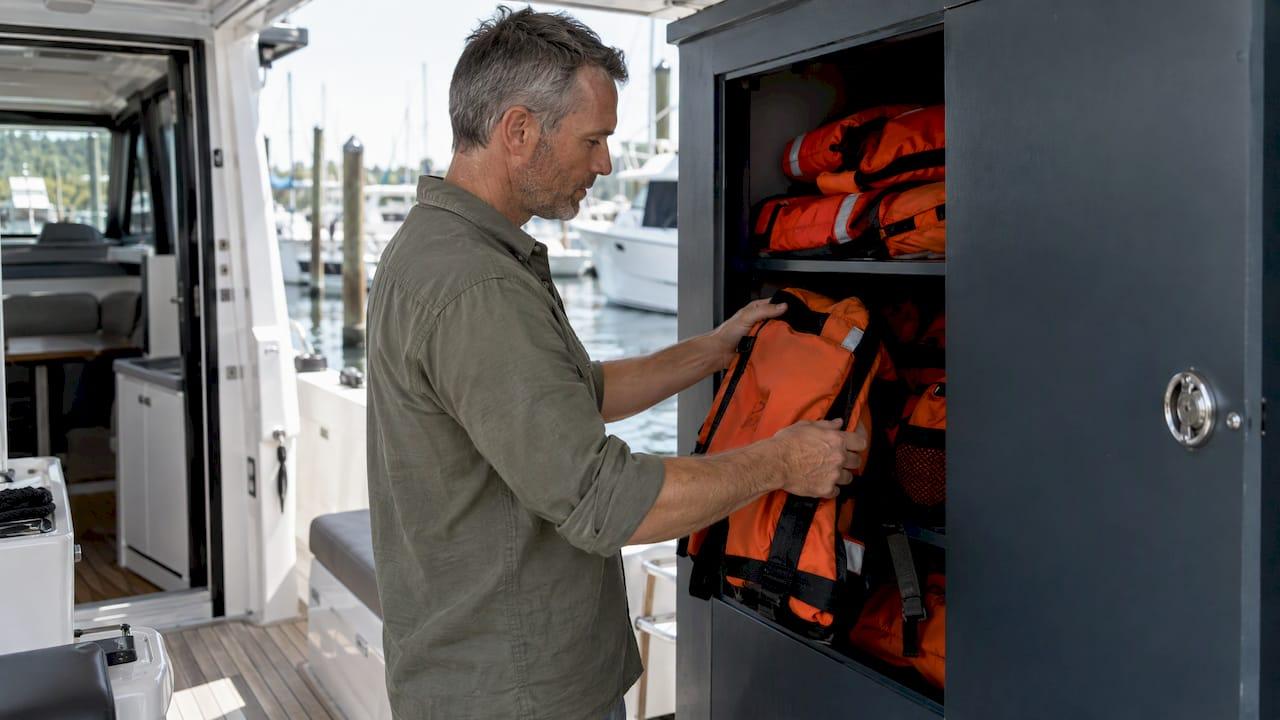
A charter boat in the United States must carry a Coast Guard-approved life jacket for every person aboard, a throwable flotation device on boats 16 feet or longer, fire extinguishers where the boat's layout calls for them, visual distress signals and a sound-signaling device. That is the federal floor. The practical question for a renter is whether the boat you are about to pay for has all of it, in good condition, before you leave the dock. The safest approach is to treat the equipment list as part of the booking itself and to confirm it while you still have time to change the plan.
TL;DR
- Every person aboard needs a properly sized, Coast Guard-approved wearable life jacket, plus at least one throwable device on boats 16 feet or longer.
- Fire extinguishers, visual distress signals and a sound signal are required depending on the boat's length, layout and where you sail.
- Offshore trips call for more than the legal minimum: VHF radio, a registered 406 MHz beacon, a life raft and a GPS.
- Count the jackets, check sizes (children included), read the extinguisher gauge and confirm the captain is credentialed before you leave.
- Add-ons such as a skipper or extra equipment are easiest to settle at booking, not at the dock.
Table of Contents
- The federal minimum, item by item
- Why your charter type changes the answer
- Beyond the legal minimum
- Your pre-departure check
- What changed recently
- Book the equipment with the boat
- Our view on charter safety
- FAQ
- Sources
The federal minimum, item by item
Federal rules for recreational boats sit in Title 33 of the Code of Federal Regulations (CFR), and the Coast Guard summarizes them in its Boater's Guide. Here is what each item is for and what the rule says.
Life jackets (PFDs)
A personal flotation device, or PFD, is the official term for a life jacket. Under 33 CFR 175.15, a recreational boat needs at least one wearable PFD for each person aboard, and boats 16 feet or longer also need one throwable PFD, subject to listed exceptions. The Coast Guard's Boater's Guide explains the split: wearable PFDs are meant to be worn, and throwable ones, such as a cushion or ring buoy, are meant to be thrown to someone in the water.
Children have their own rule. Under the same section, a recreational vessel may not be under way with a child under 13 aboard unless the child wears an appropriate Coast Guard-approved PFD or is below decks or in an enclosed cabin. If your group includes kids, the child-size jackets matter as much as the headcount.
Wearable jackets must be readily accessible, and throwables must be immediately available. 46 CFR 25.25-9 puts it that way, and 25.25-11 requires all required lifesaving gear to be serviceable. A jacket buried under sails in a locker is not "readily accessible".
Fire extinguishers
The Boater's Guide requires Coast Guard-approved Class B extinguishers (5-B, 10-B or 20-B, hand-portable, with a mounting bracket) on boats with permanently installed fuel tanks, closed living spaces, closed stowage compartments holding combustibles, or closed compartments under seats where portable fuel tanks may be stored. Class B units are designed for flaming liquids such as gasoline, oil and grease. Nearly every charter yacht and cabin motorboat meets at least one of those conditions.
Visual distress signals
Flares, orange smoke and similar devices let rescuers find you. Under 33 CFR 175.110, a boat 16 feet or longer, or any boat operating as an uninspected passenger vessel, must carry approved visual distress signals in the required number, whether day, night or combination devices. Boats under 16 feet need night-suitable signals between sunset and sunrise. The Boater's Guide applies this to coastal waters, the Great Lakes and territorial seas, plus connected waters up to the point where the waterway narrows below two nautical miles.
Sound signals and lights
New Jersey State Police's equipment checklist notes that vessels under 39.4 feet need some efficient means of making a sound signal, not necessarily a whistle or bell. It also says sailing vessels under sail alone must show navigation lights in inland and international waters, and that a sailboat under 23 feet must, if practicable, show the prescribed lights or keep a white torch or lantern ready.
Why your charter type changes the answer
The word "charter" covers two quite different arrangements, and the rules follow the difference.
Bareboat charter, where you rent the boat and run it yourself. 46 CFR 25.25-1 excludes vessels rented or chartered to another person for that person's noncommercial use from the passenger-for-hire lifesaving rules. The recreational rules above then apply, and so do the state's rules.
Crewed charter, where a captain carries you as paying passengers. The stricter passenger-for-hire standards apply. Under 46 CFR 25.25-5, each vessel carrying passengers for hire needs at least one approved PFD of suitable size for each person aboard. Vessels 26 feet or longer must also carry at least one approved lifebuoy, and larger uninspected passenger vessels of at least 100 gross tons need three. Those largest vessels must also carry an approved inflatable liferaft, serviced at an approved facility, with room for everyone aboard (46 CFR 25.25-17).

Length, waters and state rules
Equipment also scales with size. Virginia's required equipment table shows the pattern: throwable PFDs from 16 feet, 5-B extinguishers under 26 feet when certain conditions apply, 20-B extinguishers from 26 to 60 feet, and day and night signals for boats 16 feet or longer in coastal waters.

Boats under 26 feet add an engine cut-off switch. Under federal law (46 USC 4301, as summarized in the Boater's Guide), the operator must use the installed cut-off link while on plane or above displacement speed.
States add their own layers. New Jersey, for example, requires sailboats and manually propelled vessels under 16 feet to carry one wearable PFD per person, and 16-foot-plus boats one wearable PFD per person plus a Type IV throwable. BoatUS notes that requirements can depend on the season and distance from shore, so check the rules of the state where you will actually be sailing. Michigan goes further for commercial operators: its charter boat statute calls for a current inspection certificate that states maximum passenger capacity and is displayed on the boat.
Beyond the legal minimum
The Boater's Guide itself says federal requirements are minimums and do not guarantee safety. For coastal and offshore charters it recommends more:
- A VHF marine radio for communications
- An inflatable life raft sized for everyone aboard
- A 406 MHz EPIRB or PLB (emergency position-indicating radio beacon or personal locator beacon) registered with NOAA
- A GPS position device
- Immersion suits in cold water
BoatUS adds practical items: an anchor with line or chain at least five times the water depth, a bailer, oars or paddles, a first aid kit, extra fuel and water, a tool kit, sun protection and a flashlight.
A useful way to decide: the farther you are from a marina and a phone signal, the more the communication and signaling gear matters. A sheltered afternoon on a lake needs the legal basics. A passage between islands needs a radio that works when wet, a beacon and a plan.
Your pre-departure check
The Coast Guard's public safety guidance frames a renter's homework as two questions: does the vessel carry the right size and number of lifejackets, firefighting equipment and working navigation lights, and is it run by a credentialed master? Use that as your frame and walk the boat with the base staff.
- Count and fit the jackets. One per person, in the right sizes, with child sizes for children. Look at straps, buckles and fabric for wear. Inflatable models should show a green or intact indicator.
- Locate the throwable. It should sit where someone can grab it at once, not in a locker.
- Read the extinguishers. Gauge in the green, bracket secure, and know where each one is. Ask who on your crew will use them.
- Find the flares and the horn. Check the expiration dates on the flares and that the sound signal works.
- Test the lights and radio. Navigation lights on, VHF on, and a radio check if you have a handheld.
- Confirm the beacon and raft if you are going offshore. Check the beacon's registration and the raft's service date.
- Brief everyone aboard. Show each person where the jackets, extinguishers and radio are before the lines come off.
The same walk-through doubles as damage protection. Our guide to the base orientation briefing shows which checks help you avoid deposit disputes, and the boat rental checklist covers the rest of the handover. If the boat is older, our piece on verifying charter boat age and refit history helps you judge how likely the gear is to be current.
For crewed trips and commercial operators, the Coast Guard's inspection standards for small passenger vessels spell out what a well-kept jacket locker looks like: retroreflective material, working lights with unexpired batteries, the vessel's name on each jacket and a share of child sizes. If what you see falls short of that, say so before departure.
What changed recently
The most notable recent change is a December 6, 2024 amendment to 46 CFR 25.25-5. It lets a commercial hybrid PFD approved under the former 160.077 series before January 6, 2025 substitute for a required PFD on any vessel, provided it is serviceable, used according to its label and manual, and labeled for commercial use. For a renter this means you may see older-approval hybrid jackets aboard a commercial charter that are still acceptable. The core recreational rules in 33 CFR 175 are the same ones boaters have followed for years.
Book the equipment with the boat
Safety gear is easiest to sort out before you pay, when you can still compare boats and add what the trip needs. On Sailorix you search real-time availability by destination and boat type, from sailing yachts and catamarans to motor yachts and RIBs, and you can add extras such as a skipper, early check-in or equipment to the booking, with insurance options available too.
The cost structure helps. Membership is €100 per year, and bookings carry a service fee of about 1%, against the 10 to 20% typical elsewhere. On a large charter, that difference can pay for a skipper or extra equipment. Details are on the Sailorix membership page.

Before you book, our guides on vetting a charter platform and avoiding booking mistakes are worth a few minutes. If you plan to take the helm, what skippers need at check-in is worth reading as well.
Our view on charter safety
We think a charter should be settled on the boat, the crew and the equipment first, and the price second. That is why our model is built so that the booking fee stays small: about 1% on top of a €100 annual membership, instead of the 10 to 20% typical elsewhere. Money that is not spent on fees can go toward what makes a trip safer.
Booking should be simple and the details specific. We let you search real-time availability by destination and boat type, and add a skipper, equipment or insurance options to the same booking. A skipper in particular takes a lot of the pressure off a first-time charter in unfamiliar waters.
Our advice is to read the Coast Guard's list before you pick a boat, decide what your route needs beyond it, and settle those extras at booking. Our best price guarantee and global inventory are there so you can choose the right boat for the trip, not just the cheapest one.
SAILORIX
FAQ
Do I need to bring my own life jackets on a charter?
The boat should carry an approved, properly sized jacket for everyone aboard, including children. If you have a particular fit in mind for small children or a non-swimmer, raise it at booking so the right sizes are aboard when you arrive. Bringing a jacket you already trust for a child is also reasonable, provided it is Coast Guard-approved and fits correctly.
Are the rules different on a bareboat charter and a crewed charter?
Yes. A bareboat rental for your own noncommercial use falls outside the passenger-for-hire lifesaving rules in 46 CFR 25.25 and follows the recreational equipment rules plus state law. A crewed charter carries passengers for hire, so the passenger-vessel standards apply, including a PFD for every person and a lifebuoy on vessels of 26 feet or longer.
Do flares expire?
Yes, approved pyrotechnic distress signals carry an expiration date, and out-of-date ones should not be counted toward the requirement. Check the date on each flare during your walk-through, and confirm the count meets the day and night requirement for the waters you will sail.
Do children have to wear life jackets on a charter?
Federal rules require a child under 13 to wear an appropriate Coast Guard-approved PFD while the boat is under way, unless the child is below decks or in an enclosed cabin. Some states set stricter age limits, so check the rules where you sail.
Is a VHF radio required?
Federal recreational rules do not list a VHF radio as required equipment for most boats, but the Coast Guard recommends one for offshore trips, and it is the fastest way to call for help. Many charter operators and offshore routes will expect one aboard, so confirm it is installed and working.
Sources
- eCFR: 33 CFR Part 175 Subpart B, Personal Flotation Devices
- eCFR: 33 CFR Part 175, Equipment Requirements
- eCFR: 46 CFR Part 25 Subpart 25.25, Life Preservers and Other Lifesaving Equipment
- Cornell LII: 46 CFR 25.25-5
- U.S. Coast Guard: A Boater's Guide to the Federal Requirements for Recreational Boats
- U.S. Coast Guard: boating safety awareness and illegitimate charters
- Virginia DWR: Required Equipment
- New Jersey State Police: Equipment Checklist
- Michigan Legislature: Charter and Livery Boats
- BoatUS Foundation: Required Equipment