
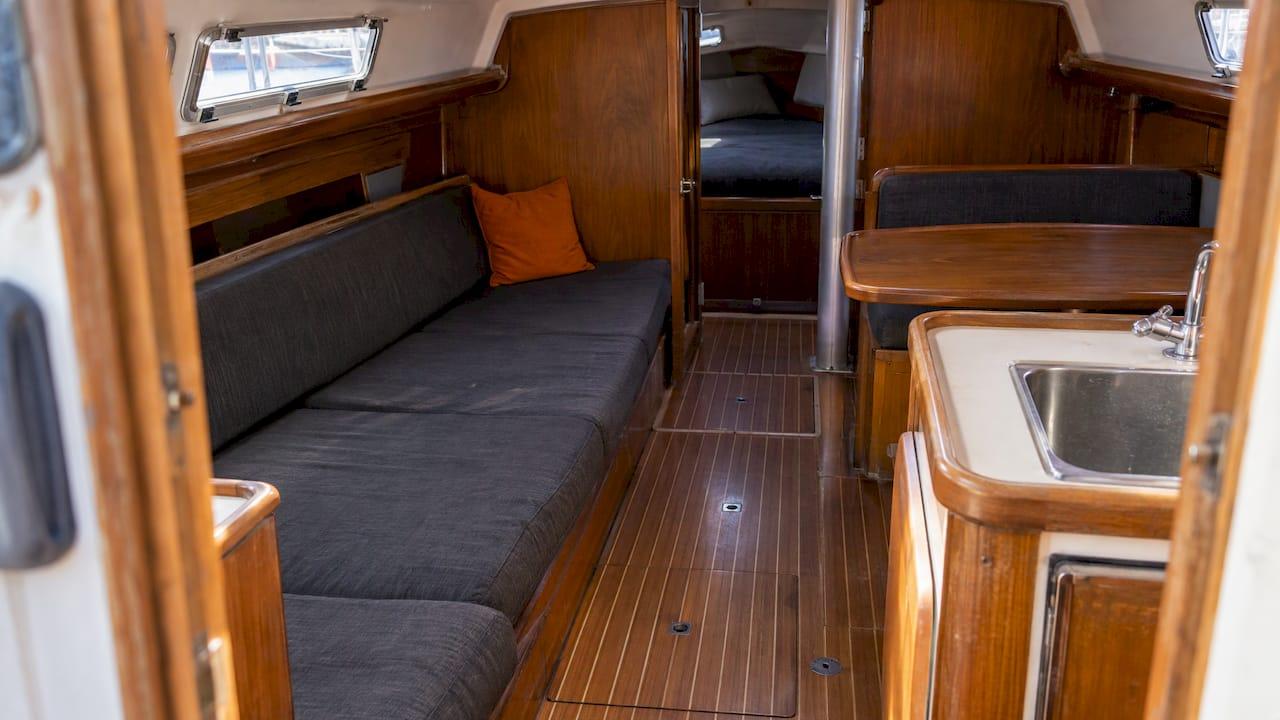
On a skippered charter, the professional skipper sleeps in a spot that is set aside for them: a dedicated crew cabin if the boat has one, or otherwise a berth that the layout can spare, often a convertible saloon seat. The right answer for you depends on the boat's layout, so confirm it in writing before you pay. That one question decides how many guests you can bring, how much privacy you keep and whether anyone ends up on a sofa they did not expect to give up.
This guide explains where skippers usually sleep, how the arrangement changes guest capacity and price, and the exact questions to put to the booking before you commit.
TL;DR
- A hired skipper needs their own berth. On boats built for crew, that is a separate cabin; on many others it is a bunk, a forward cabin or a saloon berth.
- Before booking, ask which berth the skipper uses, whether it has its own head (bathroom), and whether guests still keep every advertised cabin.
- Overnight sleeping space counts crew as well as passengers in the U.S. Coast Guard's own wording, so the skipper's berth is real space on the boat, not a freebie.
- On a bareboat charter you have no hired skipper to house; on a skippered or crewed charter you must plan for one or more people.
- Members of SAILORIX can add a skipper as an add-on at booking and pay about 1% in service fees instead of the 10 to 20% typical elsewhere.
Table of Contents
- Where a hired skipper actually sleeps
- Bareboat, skippered and crewed: who needs a berth
- Does the skipper's berth count toward the boat's capacity?
- Does hiring a skipper change the price or guest count?
- What to confirm before you book
- Privacy, comfort and a happy skipper
- Safety and qualifications
- Our perspective: ask about the berth before you ask about the price
- Book a boat with the sleeping plan in mind
- FAQ
- Sources
Where a hired skipper actually sleeps
There is no single rule. A skipper's sleeping place follows the boat's design, and boats fall into three broad groups.

Boats with a dedicated crew cabin. Larger motor yachts and some catamarans are laid out with crew quarters, usually in the bow or near the engine room, with their own door and often their own head. This is the best case for you: guests keep every guest cabin, and the skipper has real rest and you have real privacy.
Boats with a spare cabin that becomes the skipper's. Many mid-size sailing yachts and catamarans have more cabins than the party needs. If you book six guests on a boat with four cabins, the arrangement is easy: the skipper takes the fourth cabin, or a forward cabin that was sold as a guest berth. The catch is that the cabin is no longer available to you, and the advertised berth count may include it.
Boats where the skipper sleeps in the saloon. On a compact yacht where every cabin is full, the skipper typically takes a convertible saloon bench or a cockpit-adjacent berth. It works, but it shifts the daily rhythm: the shared living space is the skipper's bedroom, so they go to bed last and rise first. Offering a late breakfast and some quiet time in the morning is a courtesy this arrangement rewards.
The point to take from all three: a skipper is a person who must sleep, shower and have some space, and the boat has to accommodate that without taking away from what you were promised.
Bareboat, skippered and crewed: who needs a berth
The charter type decides how many people the boat must house.
| Charter type | Who is aboard besides your party | Sleeping space to plan for |
|---|---|---|
| Bareboat | No one. Your party operates the boat | None for crew |
| Skippered | One professional skipper | One berth, ideally a cabin |
| Crewed | Skipper plus, often, a hostess, cook or deckhand | Crew quarters or several assigned berths |
On a bareboat charter, your group handles the navigation, so no crew space is needed. A skippered charter adds one professional; a crewed charter adds a team and usually requires crew quarters to be part of the layout. If you are weighing these formats, our guide to charter boat categories and crew options walks through how each one is booked.
A short outing is different. Nobody sleeps aboard on a day trip such as an aperitif cruise in La Spezia, so the question only arises once you charter overnight, for a weekend or a week.
Does the skipper's berth count toward the boat's capacity?
This is the question that surprises people most, and it has two parts.
Sleeping space is counted for crew too. The U.S. Coast Guard defines overnight accommodation space as space with one or more berths, such as beds or bunks, where passengers or crew rest for extended periods. Staterooms, cabins and berthing areas are the usual examples. The same rules cover specified small passenger vessels under 100 gross tons, including vessels with overnight accommodation for 49 or fewer passengers. In plain words: in the regulator's eyes, a berth used by crew is still a berth.
Advertised berths and guest capacity are not always the same number. Listings often state total berths. Whether the skipper's bunk is inside that number or on top of it depends on the boat and the listing. Two examples show why it matters:
- A catamaran listed with eight berths has a bow cabin the owner treats as the skipper's. You may have only six guest berths for sale, even though eight beds exist.
- A sailing yacht listed with six berths and three cabins, where the skipper takes the saloon bench, may leave all three guest cabins untouched.
Neither is wrong. Both are different from what a quick read of the listing suggests. Ask how many guests the boat sleeps with a skipper aboard, not just how many berths it has.
Does hiring a skipper change the price or guest count?
It can change both, in different ways.
Price. A skipper is a paid professional, added to the charter as a line item or a daily rate. Some boats also charge for the skipper's provisions, which we cover in our guide on skipper meals and provisions. The weekly cost, and how service fees compound on top of it, is broken down in our piece on skipper costs and service fees.
Guest count. If the skipper takes a cabin that would otherwise be a guest cabin, your usable berths fall by one cabin. A group of eight on a boat with four guest cabins plus one skipper bunk is fine. The same group on a boat where the skipper occupies the fourth cabin is a berth short. Settle this at the quote stage, not on the dock.
If the group is large, consider moving to a boat with a real crew cabin. It costs more on paper, but it keeps your guest cabins intact and gives the skipper somewhere proper to rest.

What to confirm before you book
Use this list as your pre-booking checklist. Every item is a question you can put to the booking in one message.
- Where does the skipper sleep? Ask for the specific location: crew cabin, named guest cabin or saloon berth.
- Is it counted in the advertised berths? If so, how many guest berths remain with a skipper aboard?
- Does the skipper have a separate head? If not, which bathroom do they use and when? This is the most common privacy surprise.
- Do all guests keep a real cabin? A convertible sofa is not a cabin. Confirm which guests get which sleeping space.
- Where is the skipper's cabin in relation to yours? A crew cabin forward of the guest cabins is quiet for everyone. A skipper sleeping next to a guest cabin with a thin partition is not.
- If there is a hostess or deckhand, where do they sleep? On a crewed charter, each crew member needs a space, and some boats double up in one crew cabin.
- How does the layout handle shared bathrooms? Crew access to a head you thought was private changes how the layout works in practice.
We lay out a fuller cabin-by-cabin approach in our cabin configurations checklist, and the terms that appear in a charter contract are covered in key yacht charter terms.
Privacy, comfort and a happy skipper
A good charter depends on a rested skipper, and a rested skipper depends on the sleeping arrangement. Some habits help on any boat:
- Tell the skipper your plans early. If you expect a late night in the cockpit and the skipper sleeps in the saloon, agree a quiet hour.
- Keep the crew cabin off-limits. It is the skipper's room. Do not store luggage there, even if it looks empty.
- Offer a break from night watch when at anchor. On an anchored night, one shift off is a polite gesture.
- Agree bathroom times. If the skipper uses a guest head, a simple morning schedule avoids queueing.
For luxury guests, privacy is part of what you pay for. If a private evening on the aft deck matters to you, a boat with separate crew quarters is worth the choice. Our article on sleeping aboard a boutique yacht charter covers how comfort at night shapes the whole trip.
Safety and qualifications
A well-rested skipper is also a safe skipper, but rest is only half of it. Before you commit, confirm the skipper's credentials. Our short guide on asking for STCW and ENG1 certificates shows what to ask for in five minutes. On U.S. waters, passenger-carrying charters with a captain fall under Coast Guard rules, so also ask which licence the captain holds and what passenger limit applies to the vessel.
Our perspective: ask about the berth before you ask about the price
Most charterers start a skipper conversation with price. We think the first question should be where the skipper sleeps.
A boat's berth count is a marketing number. Guest cabins, crew space and shared bathrooms are the real picture, and they decide whether a week aboard feels like a private retreat or a crowded one. When a skipper is added, the layout either absorbs the extra person or quietly takes a guest cabin.
That is why we built SAILORIX around transparent booking. Members search real-time availability by destination and boat type, add a skipper and other extras such as early check-in or equipment at booking, and pay a service fee of about 1% instead of the 10 to 20% typical elsewhere. When the fee is that low, the money saved can go toward the boat that fits your group: one with proper crew quarters rather than a compromise.
Our advice is simple. Choose the boat for the layout, add the skipper at booking, and confirm the sleeping plan in the same message.
SAILORIX
Book a boat with the sleeping plan in mind
If you are ready to compare boats, a SAILORIX membership costs €100 per year and gives you access to bookings with service fees of about 1%. You can search sailing yachts, catamarans, motor yachts, gulets and more, and add a skipper as an extra when you book.

Start on the SAILORIX booking platform, and if you are drawn to a specific model, look at a layout such as the Viga Luxury 900 to see how cabins are arranged. For a comparison of hull types and what they mean for space, read sailing vs motor yacht.
FAQ
Does the skipper sleep in a separate cabin?
On boats with crew quarters, yes. On others, the skipper takes a spare cabin, a bunk or a saloon berth. Ask for the exact location before you book, and ask whether it is counted in the boat's advertised berths.
Can the skipper share a cabin with guests?
It is not a good arrangement and you should not accept it as a default. A skipper needs their own sleeping space, so confirm that every guest keeps a cabin of their own and that the skipper has a separate berth.
Does the skipper's bed reduce the number of guests I can bring?
It can. If the skipper uses a cabin sold as a guest berth, your usable guest space drops by that cabin. Ask how many guests the boat sleeps with a skipper aboard.
Do I need to provide a berth on a bareboat charter?
No. On a bareboat charter your own party operates the boat, so there is no hired skipper to house. If you hire a captain separately, you still need to plan a berth for them.
Who pays for the skipper's meals and cabin?
The cabin is part of the boat you charter, so it does not carry a separate sleeping fee. Meals depend on the contract, which is why our provisions guide is worth reading before you sign. Also review the yacht rental standards so you know what a standard booking includes.
Sources
- U.S. Coast Guard, 46 CFR Part 175 general provisions, definition of overnight accommodation space
- Subchapter T, Small Passenger Vessels (Under 100 Gross Tons), 46 CFR Part 175 (2023)
- Aperitif on a Boat in La Spezia