
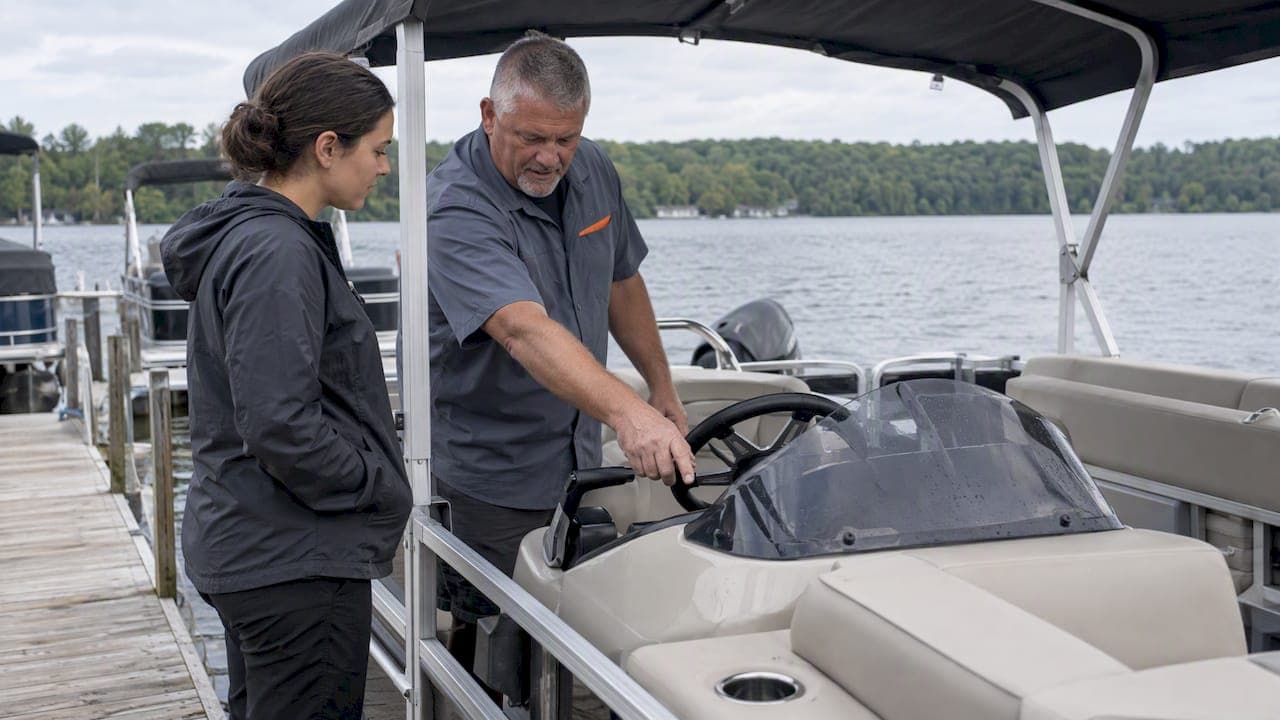
Yes, in most of the United States you can rent a boat without holding a "boating license," because there is no federal boating license and each state writes its own rules. But "no license" rarely means "no requirements." Depending on the state, your age and the engine size, you may need a boater education card, a short exam at the dock, or a safety briefing before the keys change hands. Small non-powered boats are the one category where almost nothing is asked of you.
This guide explains how the rules work, what three popular rental states actually require, what you can rent with the least paperwork, and what to do if you want a bigger boat and have no certification.
TL;DR
- There is no federal boating license. States set the rules, and most tie them to your birth year, the engine's horsepower, or both.
- Florida has no license, but anyone born on or after January 1, 1988 needs a boating safety ID card or a temporary certificate to run a motorboat of 10 HP or more.
- Kayaks, canoes and paddleboards are the true no-paperwork rentals. Powered boats almost always come with a briefing, an ID check or a card requirement.
- If you are not certified, a captained charter or a skipper add-on is the cleanest way onto a larger boat.
- Wear a life jacket whatever the law says. It is the single habit that matters most.
Table of Contents
- Why "no license" is a misleading phrase
- What three popular rental states actually require
- What you can rent with the least paperwork
- What "no license" means in Europe
- Safety matters more than the paperwork
- Our view: the license question is really a skill question
- A step-by-step way to book without surprises
- Budgeting: what to expect beyond the day rate
- When you want more than a lake pontoon
- FAQ
- Sources
Why "no license" is a misleading phrase
People search for "no license boat rental" expecting a yes-or-no answer. The honest answer is a sliding scale. Three things decide where you land on it.
Your state. A few states require every operator to be certified regardless of age. Boat-Ed lists California, New York, New Jersey and Hawaii among them. Many others only apply the rule to younger boaters, using a birth-year cutoff that quietly captures more people every year.
Your boat. Most state laws start at a horsepower threshold, commonly 10 HP. A kayak, a rowboat or a stand-up paddleboard falls below it. A pontoon with a 60 HP outboard does not.
Your rental company. Even where the law is silent, an operator can ask for more: a minimum age, a credit card for the deposit, a test run, or proof that you have boated before. Our own guide to boat rental rules in the USA explains why a short phone call before you book can save a whole trip.
So the useful question is not "is a license required?" but "what will this state and this company require of me, for this boat, on this day?"

What three popular rental states actually require
Florida, Texas and Georgia show the three most common patterns. Rules change, so confirm with the state agency before you travel.
Florida: no license, but a card for many visitors
Florida does not issue a boating license. It does, however, require a Boating Safety Education Identification Card. As of 2026, anyone born on or after January 1, 1988 must complete an approved boating safety course and carry the card to operate a motorboat of 10 horsepower or more.
Visitors have a shortcut. The state's temporary certificate program lets you pass an exam through an authorized vendor, often at the rental dock itself. The exam is 25 questions and you need 19 correct. Two details catch travelers out:
- The temporary certificate is valid for 90 days.
- It is valid only in Florida, so it will not cover you on a lake in another state.
That is why many Florida rental companies advertise "no license needed." They mean no traditional license. The certificate itself, a short online course taking roughly half an hour according to local operators, is still part of the process. If you are older than the cutoff, the card requirement does not apply to you, though you will still be briefed and asked for photo ID.
Florida's agencies publish more detail in the FWC boating safety education FAQs, which is the page to check if your situation is unusual, for example if you hold a card from another state.
Texas: the dock briefing does the heavy lifting
In Texas, boaters born on or after September 1, 1993 must complete a boater education course to operate certain vessels. For rentals, the state also puts duties on the business: the livery must provide the required safety equipment, explain how the vessel operates, and have you sign a form acknowledging that information before you leave.
In practice, that is why "no license boat rental" in a place like Lake Austin or Lake Travis often means one of two things: a non-powered craft such as a kayak, canoe or paddleboard, or a powered boat rented under a captain. If you plan to drive a motorboat yourself, expect to show either a course certificate or your birth date.
Texas also reminds boaters that children younger than 13 must wear a life jacket while underway, a rule worth knowing if you are renting for a family outing.
Georgia: a video and a checklist
Georgia shows a third approach. Its rental law says no one under 16 may rent a vessel of 10 HP or more. Sixteen and older can rent if they have completed an approved boating education course. Georgia's rental boat requirements add an orientation: renters watch a ten-minute boater education video and sign a safety checklist before operating a rented vessel of 10 HP or more.
Quick comparison
| Florida | Texas | Georgia | |
|---|---|---|---|
| Formal "license" | No | No | No |
| Who needs education | Born on or after Jan 1, 1988, for 10 HP or more | Born on or after Sept 1, 1993, for certain vessels | 16 and older renting 10 HP or more |
| Visitor shortcut | Temporary certificate, 90 days, Florida only | Livery briefing and signed form | Ten-minute video and signed checklist |
| Small paddle craft | Generally outside the horsepower rule | Outside the powered-vessel rules | Below the 10 HP threshold |
The pattern: the rules are light on a quiet lake day, but they are never zero for a powered boat.
What you can rent with the least paperwork
If your goal is to get on the water today with minimal formalities, think about the boat before the destination.
- Kayaks, canoes and paddleboards. No engine, so no horsepower trigger. You still sign a waiver and should wear a life jacket.
- Small electric or low-horsepower boats. A boat under 10 HP can fall under the threshold in states that use it, but check your state's wording. Some states apply rules to all motorized vessels.
- Pontoons and deck boats with a captain. The captain holds the qualifications, and you simply enjoy the day. This is common on busy lakes and in coastal tourist towns.
- Self-drive pontoons and runabouts. Usually available, but expect the state's education rule, an age minimum and a deposit.
Our separate guide on US boat rental age limits and company minimums covers the other half of the question. Many companies set the renter's minimum age at 18 or older, regardless of what the state allows.
What "no license" means in Europe
If you are traveling abroad, the phrase has a more literal meaning in some places. Mallorca is a good example. One local operator describes legal license-free rentals limited to 15 HP and 5 metres of length, for up to five people, in daylight hours and within a short coastal zone. The same operator lists day rates from €250.
A few practical points from that market:
- The 15 HP and 5-meter caps surprise people who expect a bigger, faster boat.
- Security deposits are typical, often in the range of €400 to €600, held on a credit card.
- Fuel is usually extra.
None of that applies in the US, where there is no 15 HP exemption. But the deposit lesson travels. Read our explainer on boat rental deposits before you hand over a card, and see how security deposits for renters and sailors are usually released.
Safety matters more than the paperwork
A certificate proves you passed a test. It does not make a rented boat easy to handle, and renters without experience are the group most likely to get in trouble in the first hour.
The U.S. Coast Guard reports that 75% of boating fatalities are drownings, and 87% of those victims were not wearing life jackets. That is the strongest argument for treating the life jacket as non-negotiable, for everyone aboard, every time.
Some habits that matter on a first rental:
- Stay near shore and in sheltered water. Skip open bays and big channels on day one.
- Use the engine cut-off switch. Texas game wardens call it the law and a way to prevent serious injury, and it works only if the lanyard is attached to you.
- Never drink and drive a boat. The same rules about impairment apply on the water.
- Ask for the briefing even if it is not offered. Where do you fill the tank, how do you kill the engine, where are the flares, what is the weather cutoff time?
- Watch the weather and daylight. Get back before the cutoff, not at it.
If you want to understand why these requirements exist, our overview of why boat licensing matters walks through the safety and legal reasoning.
Our view: the license question is really a skill question
We talk to renters every day, and the same pattern repeats. Someone finds a listing promising "no license required," books the biggest boat the budget allows, and only then learns about the state card, the deposit, the fuel and the age minimum. The headline was true. The trip was still harder than it should have been.
Here is how we think about it.
Read "no license" as "no formal license." In most states, the real questions are your birth year, the engine size and the rental company's own policy. Ask about all three before you pay anything.
Match the boat to your experience, not to your budget. A 20-foot pontoon on a calm lake is a fine first boat. A fast runabout in a busy harbor is not. If you have never docked a boat, you are paying to learn on someone else's property.
Use a skipper when the day matters. For a birthday, a proposal or a family reunion, a skipper turns a stressful day into a relaxed one, and it sidesteps the certification question entirely. On Sailorix you can add a skipper to a booking as a custom add-on, alongside extras such as early check-in or equipment.
Count the full cost. Service fees are where many renters overpay. Marketplaces commonly charge 10 to 20% on top of the rental price. Our model is different: a membership at €100 per year, with service fees of around 1% on bookings. For one small weekend rental the difference is modest. For a family that books several trips, or for a charter-sized booking, it adds up fast.
Check the paperwork like a buyer. Before you pay, confirm the boat's insurance, the deposit terms, the cancellation policy and who is on the contract. Our guides on avoiding boat rental scams and common booking mistakes cover the red flags we see most.
— SAILORIX
A step-by-step way to book without surprises
- Decide who will drive. If it is you, find out your state's rule for your birth year. If you would rather not, plan for a captain or skipper.
- Pick the boat type. Paddle craft for the lowest barrier, a pontoon or small powerboat for a lake day, a larger yacht with a skipper for open water.
- Call the operator. Ask what ID and certificate they require, the minimum age, the deposit amount and when it is returned, and what happens in bad weather.
- Get the certificate in advance if you can. In Florida, the temporary certificate can be done through an authorized vendor, and doing it before pickup saves dock time. Remember it is only valid in Florida and for 90 days.
- Check the inclusions. Life jackets, anchor, fuel policy, insurance and the cut-off switch should all be explained, not assumed.
- Use a checklist on the day. Our boat rental checklist covers what to inspect and photograph before departure.
- Brief everyone aboard. Life jackets on, who the backup driver is, where the first aid kit sits, and the plan if the engine stops.
Budgeting: what to expect beyond the day rate
The sticker price rarely tells the whole story. Plan for these extras:
- Fuel. Often charged separately or refilled at return. In the Mallorca example above, operators estimate roughly €60 to €100 for a five-hour outing, a useful order of magnitude even if US prices differ.
- Security deposit. Typically held on a credit card, not debit, and released after return.
- Certificate or exam fee. Vendors who issue Florida's temporary certificate may charge a fee, so ask.
- Captain or skipper. Usually a flat add-on per day or per trip.
- Service fees on the booking platform. This is where a membership model can cut the bill.
For tactics beyond the basics, see our walkthrough on saving on boat rental prices.
When you want more than a lake pontoon
Some renters start with "no license" because they assume a bigger boat is out of reach. It usually is not. Sailing yachts, catamarans, motor yachts, gulets and other larger vessels are commonly chartered with a professional skipper, which means you do not need your own qualification to be aboard and enjoy the trip.
Sailorix is a global booking platform. You search real-time availability by destination and boat type, add a skipper or other extras, and choose insurance options. Our fleet page shows the kinds of boats available, from motor boats and catamarans to luxury motor yachts. Membership costs €100 per year, and members pay service fees of around 1% instead of the 10 to 20% common elsewhere. You can read the details on our membership page or start from sailorix.com.
FAQ
Do I need a license to rent a boat in the US?
Not a federal one, because none exists. States set the rules, and they usually depend on your birth year, the boat's horsepower, or both. Even where no certificate is required, the rental company will typically ask for ID, brief you on the boat and may set its own age minimum.
Can I rent a motorboat in Florida without a boating card?
If you were born on or after January 1, 1988, you need either a Boating Safety Education ID card or a temporary certificate to operate a motorboat of 10 HP or more. The temporary certificate takes a 25-question exam, is valid for 90 days and works only in Florida. Older boaters are not subject to the card requirement.
What is the easiest boat to rent with no paperwork?
A kayak, canoe or paddleboard. With no engine, the horsepower rules do not come into play, though you will still sign a waiver. Wear a life jacket on any of them.
How big a boat can I handle without a captain's license?
A recreational renter does not need a captain's license to operate a private rental in most states, as long as state education rules are met. The practical limit is skill. A boat you can dock and anchor confidently is the right size, and anything bigger is better booked with a skipper.
Is a skipper a good alternative if I am not certified?
Yes. With a skipper aboard, the qualified person at the helm is the skipper, and you can focus on the trip. Many larger boats are only chartered this way. You can add one to your booking as an extra.
Sources
- Do You Need a Boating License to Rent a Boat? (Boat-Ed)
- Temporary Certificate Program (Florida FWC)
- FAQs About Boating Safety Education Requirements (Florida FWC)
- Texas Game Wardens: Leave Risk at the Ramp, May 22, 2026 (TPWD)
- Amid Increased Water Fatalities, Texas Game Wardens Stress Safety, July 3, 2025 (TPWD)
- Rental Boat Requirements (Georgia DNR Law Enforcement)
- Six ways to stay safe on the water this summer (U.S. Coast Guard)
- Boat Rental Mallorca Without Licence (BBS Management)